All species › Passerines › Finches › Trumpeter Finch
Trumpeter Finch | Bucanetes githagineus
Woestijnvink | Camachuelo trompetero
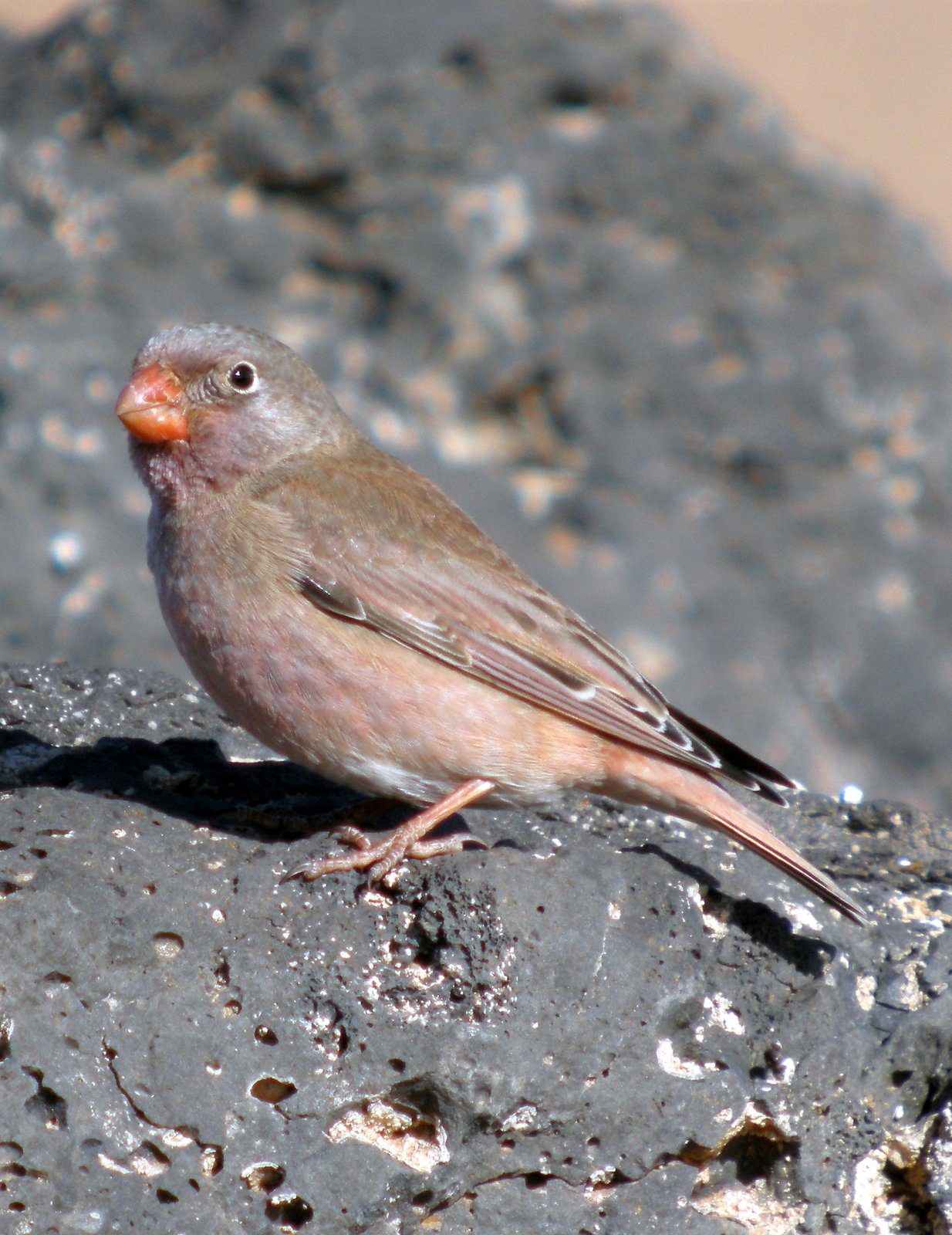
The Trumpeter Finch is the characteristic finch of stony deserts, from the Atlantic coast of the Sahara to Oman. The small, rotund bird with the coral-red bill draws attention mainly by its call: a drawn-out nasal toot like a child's toy trumpet.
Voice
The call is the best feature: a long-drawn, nasal, buzzing cheeeeee, like a toy trumpet, sometimes mixed with short chik notes and soft weep sounds. In flight a short, soft choop.
Recording: Stanislas Wroza — CC BY-NC-SA 4.0 · converted to mono · xeno-canto
Identification
12–14 cm. Small, compact and big-headed, with a short tail and a short, very thick bill which in the breeding male is coral to orange-red and otherwise yellowish horn. The breeding male is grey on the head and neck, with a pink wash on the face, breast, rump and wing edges, and a sandy mantle; wings and tail are grey-brown with pale fringes. Females and winter birds are plain sandy buff with only a hint of pink and a pale bill. It often sits motionless among stones and is then hard to see thanks to its camouflage.
Confusion species
Sinai Rosefinch (Carpodacus synoicus) is larger and longer-tailed, with a horn-coloured bill and in the male a bright pink face with silvery-white spots. Desert Finch (Rhodospiza obsoleta) has a black bill and a black, white and pink wing. Crimson-winged Finch (Rhodopechys sanguineus) is much bulkier with a bright rosy-red wing panel. In Kuwait and Iraq Mongolian Finch (Bucanetes mongolicus) may turn up: it has a white wing patch, a streaked back and a pale bill.
Habitat
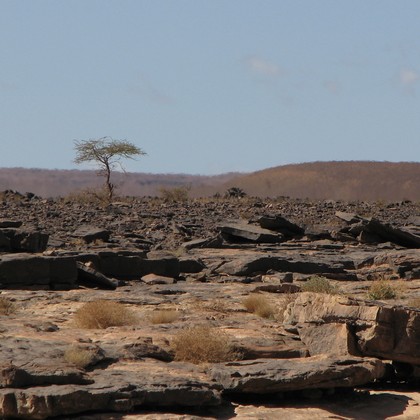
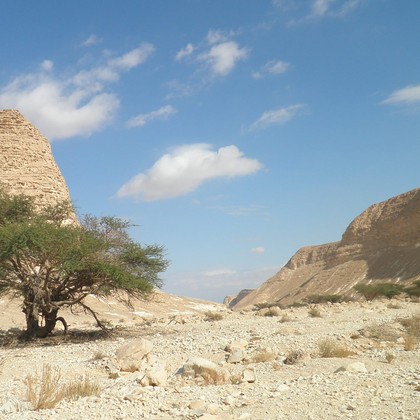
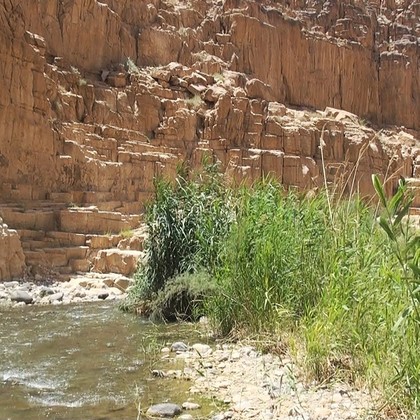
Stony desert, bare rocky slopes, gorges and wadis with scattered shrubs, and dry edges of oases and fields, from sea level to high in the Atlas and the Arabian mountains. It drinks daily and can then be found at springs, pools, troughs and leaking irrigation.
Where the bird is most at home, classified by the habitats of North Africa and the Middle East.
Range and movements
Across a large part of the region. In the Maghreb the desert fringes and interior of Morocco south of the Atlas, Western Sahara, the Algerian Sahara (including the Hoggar), southern Tunisia and Libya; in Egypt the Eastern Desert, the edges of the Nile Valley and Sinai. In the Middle East southern Israel and Jordan, southern Syria and western Iraq, most of Saudi Arabia except the sands of the Rub' al Khali, Yemen, Oman (Hajar and Dhofar) and the Hajar of the United Arab Emirates; a scarce winter visitor to Kuwait, Qatar and Bahrain. Beyond the region the Canary Islands, south-eastern Spain, the Sahel, Sudan and east through Iran to Afghanistan and Pakistan.
- Resident
- Summer visitor (c. Apr–Sep)
- Winter visitor (c. Oct–Mar)
- Passage (Mar–Apr, Oct–Nov)
- dark = core range, pale = thinly spread
How and when to look
In the early morning wait at a spring or trough in a desert wadi: small groups of Trumpeter Finches arrive, tooting, in short flights to drink. In Morocco they are easy to find in the valleys around Ouarzazate, Boumalne and Merzouga, in Israel around Eilat and in the Negev.
Conservation status
Not globally threatened and widespread; numbers fluctuate strongly with rainfall and seed supply. In the Maghreb the species is locally trapped as a cage bird.
Scientific name
Bucanetes githagineus | (Lichtenstein, 1823)
Lichtenstein described the species in 1823 as Fringilla githaginea; because it was later moved to another genus, the author and year stand in brackets. The genus Bucanetes was introduced in 1851 by Cabanis. Bucanetes is Greek, from bukanētēs 'trumpeter', from bukanē 'horn', after the nasal call. githagineus is Latin, formed on Githago, the corn cockle, from gith 'coriander' and -ago 'resembling'; Temminck believed the bird's name derived from that of the plant. The specimen the first description was based on came from Deram, Upper Egypt.