All species › Passerines › Wagtails and pipits › Tree Pipit
Tree Pipit | Anthus trivialis
Boompieper | Bisbita arbóreo
In the region the Tree Pipit is chiefly a common passage migrant, passing through oases, olive groves and desert edges in spring and autumn on its way between Europe and Africa. It breeds in small numbers in the mountains of the Levant.
Voice
The call is a hoarse, thin spees or teez, often in flight. The song is a loud, varied series of trills that begins in a song flight from a treetop, swells during the parachuting descent and ends with a series of see-a see-a see-a.
Recording: Stanislas Wroza — CC BY-NC-SA 4.0 · converted to mono · xeno-canto
Identification
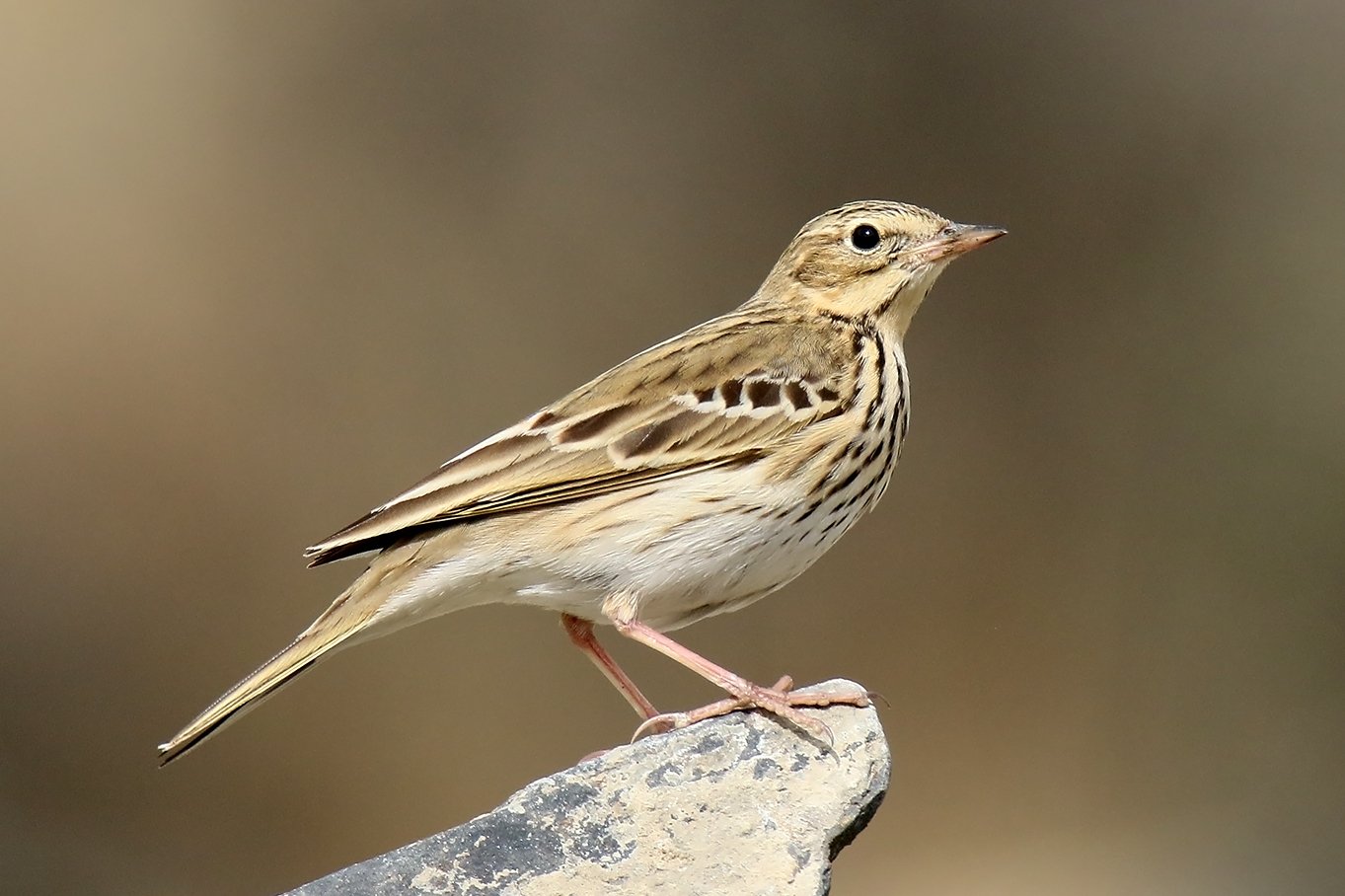
15–16 cm. Slim and fairly short-legged, with a fairly thick, short bill and flesh-coloured legs with a short, curved hind claw. Greenish olive-brown above with faint streaks; below with a warm buff breast and white belly. The breast carries heavy black streaks, which become much thinner and finer on the flanks. A weak pale supercilium, a small pale spot behind the eye and a clear malar stripe. It pumps its tail and walks calmly along branches.
Confusion species
Olive-backed Pipit (Anthus hodgsoni) is greener and nearly unstreaked above, with a striking supercilium that is buff in front of the eye and white behind it, and a white and a black spot on the ear coverts. Meadow Pipit (Anthus pratensis) is smaller and finer-built, with a long, straight hind claw, less contrast between breast and flank and a thin ist. Red-throated Pipit (Anthus cervinus) has heavily streaked upperparts with pale 'braces' and heavy flank streaks, and outside its spring plumage a different call.
Habitat
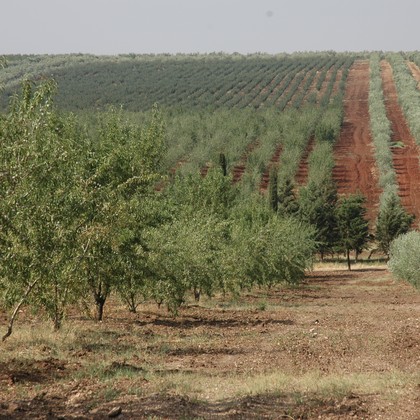
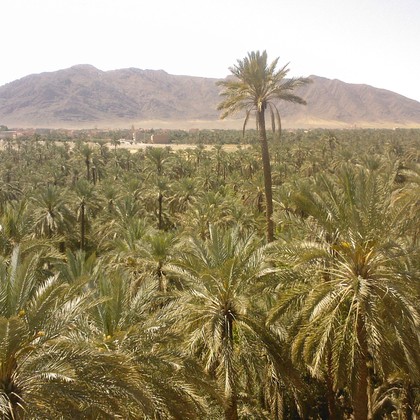
Breeds in open woodland, woodland edges and juniper and oak woodland on mountain slopes with grassland. On passage in olive groves, oases, date-palm groves, parks, orchards and field edges, even in bare desert at any tree or bush.
Where the bird is most at home, classified by the habitats of North Africa and the Middle East.

Range and movements
Breeds in small numbers in the mountains of Lebanon and Syria, on Mount Hermon and in northern Iraq. A common passage migrant throughout the region, from Morocco to Oman, with large numbers in spring in the Saharan oases, the Nile valley, Sinai, Eilat and the Rift Valley. A few winter in the highlands of Yemen and south-western Saudi Arabia. Beyond the region it breeds from Europe to eastern Siberia and winters in sub-Saharan Africa and India.
- Summer visitor (c. Apr–Sep)
- Winter visitor (c. Oct–Mar)
- Passage (Mar–Apr, Oct–Nov)
- dark = core range, pale = thinly spread
How and when to look
In April and September in olive groves, oases and parks: a pipit that flies up to a branch and gives a hoarse spees is usually a Tree Pipit. Good places are the oases of southern Morocco, the kibbutz fields around Eilat and the parks of the Gulf states.
Conservation status
Not globally threatened. It has declined sharply in western Europe; the breeding birds of the Levant are scarce and poorly studied.
Scientific name
Anthus trivialis | (Linnaeus, 1758)
Linnaeus described the species in 1758 as Alauda trivialis; because it was later moved to another genus, the author and year stand in brackets. The genus Anthus was introduced in 1805 by Bechstein. Anthus is the Latin word for a small bird of grasslands mentioned by Pliny the Elder. trivialis is Latin for 'common, ordinary', from trivium 'public street'. The specimen the first description was based on came from Sweden.