All species › Passerines › Wagtails and pipits › Richard's Pipit
Richard's Pipit | Anthus richardi
Grote pieper | Bisbita de Richard
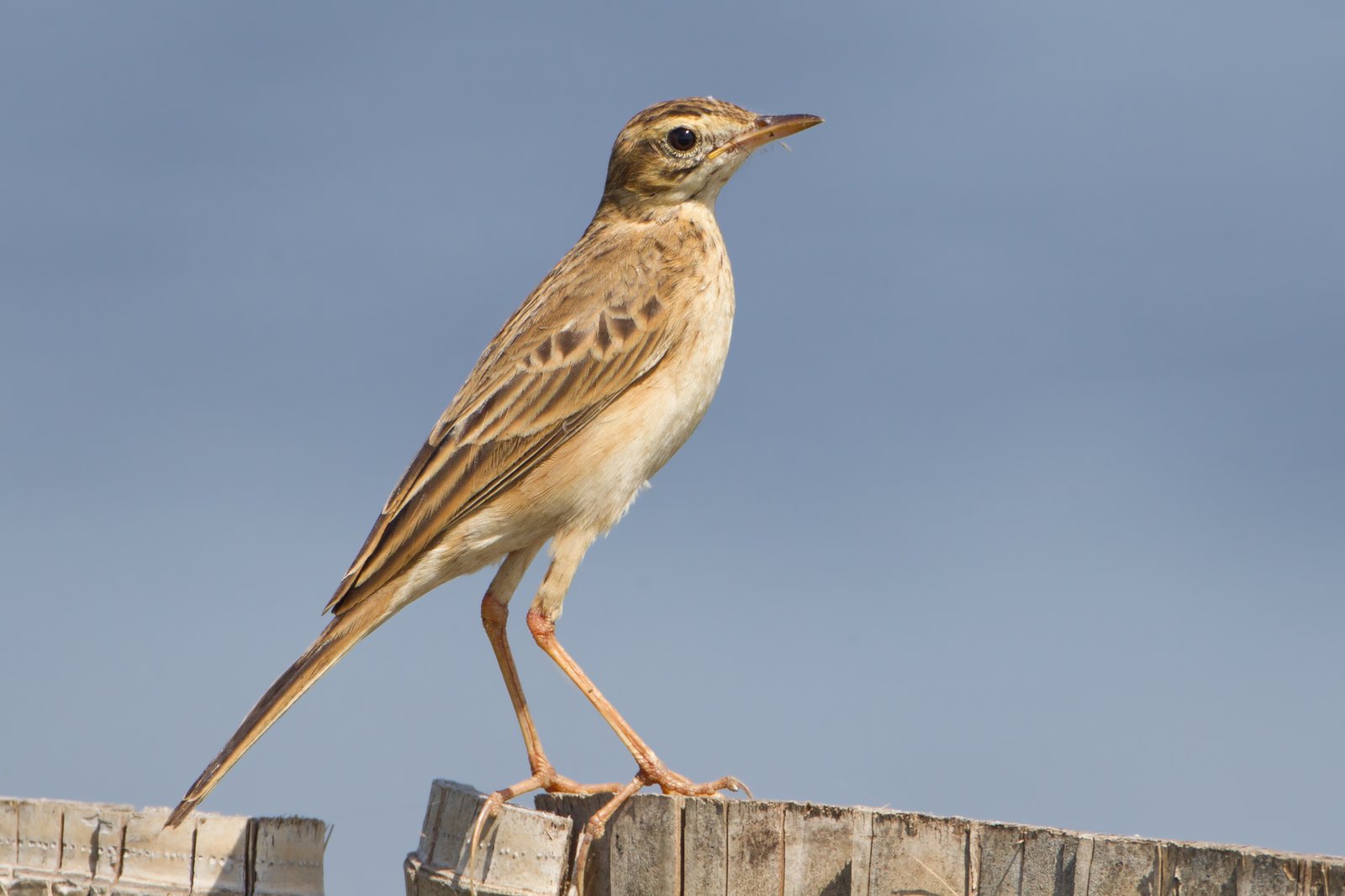
Richard's Pipit is the largest pipit of the region, a Siberian breeder that winters regularly in eastern Arabia and is a scarce visitor in the west of the region. It often draws attention first by its loud, hoarse call.
Voice
The call is a loud, explosive and hoarse shreep or shryoop, often on take-off, somewhat sparrow-like but fuller. It does not sing in the region.
Recording: Thierry THOMAS — CC BY-NC-SA 4.0 · converted to mono · xeno-canto
Identification
17–20 cm. Large, upright and long-tailed, with long, flesh-coloured legs, a very long, straight hind claw and a fairly heavy bill. Warm brown above with clear dark streaks on the mantle and crown; white below with warm buff flanks and a narrow band of fine streaks on the upper breast. A pale supercilium and pale lores, so the eye looks large and open. The median coverts have pointed dark centres. The outer tail feathers are white. Often hovers briefly before landing.
Confusion species
Blyth's Pipit (Anthus godlewskii) is slightly smaller and shorter-legged, with a shorter, more pointed bill, a shorter hind claw and square-cut dark centres to the median coverts; its call is softer and often trisyllabic. Tawny Pipit (Anthus campestris) is paler and almost unstreaked, with dark lores and a sparrow-like chilp. African Pipit (Anthus cinnamomeus) is smaller and breeds in the highlands of south-western Arabia. Paddyfield Pipit (Anthus rufulus) is clearly smaller and shorter-tailed, with a weaker call.
Habitat
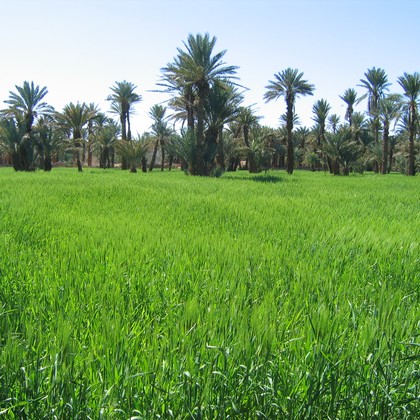
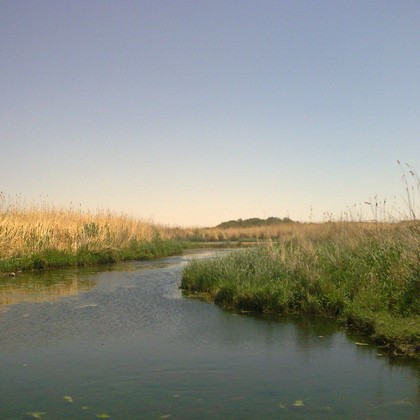
Damp and short-grazed grassland, irrigated fields, alfalfa fields, the grass of sports grounds and parks, marsh edges and sewage works.
Where the bird is most at home, classified by the habitats of North Africa and the Middle East.
Range and movements
A regular winter visitor to eastern and southern Arabia: the United Arab Emirates, Oman, Qatar, Bahrain, Kuwait, eastern Saudi Arabia and Yemen, and southern Iraq. A scarce winter visitor to Israel, Jordan and Egypt. Small numbers winter in north-west Africa, among other places regularly at Dayet Dar Bouazza near Casablanca; elsewhere in Morocco, Algeria and Tunisia a rare migrant. Breeds from western Siberia to Mongolia and north-east China and winters mainly in South and South-East Asia.
- Winter visitor (c. Oct–Mar)
- Passage (Mar–Apr, Oct–Nov)
- dark = core range, pale = thinly spread
How and when to look
In winter in the United Arab Emirates and Oman on lawns, sports fields and irrigated farms, for example around Al Ain and on the Saham plain; it rises with a hoarse shreep and hovers briefly before landing.
Conservation status
Not globally threatened and common in its vast breeding range. The number wintering in western Europe and north-west Africa has increased over recent decades.
Scientific name
Anthus richardi | Vieillot, 1818
Vieillot described the species in 1818 and placed it straight away in the genus where it still stands. The genus Anthus was introduced in 1805 by Bechstein. Anthus is the Latin word for a small bird of grasslands mentioned by Pliny the Elder. richardi honours the French naturalist Charles Richard (1745–1835), director of postal services at Lunéville and a friend of François Levaillant. The specimen the first description was based on came from France.