All species › Passerines › Chats and flycatchers › Thrush Nightingale
Thrush Nightingale | Luscinia luscinia
Noordse nachtegaal | Ruiseñor ruso
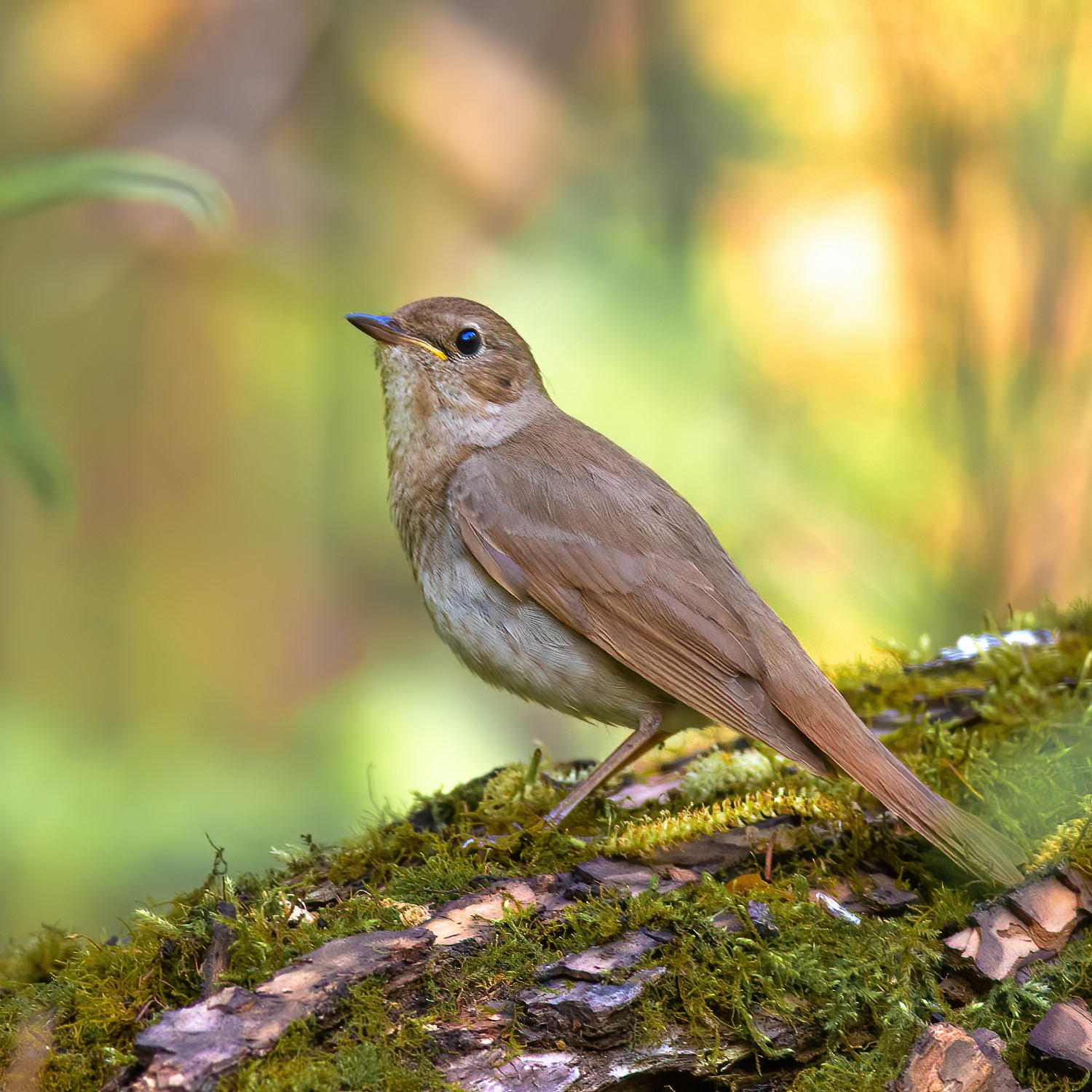
The Thrush Nightingale, or Sprosser, is the eastern twin species of the Common Nightingale, slightly darker and with a mottled breast. It breeds in eastern Europe and western Siberia and migrates through the Middle East to East and south-eastern Africa; in this region it is a passage migrant mainly through the Levant, Egypt and Arabia.
Voice
Sometimes sings on spring passage: a loud song with deep, clucking and rattling phrases, more staccato and with less crescendo than Common Nightingale, and without its whistled lead-in. Calls are a high, whistled hweet and a low, rasping krrr.
Recording: Zsombor Károlyi — CC BY-NC-SA 4.0 · shortened to the first 60 s, mono · xeno-canto
Identification
15–17 cm. Upperparts dark olive-brown, the tail rufous-brown but duller than in Common Nightingale, the uppertail coverts rusty. The throat is white with a dark malar stripe; breast and flanks are grey-brown with diffuse dark mottling or a mottled breast band, best seen in good light. The belly is off-white, the undertail coverts pale with dark centres. The primary projection is short; the outermost primary is very short (shorter than the primary coverts), a feature in the hand. Sexes are alike.
Confusion species
Common Nightingale (Luscinia megarhynchos) is warmer brown, with a brighter rufous tail, an unmarked plain buff breast, no malar stripe and a more obvious pale eye-ring; its eastern subspecies golzii, however, is paler and greyer and closer to Thrush Nightingale. Rufous-tailed Scrub-Robin (Cercotrichas galactotes) has a supercilium and black-and-white tail tips.
Habitat
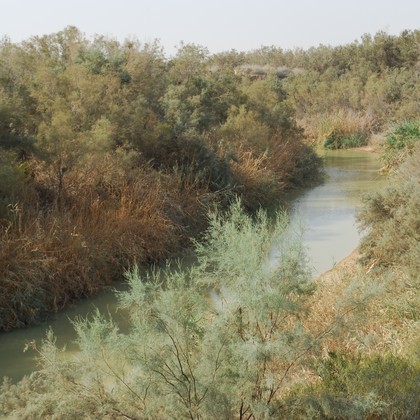
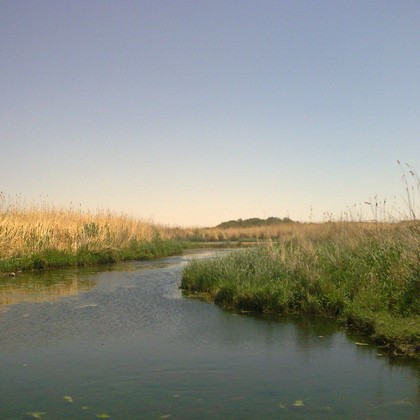
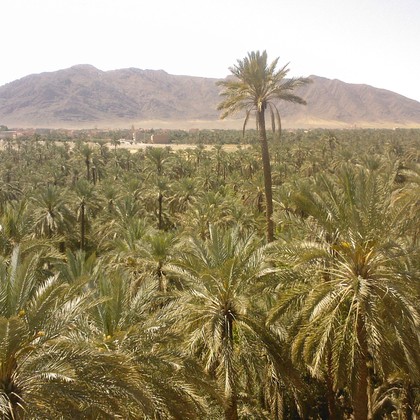
On passage dense scrub and rank vegetation, often near water: riverine woodland with willow and tamarisk, reed fringes, bushes in oases and gardens, kibbutz fields and overgrown parks. Keeps hidden close to the ground.
Where the bird is most at home, classified by the habitats of North Africa and the Middle East.
Range and movements
Passage migrant through the east of the region: through Syria, Lebanon, Israel, Jordan, Iraq and Kuwait, across Saudi Arabia, Yemen, Oman and the Gulf states to Africa, and through Egypt (Sinai, Nile Valley). In spring mainly in the second half of April and in May, in autumn in August and September. Scarce in Libya, very rare in Tunisia, Algeria and Morocco. Winters in East Africa, from Kenya to Zimbabwe and Mozambique. Breeds from Denmark and southern Scandinavia through the Baltic states and Russia to western Siberia.
- Resident
- Summer visitor (c. Apr–Sep)
- Passage (Mar–Apr, Oct–Nov)
- dark = core range, pale = thinly spread
How and when to look
In May in the overgrown gardens and bushes of Eilat or at the ringing stations of Israel and Kuwait; most birds are seen in the hand, but a singing bird in the bushes gives itself away by its rattling, clucking song.
Conservation status
Not globally threatened and has increased in parts of northern Europe. On passage it is locally trapped with nets in the Middle East.
Scientific name
Luscinia luscinia | (Linnaeus, 1758)
Linnaeus described the species in 1758 as Motacilla Luscinia; because it was later moved to another genus, the author and year stand in brackets. The genus Luscinia was introduced in 1817 by Forster. Luscinia is the Latin word for 'nightingale'. The specific name repeats the genus name. The specimen the first description was based on came from Sweden.