All species › Passerines › Chats and flycatchers › Common Nightingale
Common Nightingale | Luscinia megarhynchos
Nachtegaal | Ruiseñor común
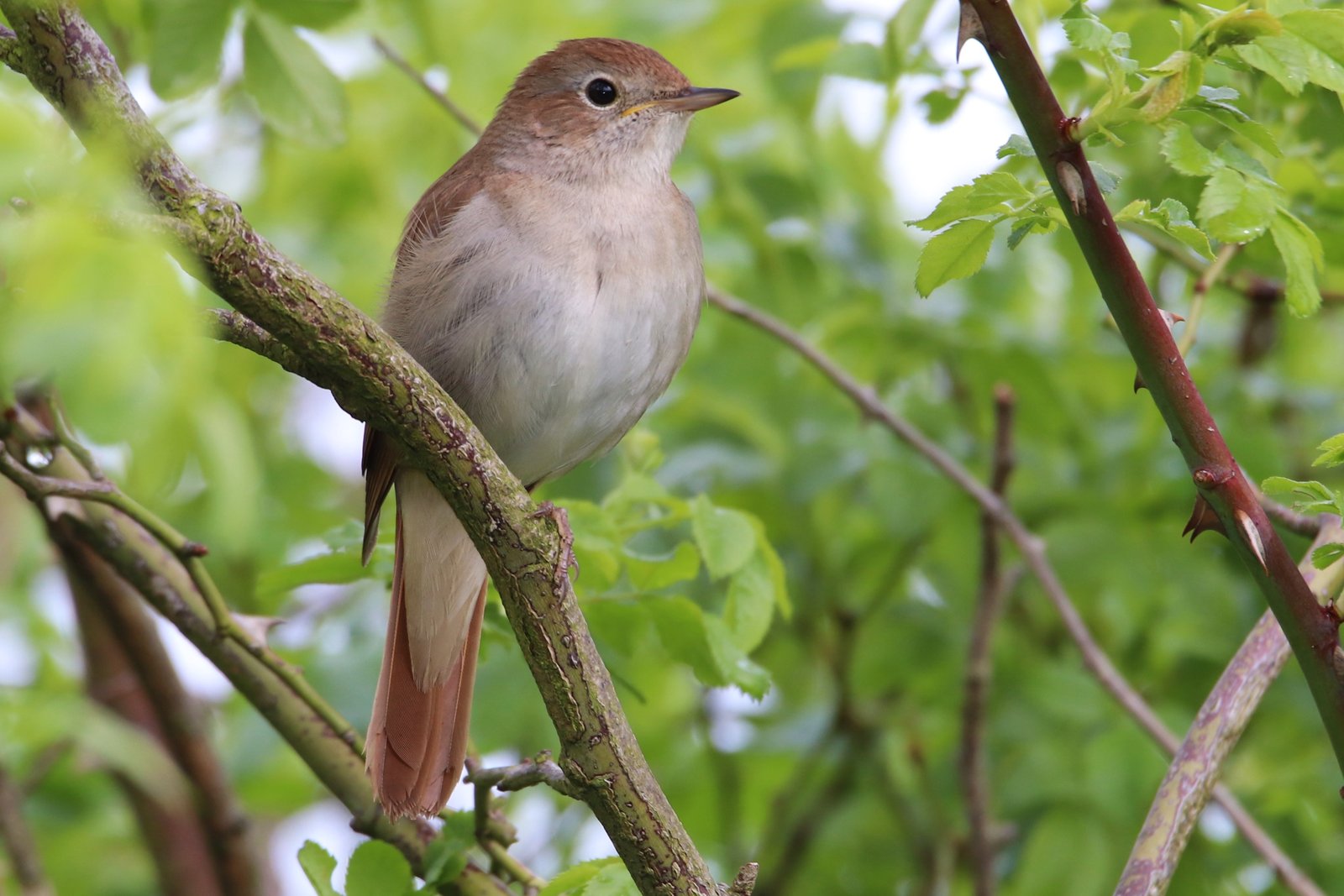
The Common Nightingale is a brown, skulking songbird with a rufous tail, famous for its powerful song by day and night. In this region it breeds in the scrub and riverine woodland of the Maghreb, the Levant and Iraq, and migrates through the whole region to sub-Saharan Africa.
Voice
The song is loud and varied: clear whistles, rapid repeated notes chook-chook-chook, rattles and a characteristic swelling pioo-pioo-pioo-pioo crescendo, with long pauses, both by day and at night. Calls are a rising whistled hweet and a low, rasping krrr.
Recording: Zsombor Károlyi — CC BY-NC-SA 4.0 · converted to mono · xeno-canto
Identification
15–16.5 cm. Upperparts warm brown, the rump and especially the fairly long tail bright rufous-brown. Underparts plain dull buff, the throat paler, unmarked. A large dark eye with a narrow pale eye-ring gives a gentle face. Legs pinkish-brown. Sexes are alike; juveniles are spotted pale. Often stands on the ground with drooped wings and raised tail. The eastern subspecies golzii (Central Asia, on passage in the east of the region) is paler, greyer and longer-tailed with a clearer supercilium; the Caucasian and Iranian form africana is slightly greyer than the nominate.
Confusion species
Thrush Nightingale (Luscinia luscinia) is darker olive-brown, with a less rufous tail, a dark malar stripe and a diffusely mottled breast. Rufous-tailed Scrub-Robin (Cercotrichas galactotes) has a clear supercilium and black-and-white tail tips. Female Common Redstart (Phoenicurus phoenicurus) is smaller and constantly quivers its tail.
Habitat
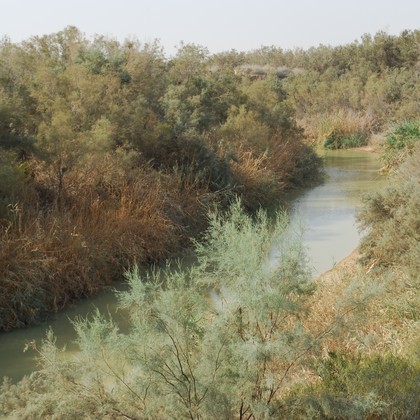
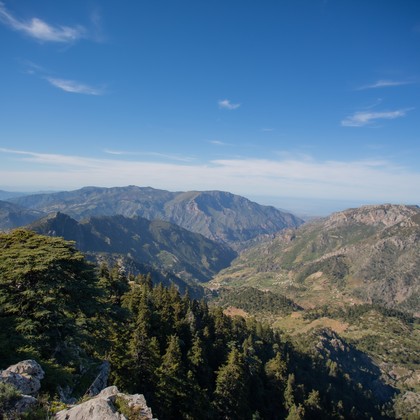
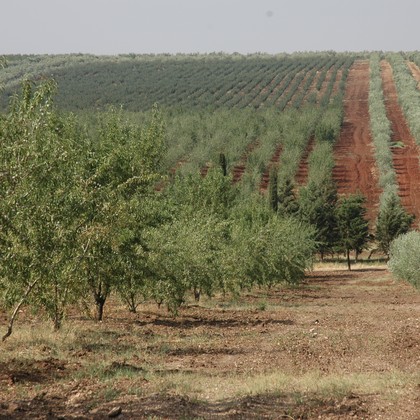
Dense scrub and rank undergrowth in broadleaved woodland, riverine woodland with willow, poplar and tamarisk, bramble thickets, maquis, the edges of orchards and olive groves, and dense bankside vegetation along streams and irrigation channels. On passage in any dense cover, in oases, gardens and wadis.
Where the bird is most at home, classified by the habitats of North Africa and the Middle East.
Range and movements
Breeds in Morocco (mainly in the north and the Atlas, also in river valleys to the south), in northern Algeria and Tunisia and in north-eastern Libya (Jebel Akhdar), in the Levant: Israel (mainly the north and centre), Lebanon, Syria and northern and western Jordan, and in Iraq, mainly in the north and along the rivers. On passage throughout the region, including the Sahara, Egypt, Saudi Arabia, Yemen, Oman and the Gulf states. Winters in the savanna belt of sub-Saharan Africa, from Senegal to East Africa. Beyond the region it breeds in southern and central Europe, Turkey, the Caucasus, Iran and Central Asia.
- Resident
- Summer visitor (c. Apr–Sep)
- Winter visitor (c. Oct–Mar)
- Passage (Mar–Apr, Oct–Nov)
- dark = core range, pale = thinly spread
How and when to look
In April and May, just after arrival, it sings most and loudest: in the riverine woods of the Middle Atlas, the Ichkeul area in Tunisia or the Hula Valley in Israel. On passage at Eilat or in the Gulf states it hides in dense bushes; a rufous tail vanishing into the shade is often all you see.
Conservation status
Not globally threatened. Declined in parts of western Europe through the loss of dense scrub; in this region it is still locally caught as a cage bird.
Scientific name
Luscinia megarhynchos | Brehm, 1831
Brehm described the species in 1831 and placed it straight away in the genus where it still stands. The genus Luscinia was introduced in 1817 by Forster. Luscinia is the Latin word for 'nightingale'. megarhynchos is Greek, from megas 'great' and rhunkhos 'bill'. The specimen the first description was based on came from Germany.