All species › Waders, gulls and terns › Sandpipers and snipes › Temminck's Stint
Temminck's Stint | Calidris temminckii
Temmincks strandloper | Correlimos de Temminck
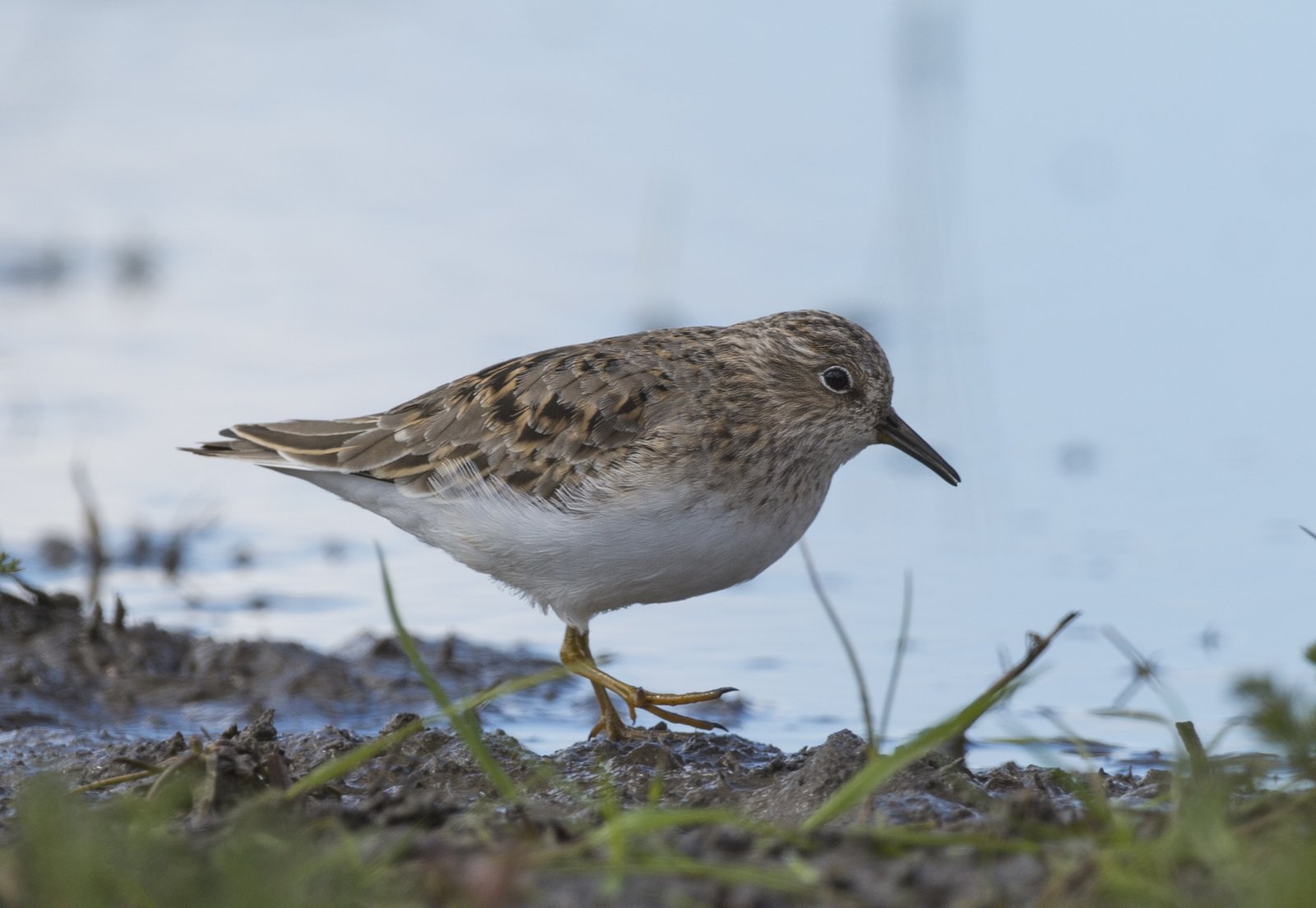
A small, plain grey-brown sandpiper that recalls a miniature Common Sandpiper more than its relatives. It avoids open mudflats and seeks out the vegetated edges of fresh water: in the region it is found on passage and in winter at sewage ponds, irrigation ditches, fishponds and the banks of the Nile.
Voice
A rapid, dry trill tirrrrr or tiririririt, often heard as a bird flushes; quite different from Little Stint's short tit.
Recording: Stanislas Wroza — CC BY-NC-SA 4.0 · converted to mono · xeno-canto
Identification
One of the smallest sandpipers, with a fairly long rear end, a short, slightly decurved dark bill and short, yellowish-green to olive legs. The upperparts and breast are rather uniform grey-brown, the breast band sharply demarcated from the white belly, giving it the look of a small Common Sandpiper. In breeding plumage some scapulars show black centres with rufous fringes. Juveniles are browner with fine pale scaling. In flight a narrow white wingbar and, conspicuously, all-white outer tail feathers.
Confusion species
Little Stint (Calidris minuta) has black legs, a straight bill, a white throat and breast with only the sides streaked, and paler, more contrasting upperparts, often with a white V on the mantle; its outer tail feathers are grey. Long-toed Stint (Calidris subminuta) also has yellow legs, but is more variegated, with dark, rufous-fringed upperparts, a clear supercilium and long toes. Common Sandpiper (Actitis hypoleucos) is larger, bobs its rear end and flies low with stiff, flickering wingbeats.
Habitat
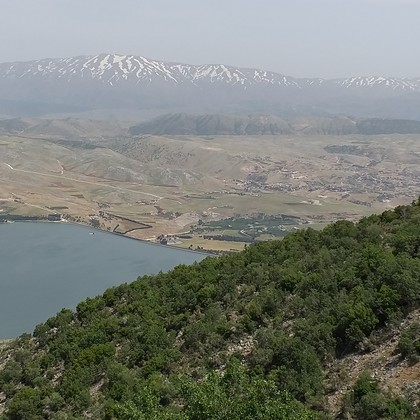
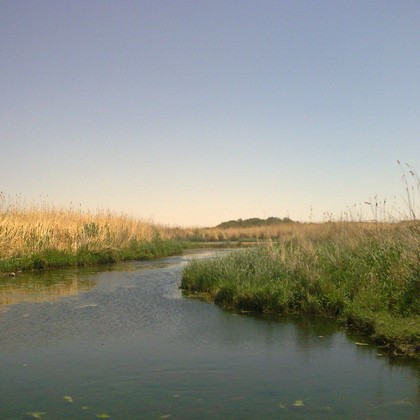
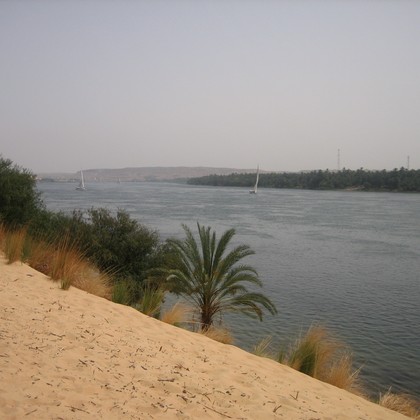
The muddy, often vegetated margins of fresh and slightly brackish water: sewage ponds, fishponds, irrigation channels, flooded fields, rice fields, river and reservoir banks, and the edges of oasis springs. It likes to hide among low vegetation and is often alone or in small groups.
Where the bird is most at home, classified by the habitats of North Africa and the Middle East.
Range and movements
On passage throughout the region, including oases and irrigation schemes deep in the Sahara and the Arabian deserts, mainly in March–May and August–October. It winters in the Egyptian Nile Delta and Valley, in Iraq (the Mesopotamian marshes and the Euphrates valley), in small numbers in Israel and Jordan, and widely in Arabia: from Kuwait, Bahrain, Qatar and the Emirates to Oman, inland Saudi Arabia and the Tihama and highlands of Yemen. In North Africa west of Egypt a fairly scarce passage migrant and local winter visitor in Tunisia, Algeria and Morocco. Beyond the region it breeds from northern Scandinavia to eastern Siberia and winters in the Sahel, East Africa and South and South-East Asia.
- Resident
- Winter visitor (c. Oct–Mar)
- Passage (Mar–Apr, Oct–Nov)
- dark = core range, pale = thinly spread
How and when to look
In winter, work the sewage ponds and irrigation channels of the Gulf states, such as at Al Wathba and Al Ansab (Muscat), or the fishponds of the Bet She'an Valley in Israel. A small sandpiper flushing with a trilling call and white tail sides is almost certainly a Temminck's Stint.
Conservation status
Not globally threatened, with a large breeding range and a stable or slightly declining population. In the region it benefits locally from sewage pools and irrigation, but loses natural wetlands through drainage and desiccation.
Scientific name
Calidris temminckii | (Leisler, 1812)
Leisler described the species in 1812 as Tringa Temminckii; because it was later moved to another genus, the author and year stand in brackets. The genus Calidris was introduced in 1804 by Merrem. Calidris goes back to Ancient Greek kalidris or skalidris, a name Aristotle used for an unidentified grey waterside bird. temminckii honours the Dutch zoologist Coenraad Jacob Temminck (1778–1858), first director of the national natural history museum in Leiden. The specimen the first description was based on came from Hanau, Germany.