All species › Passerines › Larks › Temminck's Lark
Temminck's Lark | Eremophila bilopha
Temmincks strandleeuwerik | Alondra sahariana
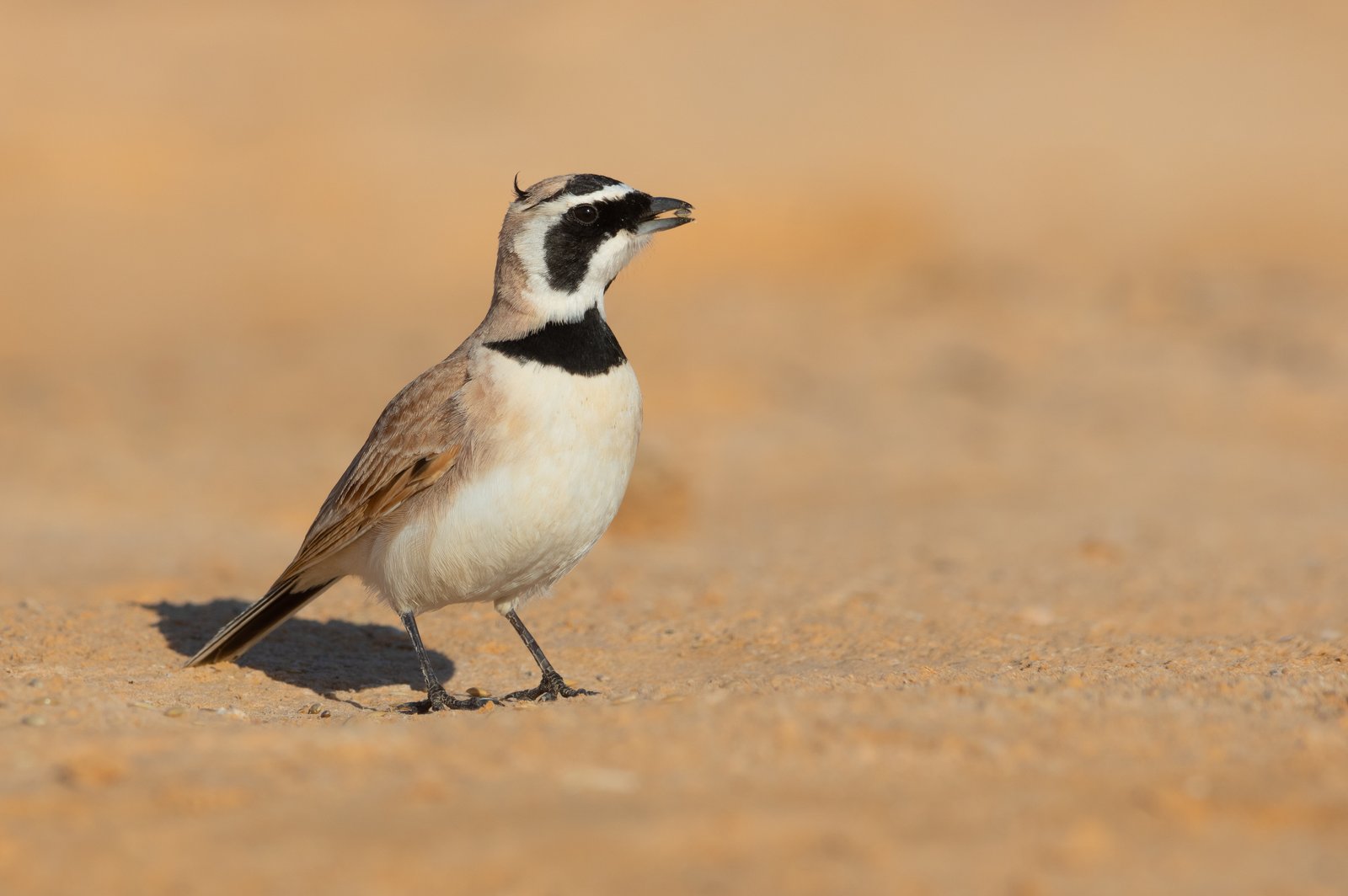
Temminck's Lark is a slim, small desert lark with a black-and-white face mask and two pointed black horns. It is almost entirely confined to North Africa and the Middle East, making it one of the core species of the guide. On the bare gravel plains of the Sahara and the Syrian Desert it runs quickly between the stones and presses itself flat to the ground when alarmed.
Voice
The song is short and twittering, a series of high, rather dry phrases, given from the ground, a stone or in a low song flight. The call is a soft chee-rup or a thin tseep.
Recording: Sven Normant — CC BY-NC-SA 4.0 · converted to mono · xeno-canto
Identification
14–15 cm, slim and fairly long-tailed. Upperparts rather plain pinkish-sandy, underparts white. The face is white with a black stripe from the bill base through the eye that curves down over the cheek, and a black breast patch separated from the face mask by white. In the breeding season the male carries two long black feathers like horns above the eye. The female is duller with smaller horns. Juveniles lack the black markings and are sandy with pale spots. In flight a dark tail with sandy central feathers.
Confusion species
Horned Lark (Eremophila alpestris) is larger, with greyer brown, streaked upperparts and a black cheek mask that in Levant birds joins the breast band; it lives in high mountains, not in desert. Greater Short-toed Lark (Calandrella brachydactyla) and Desert Lark (Ammomanes deserti) lack any black face pattern. Juveniles can resemble young Greater Short-Toed Larks but have a longer tail and the pinkish tone of the species.
Habitat
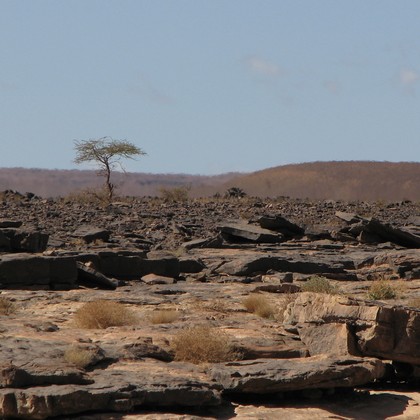
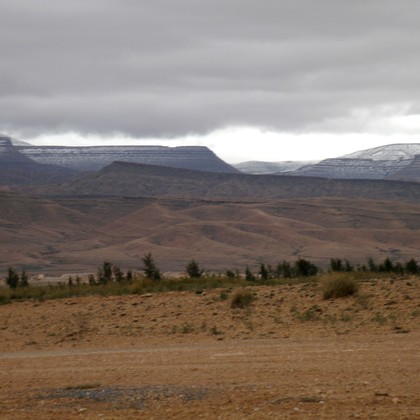
Bare, flat stony and gravel desert (hamada and reg) with scattered low shrubs, also sandy plains with gravel and the edges of semi-desert and alfa steppe. Avoids dunes and rocky mountains.
Where the bird is most at home, classified by the habitats of North Africa and the Middle East.
Range and movements
In North Africa in Morocco east and south of the Atlas and in Western Sahara, in the northern Algerian Sahara, southern Tunisia and much of Libya, and in Egypt in the Western Desert, along the north coast and in Sinai. In Israel a scarce and declining breeder of the Negev (around Nitzana and Shivta, the makhteshim, the Paran plain and the wadis of the southern Negev); it has not bred in the Arava since the 1990s. Further in the eastern desert of Jordan, the Syrian Desert, western Iraq and northern Saudi Arabia, with wandering birds reaching Kuwait in winter. Outside the region only in adjacent parts of Mauritania and Mali.
- Resident
- Winter visitor (c. Oct–Mar)
- Passage (Mar–Apr, Oct–Nov)
- dark = core range, pale = thinly spread
How and when to look
In Morocco the Tagdilt plateau near Boumalne-Dadès is the classic site, as are the plains around Errachidia and Merzouga; drive slowly along the tracks and watch for birds running off between the stones. In Israel look for it in March–April on the plains around Nitzana.
Conservation status
Not threatened. In Israel the species is assessed as Vulnerable: the population numbers fewer than 1000 birds, fluctuates strongly with rainfall and has declined steeply since the 1960s–1970s, when hundreds of pairs bred in the Negev and Arava. Elsewhere it is poorly known but widespread.
Scientific name
Eremophila bilopha | (Temminck, 1823)
Temminck described the species in 1823 as Alauda bilopha; because it was later moved to another genus, the author and year stand in brackets. The genus Eremophila was introduced in 1828 by Boie. Eremophila is Ancient Greek, from erēmos, 'desert', and phileō, 'to love'. bilopha joins Latin bi-, 'two', to Ancient Greek lophos, 'crest', after the two black feather horns. The specimen the first description was based on came from the desert near Aqaba.