All species › Nightjars › Nightjars › Sykes's Nightjar
Sykes's Nightjar | Caprimulgus mahrattensis
Sykes' nachtzwaluw | Chotacabras de Sykes
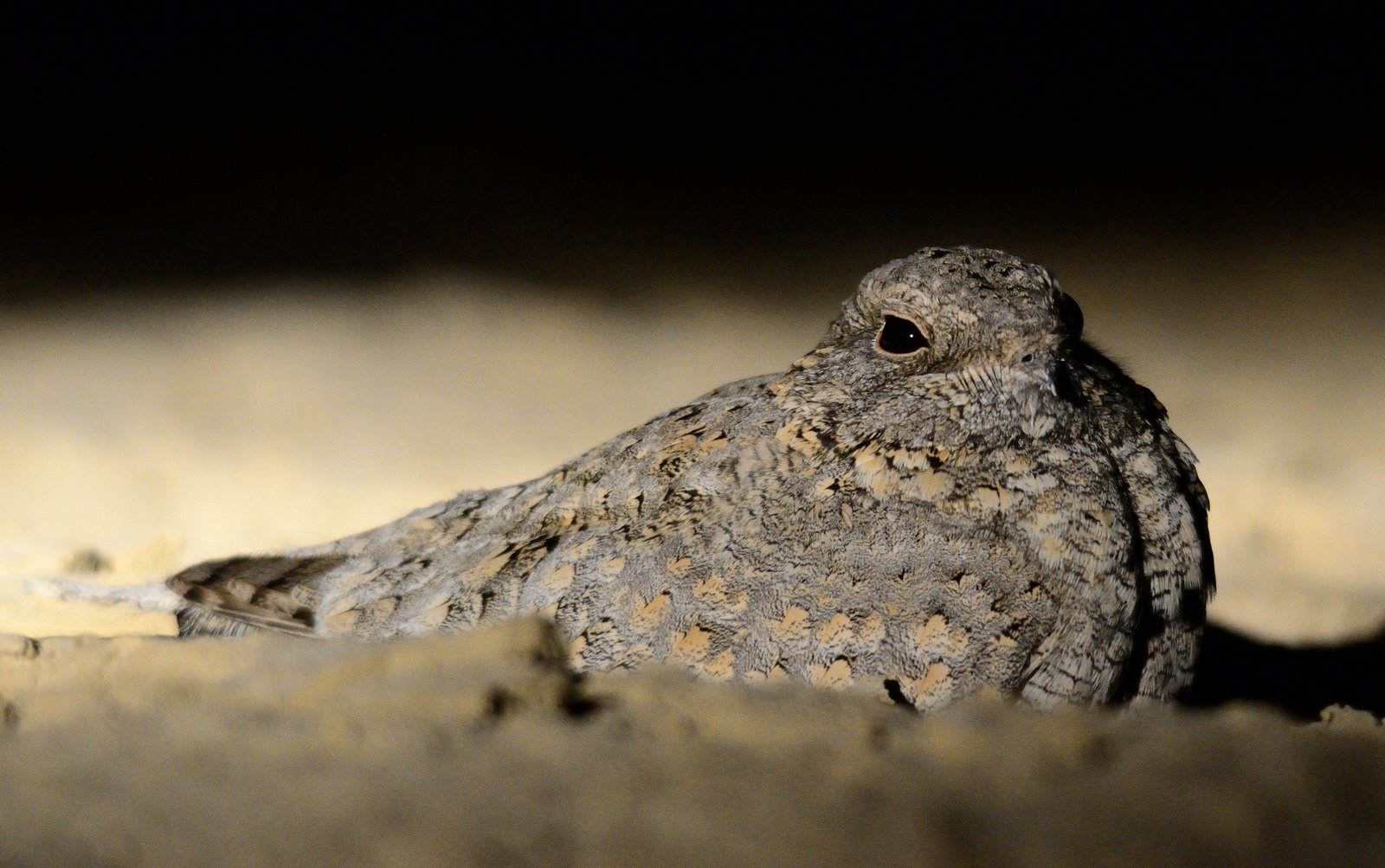
A small, pale nightjar of the semi-deserts of Pakistan and north-west India, recorded in the region only as a rare winter vagrant to the Emirates and Oman.
Voice
The song is a long, even, soft churr, churrrrrr, lower and more uniform than that of Eurasian Nightjar; the call a short chuk. Winter vagrants are usually silent.
Recording: Sven Normant — CC BY-NC-SA 4.0 · converted to mono · xeno-canto
Identification
Small and fairly short-tailed, pale sandy-grey with fine vermiculation, a crown with narrow dark streaks, a pale buff collar and little contrast on the upperparts. The male has large white spots on the four outer primaries and broad white tail corners; in the female the wing spots are paler and smaller and the tail corners buff. At rest it is barely separable from Egyptian Nightjar; a safe identification requires flight views or photographs of the spread wing and tail.
Confusion species
Egyptian Nightjar (Caprimulgus aegyptius) is larger and longer-winged and longer-tailed, with only small, dull white wing spots and almost no white tail corners. Eurasian Nightjar (Caprimulgus europaeus), sometimes pale in its eastern subspecies, is larger and has a dark scapular line. Nubian Nightjar (Caprimulgus nubicus) is warmer in colour with a rusty nape band.
Habitat
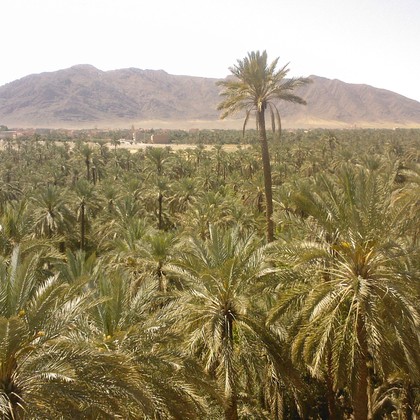
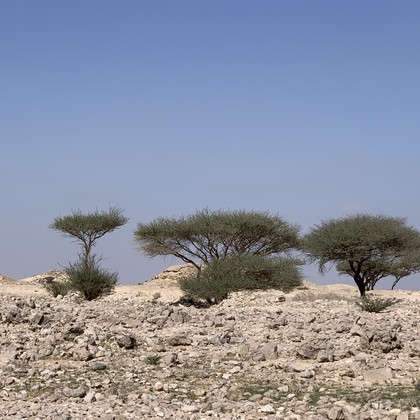
In its breeding range dry, open plains with scattered bushes, field margins and dry riverbeds. The vagrants in Arabia were found in oases and on the edges of wadis with bushes and palms.
Where the bird is most at home, classified by the habitats of North Africa and the Middle East.
Range and movements
Known from a handful of records in the east of the Arabian Peninsula: in the United Arab Emirates (records since at least 2001; the fifth in December 2021 at Wadi Wurayah) and in Oman (the first in December 2016 at Muntasar oasis, a few more since). Not reliably recorded elsewhere in the region. Beyond the region it breeds in Pakistan (Sindh, Baluchistan) and north-west India and moves in winter to central and western India.
How and when to look
The best chance is in the winter months in the oases of interior Oman, such as Muntasar, and in the wadis of the Hajar Mountains, where roosting nightjars are sometimes flushed by chance. Photograph wing and tail in flight when reporting one.
Conservation status
Not globally threatened and fairly common in its core range. As a vagrant it is of no significance in the region; records in Oman and the Emirates are assessed by the national rarities committees.
Scientific name
Caprimulgus mahrattensis | Sykes, 1832
Sykes described the species in 1832 and placed it straight away in the genus where it still stands. The genus Caprimulgus was introduced in 1758 by Linnaeus. Caprimulgus is Latin, from capra 'nanny goat' and mulgere 'to milk', after the old belief that nightjars suckled goats at night. mahrattensis refers to the Maratha (Mahratta) country of western India. The specimen the first description was based on came from Maharashtra, India.