All species › Sandgrouse › Sandgrouse › Spotted Sandgrouse
Spotted Sandgrouse | Pterocles senegallus
Sahelzandhoen | Ganga moteada
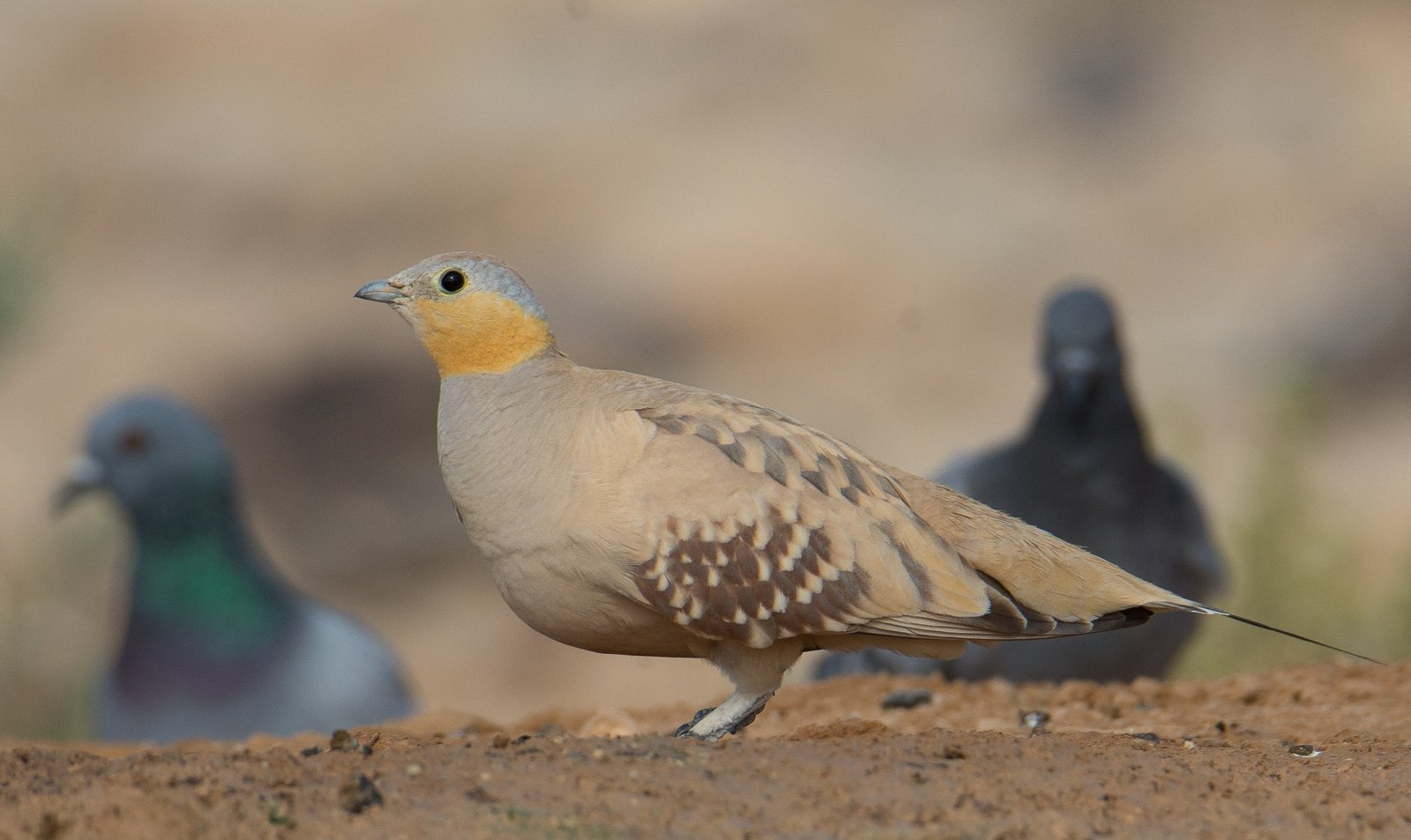
The most widespread sandgrouse of the Sahara and the Arabian deserts. A pale, sandy-yellow sandgrouse with tail pins that flies each morning in flocks of tens to hundreds to an oasis, well or reservoir. Its soft, bubbling call over a desert plain is often the first sign of water nearby.
Voice
A soft, bubbling, disyllabic kwitoo kwitoo or wooku-wooku, repeated by the whole flock and carrying far. Softer and more gurgling than the nasal phrases of Crowned Sandgrouse and the hoarse katar of Pin-tailed Sandgrouse.
Recording: Stanislas Wroza — CC BY-NC-SA 4.0 · converted to mono · xeno-canto
Identification
Medium-sized, with long pointed wings and two thin, elongated central tail feathers. The male is pale sandy-yellow to greyish, with a plain orange-yellow face and throat, a blue-grey supercilium continuing behind the eye to the nape, and a pinkish-grey breast without a breast band; back and wing coverts carry scattered round pale spots. A narrow black stripe runs down the centre of the pale belly. The female is densely covered with small dark spots on head, breast and back, with a yellow throat and the same black belly stripe. In flight the underwing coverts are pale and the flight feathers dark, with a black trailing edge to the primaries.
Confusion species
Crowned Sandgrouse (Pterocles coronatus) is smaller and stockier, without tail pins or belly stripe; the male has a black mask from forehead to chin. Pin-tailed Sandgrouse (Pterocles alchata) has a pure white belly and breast bands, Chestnut-bellied Sandgrouse (Pterocles exustus) a dark belly and dark underwing. At a distance a flying flock can look like pigeons, but the pointed wings and fast, direct flight are distinctive.
Habitat
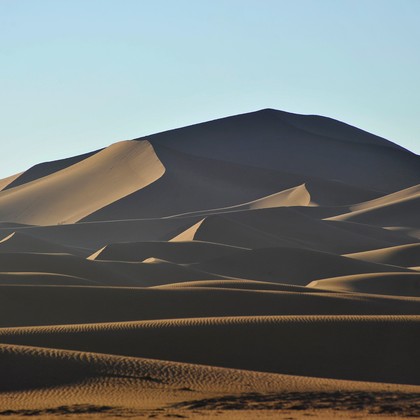
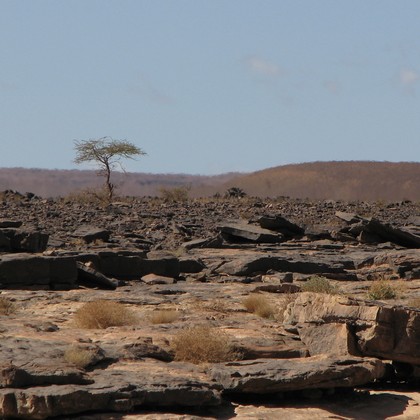
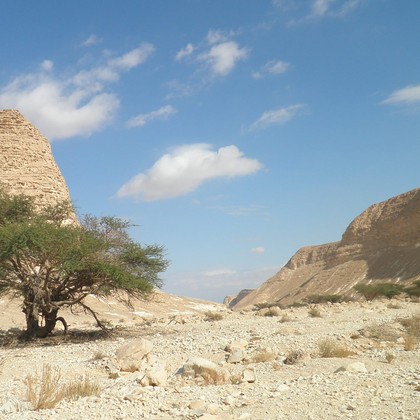
True desert: sand plains and flat ground between dunes, gravel desert with scattered shrubs, wadis and oasis edges. More often on soft, sandy ground than Crowned Sandgrouse. Eats mainly hard seeds. Drinks every morning, usually two to three hours after sunrise, at oases, wells, troughs, reservoirs and sewage ponds; in dry years it leaves the breeding areas in large flocks.
Where the bird is most at home, classified by the habitats of North Africa and the Middle East.
Range and movements
Throughout the desert belt of the region. In the Maghreb south of the Atlas: south-eastern Morocco (the Tafilalt, the Draa valley and the Merzouga area) and Western Sahara, the whole Algerian and Libyan Sahara and southern Tunisia. Egypt: the Western Desert with its oases, the Eastern Desert and Sinai. In the east in Israel (Negev and Arava), Jordan, eastern Syria, the western desert of Iraq, Kuwait, almost all of Saudi Arabia, Qatar, the UAE, Oman and Yemen. Beyond the region in the Sahel from Mauritania to Sudan and Eritrea, and from Iran to Pakistan and north-west India.
- Resident
- Winter visitor (c. Oct–Mar)
- Passage (Mar–Apr, Oct–Nov)
- dark = core range, pale = thinly spread
How and when to look
In south-eastern Morocco, southern Israel and Oman flocks come to regular drinking places in the morning: in Morocco the pools and troughs around Merzouga and Rissani, in Israel the sewage ponds of the Arava, in Oman the wells and irrigated fields of the interior. Settle at a quiet spot before eight and listen for the bubbling kwitoo of approaching flocks.
Conservation status
Not globally threatened and still common across much of the Sahara and Arabia. It locally benefits from new water points, irrigated fields and sewage ponds in the desert, but is hunted at drinking places. Numbers fluctuate strongly with rainfall, which makes trends hard to establish.
Scientific name
Pterocles senegallus | (Linnaeus, 1771)
Linnaeus described the species in 1771 as Tetrao senegallus; because it was later moved to another genus, the author and year stand in brackets. The genus Pterocles was introduced in 1815 by Temminck. Pterocles is Greek, from pteron 'wing' and -klēs 'notable, splendid'. senegallus is Latin for 'of Senegal', after the country the first described birds came from. The specimen the first description was based on came from Algeria.