All species › Cranes, rails and allies › Rails and crakes › Spotted Crake
Spotted Crake | Porzana porzana
Porseleinhoen | Polluela pintoja
A compact, finely white-spotted crake that crosses the region mainly on passage between Europe and sub-Saharan Africa. On migration it appears at the edge of the smallest patches of marsh, even at sewage ponds in the Arabian desert; a few winter in North Africa, the Nile Delta and Iraq.
Voice
In the breeding season a far-carrying, whiplash hwit, repeated about once a second, like a drop falling into a bucket, mainly at night. On passage and in winter usually silent, sometimes a short tchek.
Recording: János Schadl — CC BY-NC-SA 4.0 · shortened to the first 60 s, mono · xeno-canto
Identification
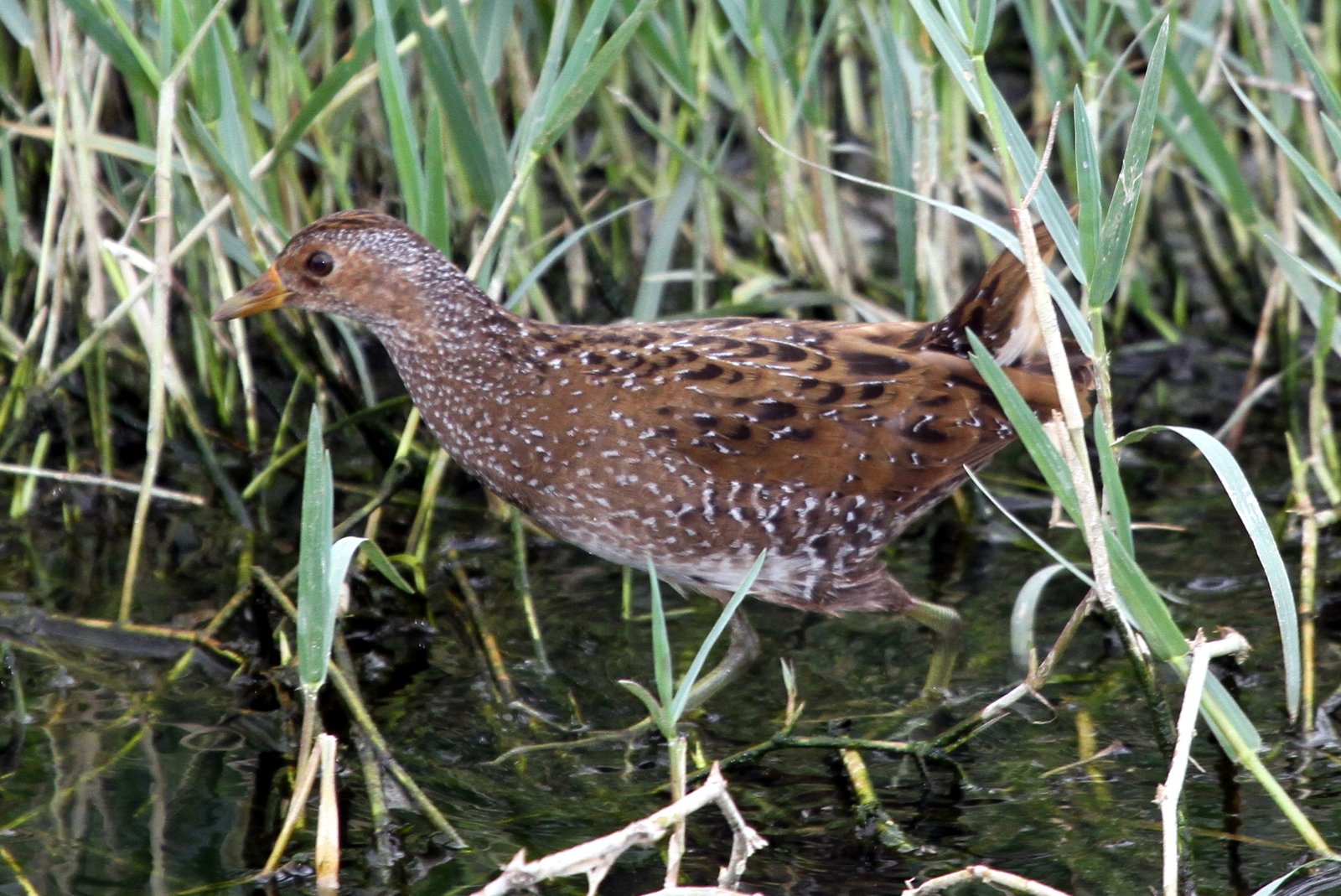
Short and rounded, with a short yellow bill with an orange-red base. Upperparts olive-brown with black centres and white streaks; head, neck and breast grey to brown, densely sprinkled with white spots; flanks barred brown and white; undertail plain pale buff, well visible when it flicks its tail. Legs green. Juveniles have a pale throat and less grey.
Confusion species
Little Crake (Zapornia parva) and Baillon's Crake (Zapornia pusilla) are smaller and slimmer, without the dense white spotting on the breast and without the buff undertail; Little Crake has a green bill with a red base. Water Rail (Rallus aquaticus) has a long red bill. Corn Crake (Crex crex) is larger, with rufous wings, and lives in dry grassland.
Habitat
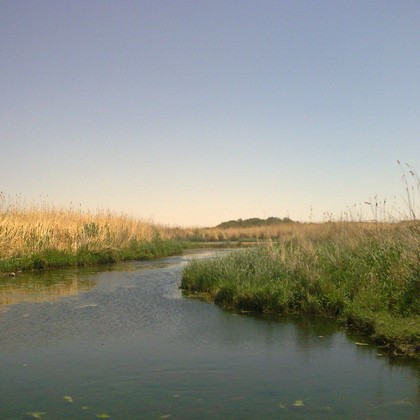
Shallow marshes with dense, low vegetation of sedges, rushes and grass and open muddy edges; on passage also wet meadows, rice fields, reservoir margins, fish ponds and sewage ponds. Forages at dusk at the edge of vegetation.
Where the bird is most at home, classified by the habitats of North Africa and the Middle East.
Range and movements
Passage migrant throughout the region, on a broad front across the Sahara and Arabia. Regular in Morocco, Algeria and Tunisia, in the Nile Delta and valley, in Israel, Jordan, Lebanon, Syria and Iraq, and annual in small numbers in Kuwait, Saudi Arabia, the Gulf states, the United Arab Emirates and Oman; scarce in Yemen. Winters in small numbers in Morocco, the Nile Delta and the marshes of southern Iraq. Breeds from western Europe to western Siberia and Central Asia and winters mainly in the Sahel and East Africa, south to South Africa, and in South Asia.
- Winter visitor (c. Oct–Mar)
- Passage (Mar–Apr, Oct–Nov)
- dark = core range, pale = thinly spread
How and when to look
In April and September, the edges of reedbeds at sewage ponds in the United Arab Emirates and Oman, the fish ponds of the Jordan Valley and the marshes around Eilat are good places. Sit at dawn or late afternoon with a view of a muddy margin: Spotted Crakes then step cautiously out onto the open mud.
Conservation status
Not threatened, but declining in parts of Europe because of drainage. In the region it suffers from the loss of wet grasslands in the Nile Delta and the Maghreb; artificial wetlands in Arabia offer migrants new stopover sites.
Scientific name
Porzana porzana | (Linnaeus, 1766)
Linnaeus described the species in 1766 as Rallus Porzana; because it was later moved to another genus, the author and year stand in brackets. The genus Porzana was introduced in 1816 by Vieillot. Porzana is a Latinised Venetian folk name for the small crakes. The species name repeats the genus name. The specimen the first description was based on came from France.