All species › Waders, gulls and terns › Skuas › South Polar Skua
South Polar Skua | Stercorarius maccormicki
Zuidpooljager | Págalo polar
A large skua from Antarctica that breeds during our winter and crosses the equator in the northern summer. In the region it appears in the monsoon months off the coasts of Oman and Yemen, where the cold, food-rich upwelling waters of the Arabian Sea attract many seabirds.
Voice
Silent at sea; only in the Antarctic breeding colonies is a hoarse, laughing screech heard.
Recording: steve — CC BY-SA 4.0 · converted to mono · xeno-canto
Identification
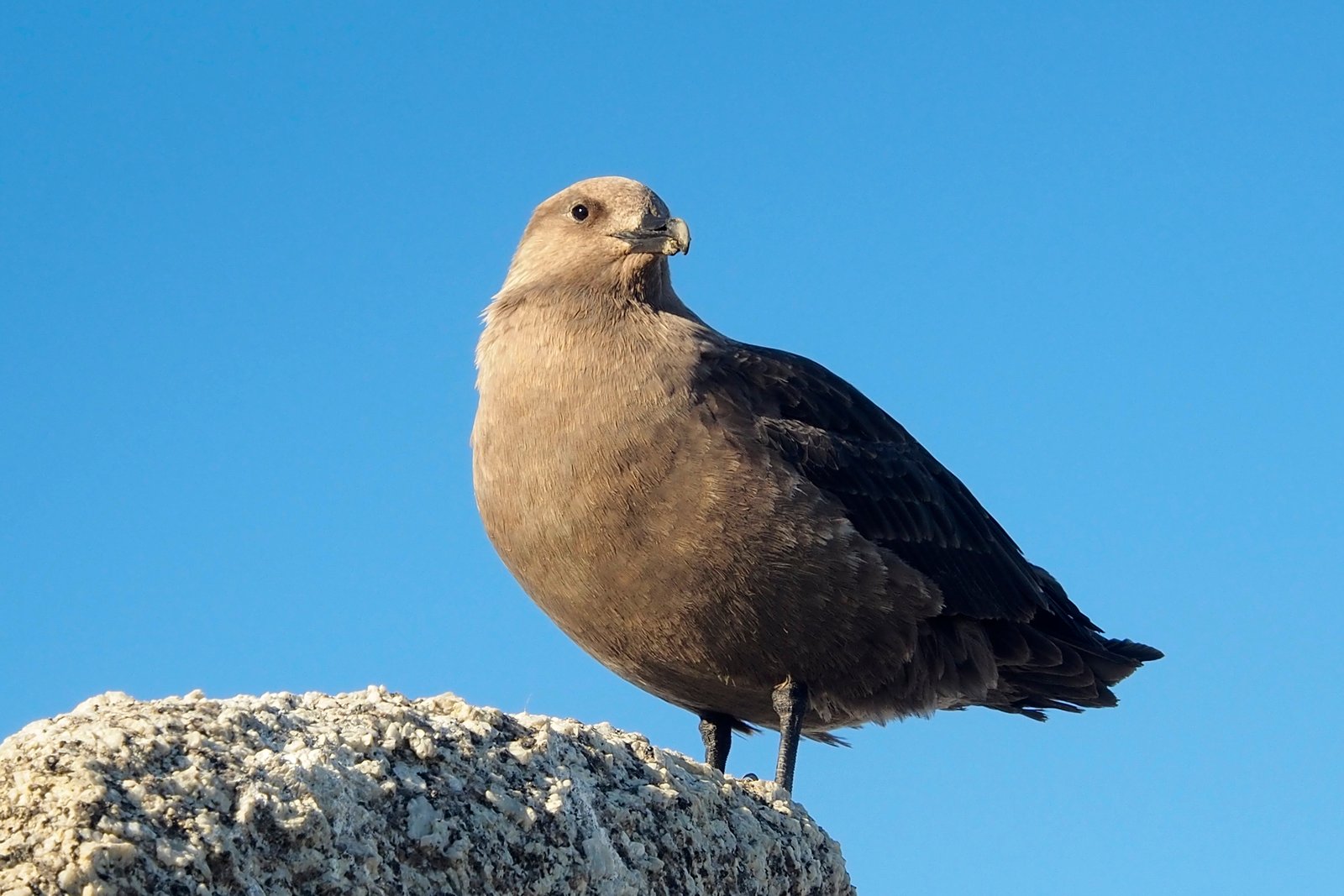
Large and compact, with broad wings, a short blunt tail and a heavy black bill, slightly slimmer than in Great Skua. There is a pale and a dark morph with intermediates. Pale birds have a strikingly pale grey-buff head, neck and underparts sharply contrasting with uniformly dark, almost unmarked upperparts and underwings, often with a fine pale collar; dark birds are uniformly cold brown without warm tones. In all morphs a white patch at the base of the primaries, above and below. Young birds are greyer and plainer, with a blue-grey bill base.
Confusion species
Brown Skua (Stercorarius antarcticus), which also occurs in the Arabian Sea, is bulkier and warmer brown, with rusty blotches and streaks on the upperparts and no contrast between body and wing. Great Skua (Stercorarius skua) has warm rufous and golden streaking, but is not known with certainty from Arabia. Dark Pomarine Jaegers (Stercorarius pomarinus) are slimmer, with a longer tail and a smaller white patch.
Habitat
Open ocean, especially over the cool, food-rich upwelling waters of the Arabian Sea during the summer monsoon. Follows fishing boats and flocks of shearwaters; rarely comes close inshore.
Where the bird is most at home, classified by the habitats of North Africa and the Middle East.
Range and movements
Oman: scarce but probably annual visitor in May – October, mainly during the monsoon off the coast of Dhofar, at Masirah and Ras al Hadd, with a few records as far as Muscat; in total a few dozen reports of large skuas, part of them Brown Skuas. Yemen: in the same period in the Gulf of Aden and the waters around Socotra. Emirates: one large skua not identified to species from the shore in January 2000. There are no certain records from the Red Sea, the Persian Gulf or the Mediterranean. Breeds along the coasts of Antarctica; in the austral winter migrates north into the Pacific, Atlantic and Indian Oceans.
- Passage (Mar–Apr, Oct–Nov)
- dark = core range, pale = thinly spread
How and when to look
The best chance is a pelagic trip in July – September off the coast of Dhofar or Masirah, although the high monsoon swell makes this difficult. Look for a large, uniformly dark skua with a contrasting pale head among the Sooty Shearwaters.
Conservation status
Globally not threatened; the Antarctic population is estimated at a few thousand pairs and seems stable. No threats are known within the region; the species is seen so rarely here that its true numbers in the Arabian Sea are unknown.
Scientific name
Stercorarius maccormicki | Saunders, 1893
Saunders described the species in 1893 and placed it straight away in the genus where it still stands. The genus Stercorarius was introduced in 1760 by Brisson. Stercorarius is Latin for 'of dung', from stercus 'dung': the food disgorged by seabirds when pursued by skuas was once taken for excrement. maccormicki honours the British naval surgeon and naturalist Robert McCormick (1800–1890), who sailed to Antarctica with James Clark Ross. The specimen the first description was based on came from Possession Island, Victoria Land, Antarctica.