All species › Waders, gulls and terns › Skuas › Great Skua
Great Skua | Stercorarius skua
Grote jager | Págalo grande
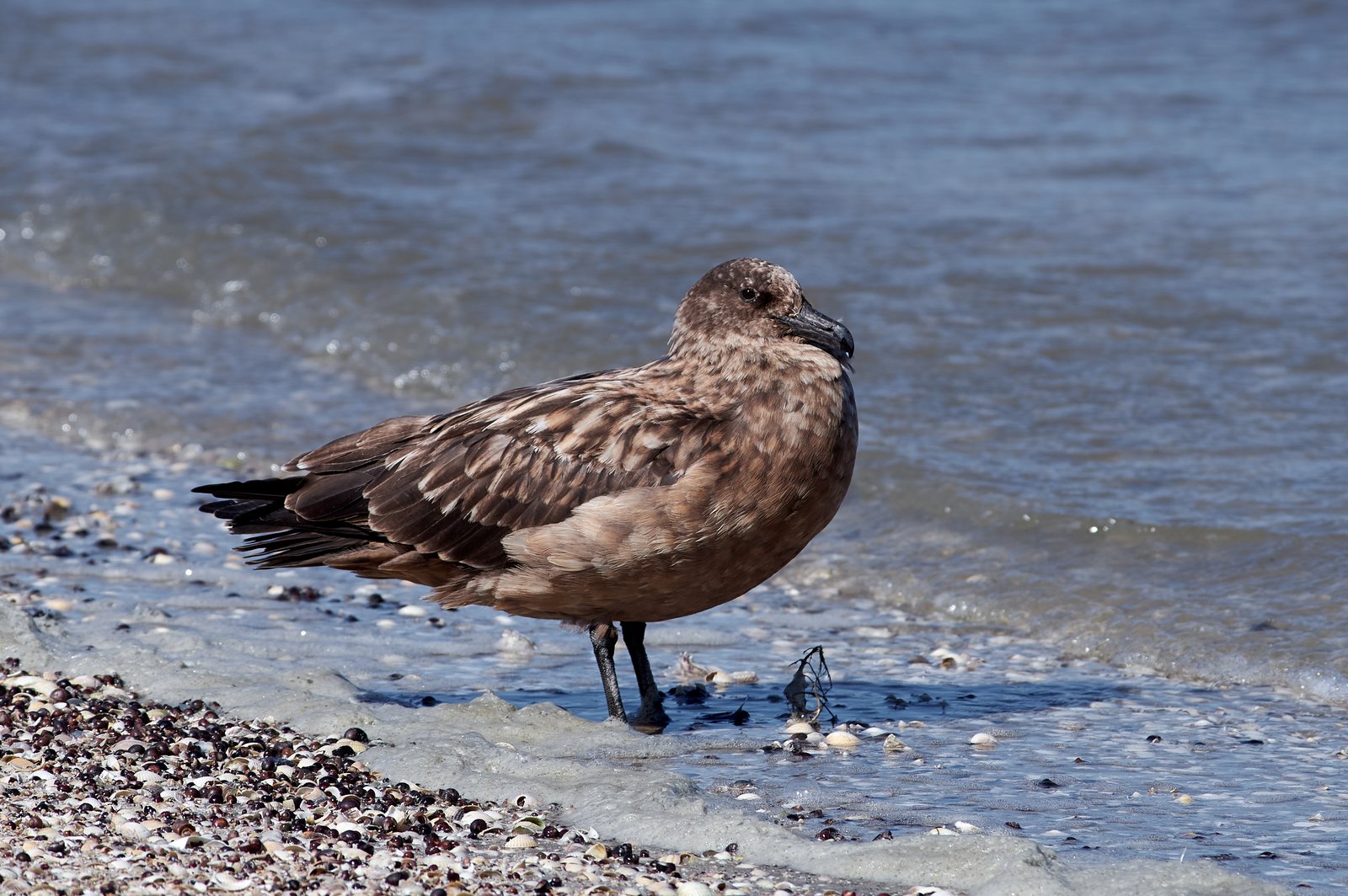
A massive, dark brown pirate that forces even Northern Gannets to drop their fish. It breeds in the north-east Atlantic and part of the population winters off the coast of Morocco and Western Sahara; in the Mediterranean it becomes increasingly rare eastwards.
Voice
Silent in winter. On the breeding grounds in Scotland, the Faroes and Iceland it gives a hoarse, barking uk-uk-uk when attacking walkers; it is not heard in the region.
Recording: Stanislas Wroza — CC BY-NC-SA 4.0 · shortened to the first 60 s, mono · xeno-canto
Identification
Large and compact, as big as a Lesser Black-backed Gull but heavier, with broad wings, a short wedge-shaped tail and a thick black hooked bill. Wholly dark brown with warm rufous and golden streaks on mantle, coverts and nape; at sea simply dark. Decisive in flight is the large, bright white patch at the base of the primaries, above and below the wing. The central tail feathers barely project. Juveniles are plainer and colder brown, with less streaking and a darker head.
Confusion species
South Polar Skua (Stercorarius maccormicki) is slightly smaller and colder in tone, with uniformly dark upperparts lacking warm streaks and often a pale grey-buff head and underparts contrasting with dark wings; in the region the two species hardly overlap. Dark Pomarine Jaegers (Stercorarius pomarinus) are slimmer, with a longer tail and a smaller white patch. Young Great Black-Backed Gulls (Larus marinus) and Yellow-Legged Gulls (Larus michahellis) have a pale tail base and no white primary patch.
Habitat
Open sea and waters over the continental shelf, often near fishing boats and feeding flocks of Northern Gannets and gulls. In storms it comes close inshore and into large bays.
Where the bird is most at home, classified by the habitats of North Africa and the Middle East.
Range and movements
Morocco and Western Sahara: regular passage migrant and winter visitor along the whole Atlantic coast, mainly October – April, with most birds off the southern coast down to Dakhla and on to the Banc d'Arguin beyond; also in the Strait of Gibraltar. Algeria and Tunisia: scarce winter visitor along the Mediterranean coast. Libya, Egypt, Israel and Lebanon: rare to very rare winter visitor. There are no certain records from Arabia or the Red Sea: large skuas off Oman are South Polar or Brown Skuas (Stercorarius antarcticus). Breeds in Scotland, on the Faroes, Iceland and in Norway; winters in the Atlantic from the Bay of Biscay to West Africa and Brazil.
- Resident
- Summer visitor (c. Apr–Sep)
- Winter visitor (c. Oct–Mar)
- Passage (Mar–Apr, Oct–Nov)
- dark = core range, pale = thinly spread
How and when to look
The Atlantic coast of Morocco from November to February is the place: at Tarfaya, Essaouira and Dakhla it is seen on seawatches or around fishing boats near the harbour. In Tunisia and Algeria a sighting is a stroke of luck, usually after winter storms.
Conservation status
Globally not threatened, with a small world population most of which breeds in Scotland, the Faroes and Iceland. In 2021 and 2022 thousands of breeding birds died of avian influenza, and declines in sandeels and fishery discards also affect the species; the long-term consequences are still uncertain. No specific threats are known within the region.
Scientific name
Stercorarius skua | (Brünnich, 1764)
Brünnich described the species in 1764 as Catharacta Skua; because it was later moved to another genus, the author and year stand in brackets. The genus Stercorarius was introduced in 1760 by Brisson. Stercorarius is Latin for 'of dung', from stercus 'dung': the food disgorged by seabirds when pursued by skuas was once taken for excrement. skua comes from Faroese skúgvur, the name for this bird; the island of Skúvoy is known for its colony. The specimen the first description was based on came from the Faroe Islands and Iceland.