All species › Waders, gulls and terns › Gulls and terns › Sooty Tern
Sooty Tern | Onychoprion fuscatus
Bonte stern | Charrán sombrío
A large, contrasting tropical ocean tern, black above and white below, which is almost continuously on the wing outside the breeding season. In the region it breeds on a few remote islands in the southern Red Sea, the Gulf of Aden and off Oman; elsewhere it is a rare visitor, sometimes after storms.
Voice
A loud, nasal ker-wacki-wack or wide-awake, heard both at the colony and at sea, also at night.
Recording: AUDEVARD Aurélien — CC BY-NC-SA 4.0 · converted to mono · xeno-canto
Identification
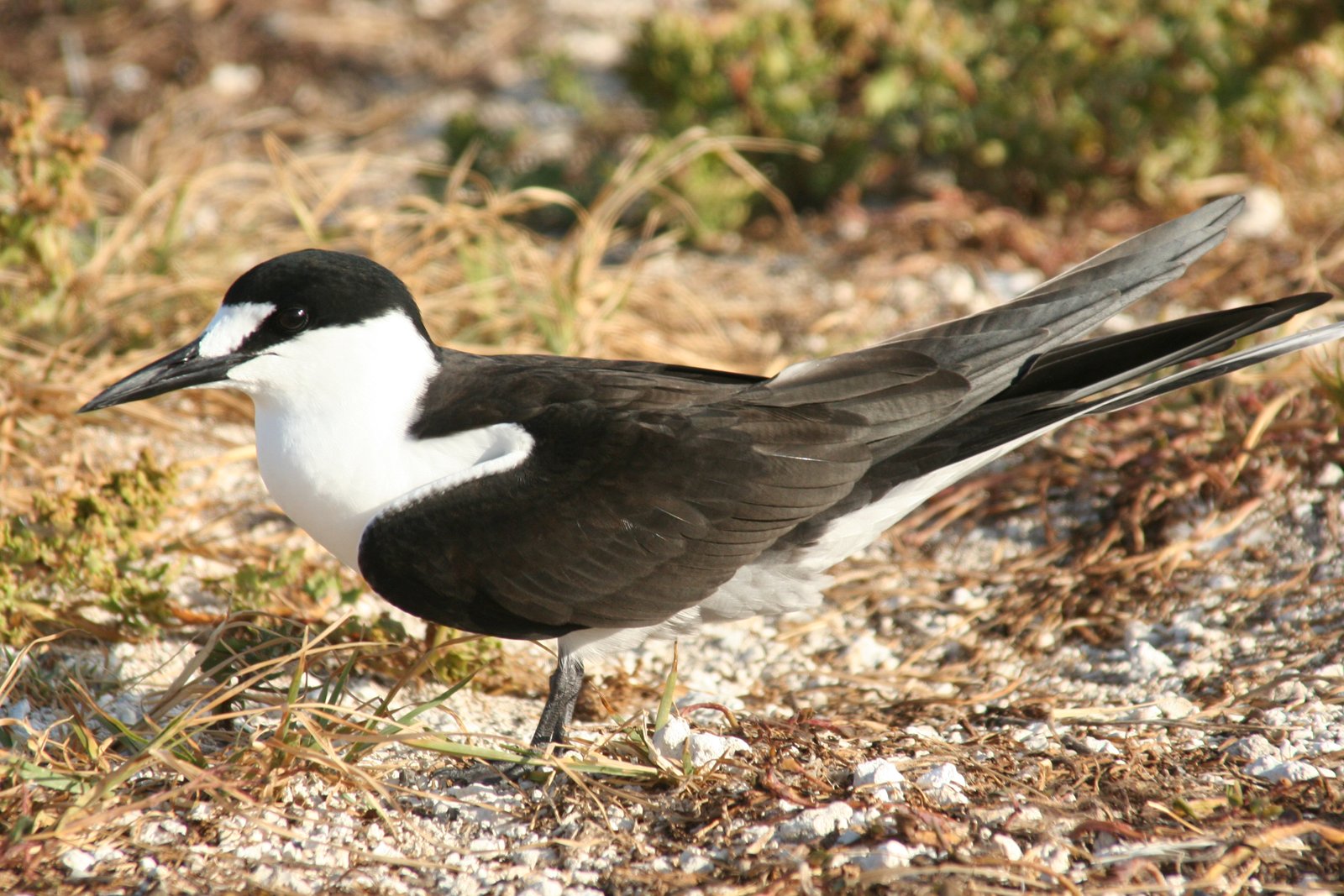
Upperparts, wings and tail blackish, underparts bright white. The black cap reaches the bill; the white forehead patch is broad and extends only to above the eye, not behind it. Black bill and legs. Deeply forked tail with white outer feathers. From below the primaries are dark, giving a dark trailing edge to the underwing. Juveniles are very different: largely sooty brown with white spots on mantle and wings, and only the lower belly and undertail coverts paler. Flies with deep, supple beats, often high over the sea.
Confusion species
Bridled Tern (Onychoprion anaethetus) is smaller and slimmer, with a grey-brown rather than black mantle that contrasts with the black cap, a pale nape band and a narrow white forehead patch extending behind the eye. Juvenile Sooty Terns can recall a Brown Noddy (Anous stolidus), but have a forked tail, white spots and a pale belly.
Habitat
Open, warm sea, often far offshore; hunts in flocks over schools of tuna and dolphins, snatching small fish from the surface without plunging. Breeds in dense colonies on bare or sparsely vegetated sand and coral islands.
Where the bird is most at home, classified by the habitats of North Africa and the Middle East.

Range and movements
Breeds in summer on a small number of islands: in the southern Red Sea off Yemen and Saudi Arabia, in the Gulf of Aden and in the Arabian Sea off Oman, including the Hallaniyat archipelago. Outside the breeding season the birds move out into the Indian Ocean. A rare visitor to the northern Red Sea (Egypt, Gulf of Aqaba), with a few records at Eilat, and to the Gulf of Oman and the Persian Gulf: about 25 records in the UAE up to 2022, often after summer storms. Exceptional on the Mediterranean and Morocco's Atlantic coast, as a vagrant from the Atlantic. Beyond the region it breeds on tropical islands in all oceans, from the Caribbean to the Pacific and Australia.
- Summer visitor (c. Apr–Sep)
- Passage (Mar–Apr, Oct–Nov)
- dark = core range, pale = thinly spread
How and when to look
Breeding colonies are hard to reach and better left alone. Pelagic trips in the Arabian Sea off Mirbat and Salalah in summer, during the monsoon, give the best chance; look for the birds in mixed flocks over feeding tuna.
Conservation status
Not globally threatened and one of the most numerous seabirds in the world. The small colonies in the region are vulnerable to introduced rats and cats, egg collecting and disturbance; numbers in the region are poorly known.
Scientific name
Onychoprion fuscatus | (Linnaeus, 1766)
Linnaeus described the species in 1766 as Sterna fuscata; because it was later moved to another genus, the author and year stand in brackets. The genus Onychoprion was introduced in 1832 by Wagler. Onychoprion comes from Greek onux 'nail, claw' and prion 'saw'. fuscatus is Latin for 'darkened', from fuscus 'dark', after the sooty upperparts. The specimen the first description was based on came from Santo Domingo.