All species › Falcons › Falcons › Sooty Falcon
Sooty Falcon | Falco concolor
Woestijnvalk | Halcón pizarroso
The Sooty Falcon is a slim, uniformly slate-grey falcon of desert cliffs and islands in the Red Sea and the Persian Gulf. Like Eleonora's Falcon it breeds late in summer, so that its young are raised on autumn migrants crossing the desert; almost the entire world population breeds in the region and winters in Madagascar.
Voice
At the nest ledge a high, hoarse kee-kee-kee-kee, thinner than a Peregrine's call, and a sustained alarm when someone approaches the cliff. Otherwise silent.
Recording: uri laor — CC BY-NC-SA 4.0 · converted to mono · xeno-canto
Identification
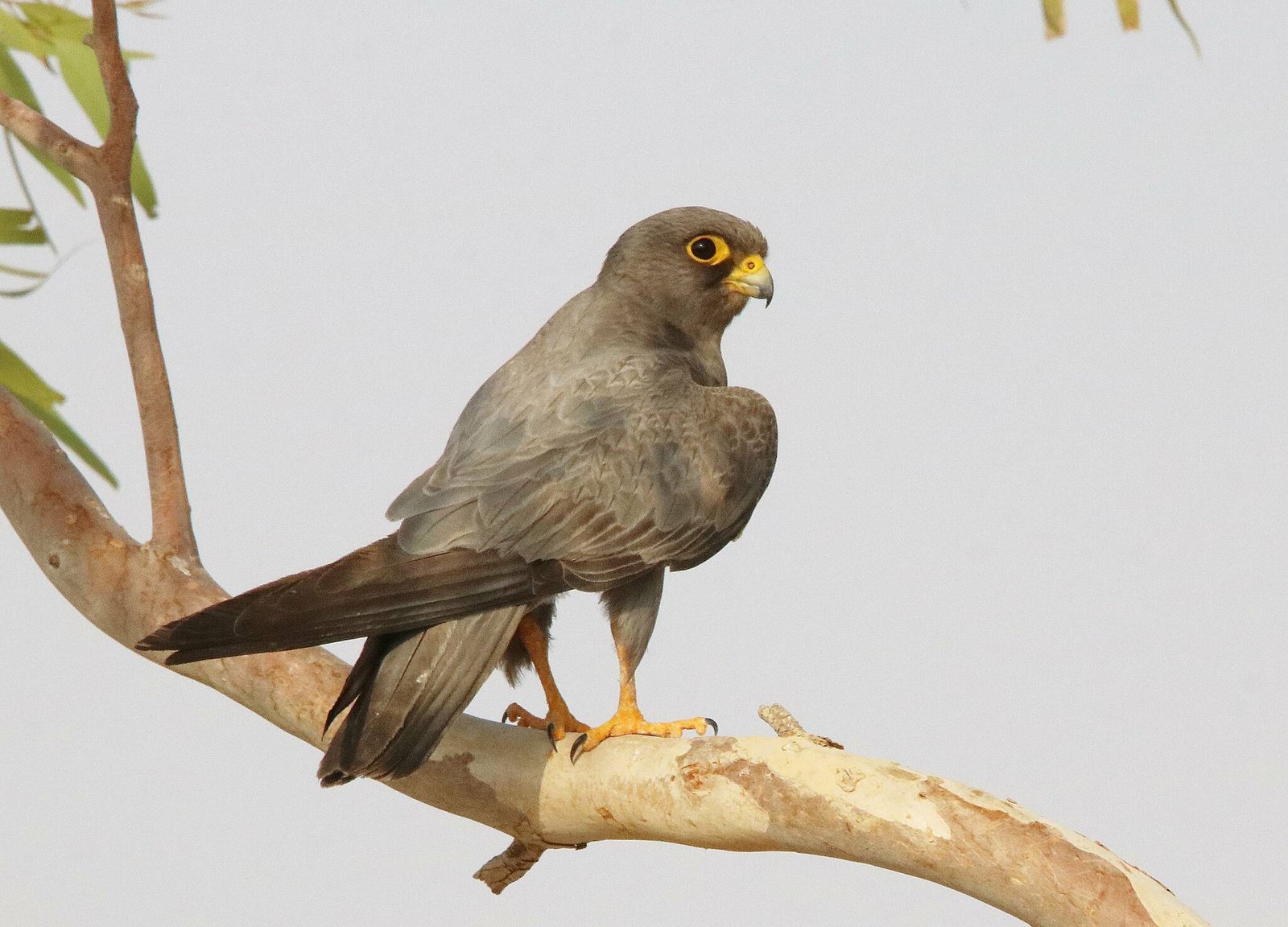
32–37 cm, wingspan 78–90 cm. Long and slender, with very long pointed wings whose tips reach beyond the tail at rest, and a medium-length tail with slightly projecting central feathers. The adult is uniform blue-grey, slightly darker on the primaries, without markings below and without contrast in the underwing; cere, eye ring and feet are yellow and a faint dark moustache is sometimes visible. The juvenile is greyish-brown above, creamy with dark streaks below, with a dark trailing edge to wing and tail. Flight is light and floating, with long glides and sudden stoops.
Confusion species
The dark morph of Eleonora's Falcon (Falco eleonorae) is sooty brown to black, larger and longer-tailed, with dark underwing coverts against paler flight feathers; the Sooty Falcon is evenly grey below. The male Red-footed Falcon (Falco vespertinus) is also slate-grey, but smaller, with red legs and cere and rufous thighs. Young Sooty Falcons resemble young Eurasian Hobbies (Falco subbuteo), but those are more compact, with a sharp black-and-white head pattern. In poor light a dark Lanner Falcon (Falco biarmicus) can confuse, but that is much bulkier.
Habitat
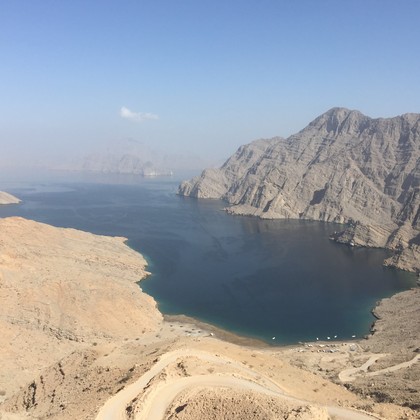
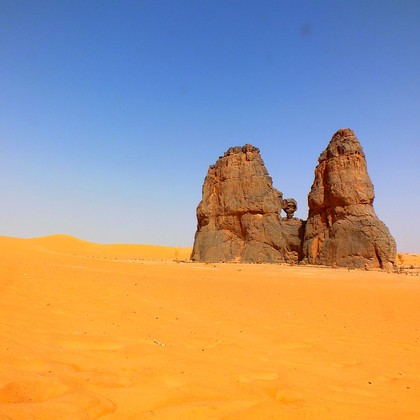
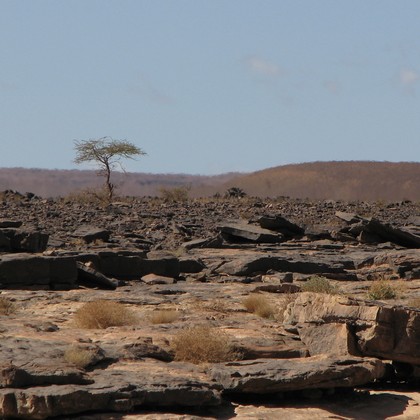
Bare desert rock: cliffs, wadi walls and rocky hills inland, bare islets in the Red Sea and the Gulf, and steep coastal rocks. Lays without a nest in a shaded niche or under an overhang, on islands also under stones or in bushes. Hunts large insects and bats at dusk, and from August mainly migrant birds crossing the desert and the sea.
Where the bird is most at home, classified by the habitats of North Africa and the Middle East.
Range and movements
In Egypt on islands in the Red Sea, among others off Hurghada, and in the Eastern and Western Deserts; in the interior of Libya in rocky desert. A small population in Jordan, and in Israel almost gone as a breeder from the Arava and the Dead Sea area. In Arabia on the Red Sea islands of Saudi Arabia and Yemen, in the deserts of Saudi Arabia, and further on the islands and coastal cliffs of Oman (among others the Daymaniyat Islands and the coast near Muscat), the UAE, Qatar and Bahrain (Hawar Islands); Oman holds an important part of the world population. On passage elsewhere in the region too. Beyond the region on the islands of Eritrea and in Iran and Pakistan; winters in Madagascar and south-east Africa.
- Summer visitor (c. Apr–Sep)
- Passage (Mar–Apr, Oct–Nov)
- dark = core range, pale = thinly spread
How and when to look
In late summer (August–September) by boat around the islands off Muscat or the Daymaniyat Islands in Oman, or along the rocky Red Sea coasts of Egypt. Sit down towards sunset: that is when it hunts most actively, and its silhouette with long, narrow wings stands out sharply against the sky.
Conservation status
Vulnerable, with a world population estimated at 2,300–3,200 mature birds and a declining trend; an international single species action plan was adopted for it in 2024. Threats are disturbance and development of coasts and islands (tourism, housing, shrimp farms), loss of habitat for its prey, pesticides along the flyway, theft of eggs and young, and the low survival of young birds.
Scientific name
Falco concolor | Temminck, 1825
Temminck described the species in 1825 and placed it straight away in the genus where it still stands. The genus Falco was introduced in 1758 by Linnaeus. Falco is Late Latin for 'falcon', from falx, falcis 'sickle', after the sickle-shaped claws of the bird. concolor is Latin for 'of one colour', from con- 'alike' and color 'colour', after the uniformly slate-grey plumage. The specimen the first description was based on came from Barqan Island, Gulf of Aqaba.