All species › Passerines › Sunbirds › Socotra Sunbird
Socotra Sunbird | Chalcomitra balfouri
Socotrahoningzuiger | Suimanga de Socotora
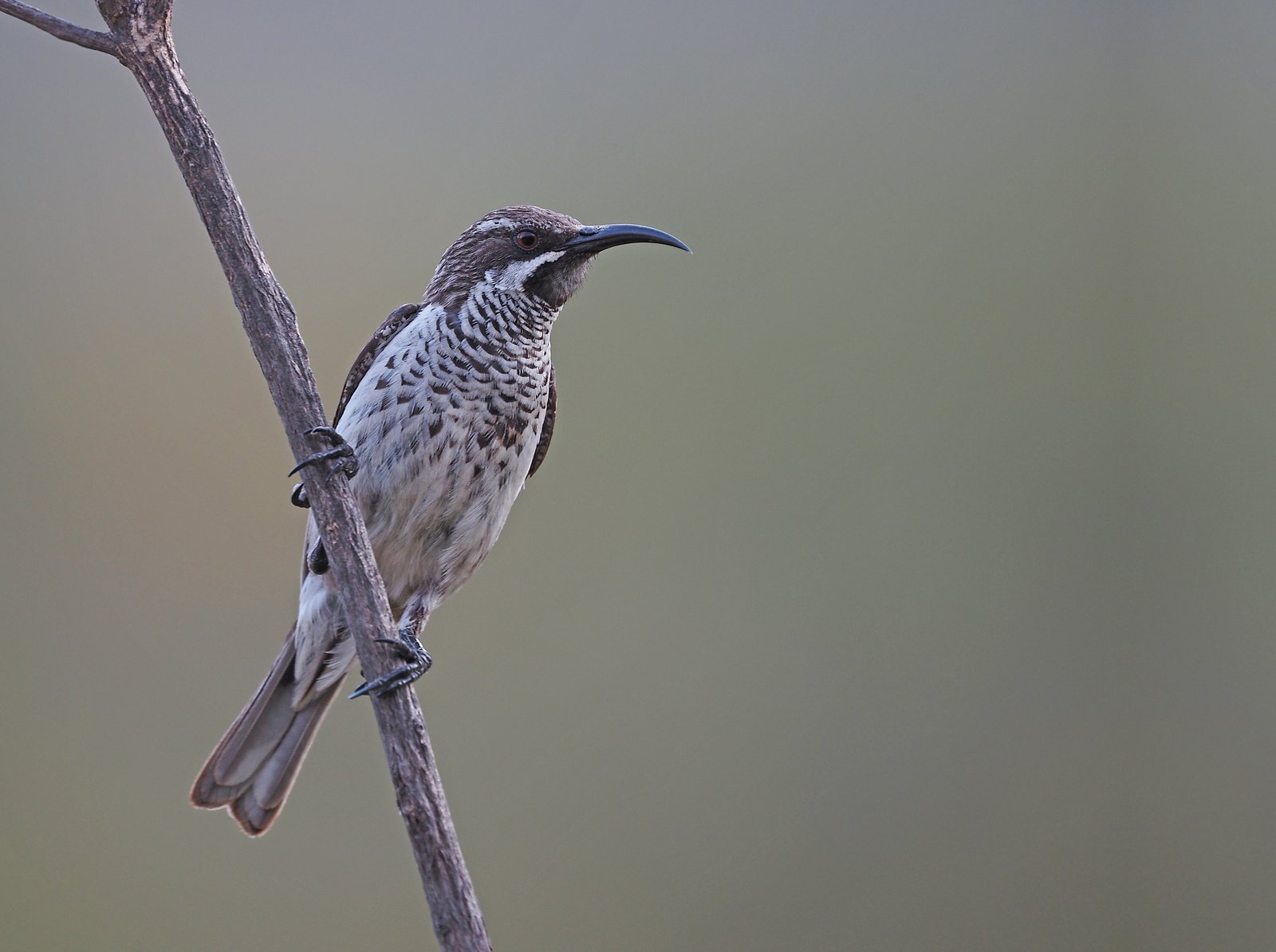
The Socotra Sunbird is one of Socotra's endemic birds and a strikingly plain sunbird: both sexes lack the metallic gloss of their relatives. On the island it is found everywhere, from the coast to the highest mountains.
Voice
A loud, sharp tchik or tchit, often in a dry series; the song is a fast, chattering and rather sharp series of high notes and short trills.
Recording: Mike Evans — CC BY-NC-SA 4.0 · shortened to the first 60 s, mono · xeno-canto
Identification
12–13 cm. A fairly large, sturdy sunbird with a long, strongly curved black bill. Both sexes are grey-brown above and dull white below, with fine dark scaling or spotting on throat and breast that fades towards the belly; a faint pale supercilium and dark lores. The tail is dark with pale tips to the outer feathers. The male has yellow pectoral tufts, visible mainly in display or when the wings are raised, and is somewhat more heavily marked on the throat. Juveniles are more uniformly brown and less marked.
Confusion species
No other sunbird occurs on Socotra, so confusion is hardly possible. Socotra White-eye (Zosterops socotranus) is smaller, greenish yellow, with a short straight bill and a white eye-ring. Palestine Sunbird (Cinnyris osea) and Arabian Sunbird (Cinnyris hellmayri) on the mainland have metallic males and females with unmarked underparts.
Habitat
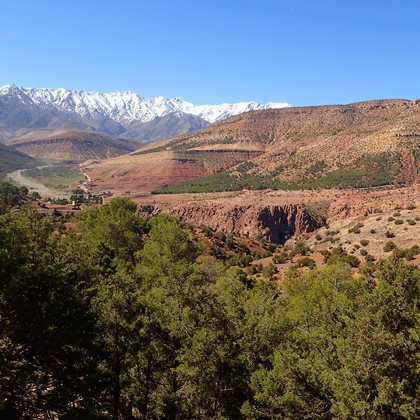
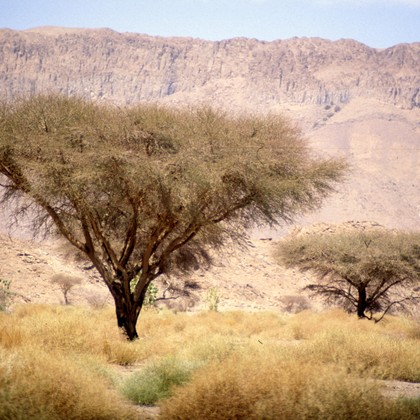
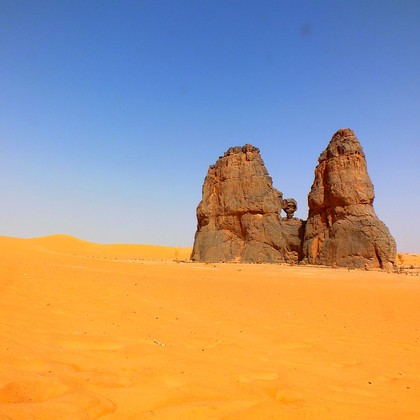
Nearly all vegetated habitats on Socotra: coastal plains with Croton scrub, dry lowland scrub with bottle trees (Adenium) and frankincense trees, the dragon's blood woodland (Dracaena cinnabari) on the limestone plateaus and the shrubland and grassland of the Haggeher mountains; also gardens and date-palm groves.
Where the bird is most at home, classified by the habitats of North Africa and the Middle East.
Range and movements
Endemic to Socotra (Yemen), where it occurs across the whole main island, from sea level to the summits of the Haggeher mountains (about 1500 m). Found nowhere else in the world.
- Winter visitor (c. Oct–Mar)
- Passage (Mar–Apr, Oct–Nov)
- dark = core range, pale = thinly spread
How and when to look
Almost any excursion on Socotra produces the species, for example in the dragon's blood woodland of the Diksam plateau or the scrub around Hadibu. Check flowering Aloe and bottle trees, where males chase each other noisily.
Conservation status
Not globally threatened (IUCN: Least Concern). Common on Socotra, but its small range makes it sensitive to habitat loss through overgrazing by goats, the decline of the dragon's blood woodland and cyclone damage.
Scientific name
Chalcomitra balfouri | (Sclater & Hartlaub, 1881)
Sclater & Hartlaub described the species in 1881 as Cinnyris balfouri; because it was later moved to another genus, the author and year stand in brackets. The genus Chalcomitra was introduced in 1854 by Reichenbach. Chalcomitra comes from the Greek khalkos, 'bronze, copper', and mitra, 'headband, diadem' — for the metallic sheen on the males' head and throat. balfouri honours the Scottish botanist Isaac Bayley Balfour (1853–1922), who explored Socotra in 1880. The specimen the first description was based on came from Socotra, Yemen.