All species › Birds of prey › Hawks, eagles and kites › Short-Toed Snake-Eagle
Short-Toed Snake-Eagle | Circaetus gallicus
Slangenarend | Culebrera europea
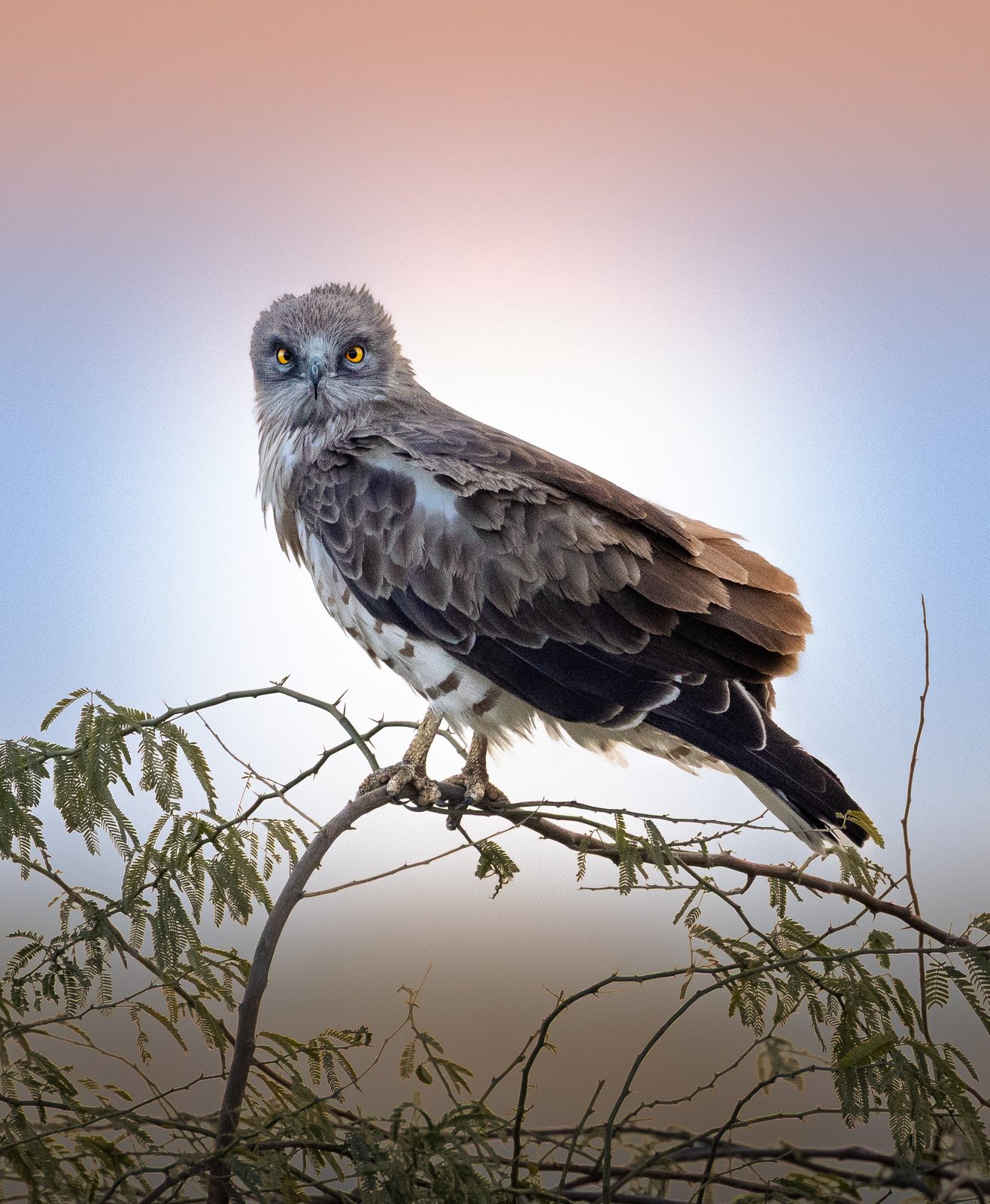
The Short-toed Snake-Eagle is a large, pale eagle with a rounded, owl-like head and large yellow eyes, which feeds almost entirely on snakes and lizards. It hunts by hovering with dangling legs above dry slopes. In the Maghreb and the Levant it is a fairly common breeder, and it passes in large numbers at the Strait of Gibraltar and Eilat.
Voice
Fairly vocal in the breeding season: a melodious, rather gull-like whistle, keeyo or oo-ee-oh, often in flight over the territory.
Recording: João Tomás — CC BY-NC-SA 4.0 · converted to mono · xeno-canto
Identification
62–69 cm, wingspan 170–185 cm. Upperparts grey-brown with paler coverts; underparts white with a variable amount of brown spotting and barring, often with a dark brown hood over the head and breast, but sometimes almost entirely white. The large round head with bright yellow eyes gives an owl-like impression. In flight long, broad wings with six fingers, held flat or slightly angled; the underwing is white with rows of fine dark spots, and the tail has three or four narrow dark bands. Very often hangs heavily hovering over one spot for a long time. Young birds are plainer and paler, with less marked underparts.
Confusion species
Osprey (Pandion haliaetus) also has white underparts, but narrower, angled wings, a black carpal patch and a dark eye-stripe. The pale morph of Booted Eagle (Hieraaetus pennatus) is much smaller and has uniformly black flight feathers. Pale buzzards such as Long-legged Buzzard (Buteo rufinus) and Common Buzzard (Buteo buteo) have dark carpal patches and a smaller head; European Honey-Buzzard (Pernis apivorus) has a small head and a tail with a broad dark terminal band.
Habitat
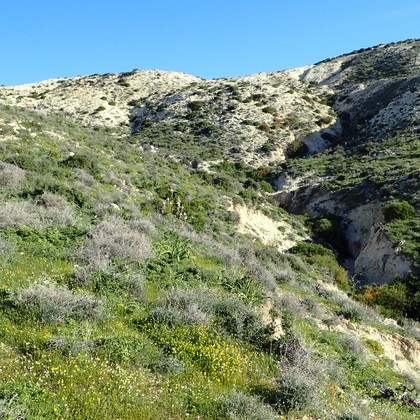
Dry, open, sunny terrain rich in reptiles: garrigue, maquis, open oak, pine and cedar woodland, steppe with scattered trees and rocky mountain slopes. The nest, a small stick platform, is placed at the top of a tree. On migration over all kinds of open country.
Where the bird is most at home, classified by the habitats of North Africa and the Middle East.


Range and movements
In Morocco a fairly common breeder in the Rif, the Middle and High Atlas and the forests of the north-west; in Algeria and Tunisia scattered in the north, in Libya in small numbers in the Jebel Akhdar. In Israel a fairly common breeder from the north to the Negev highlands, and also in Jordan, Lebanon, Syria and northern Iraq. Small numbers breed in the mountains of western Saudi Arabia and Yemen. At the Strait of Gibraltar thousands of birds pass to Africa in autumn; in Israel the species is a numerous migrant in both seasons, in spring especially at Eilat. Elsewhere in Arabia, Egypt and the Gulf states a scarce passage migrant. Beyond the region from Iberia and southern Europe to Central Asia and India; European and West Asian birds winter in the Sahel.
- Resident
- Summer visitor (c. Apr–Sep)
- Winter visitor (c. Oct–Mar)
- Passage (Mar–Apr, Oct–Nov)
- dark = core range, pale = thinly spread
How and when to look
Visit Jbel Moussa or Cap Spartel in September and October, or the mountains near Eilat in March, where they pass in a broad stream. In the breeding season look for them on sunny mornings in the Middle Atlas and Galilee over slopes, hovering like a giant kestrel.
Conservation status
Not globally threatened. Locally vulnerable through the loss of extensively grazed, reptile-rich terrain, electrocution on power poles and shooting on migration.
Scientific name
Circaetus gallicus | (Gmelin, 1788)
Gmelin described the species in 1788 as Falco gallicus; because it was later moved to another genus, the author and year stand in brackets. The genus Circaetus was introduced in 1816 by Vieillot. Circaetus is Greek, from kirkos, a kind of hawk, and aetos 'eagle'. gallicus is Latin for 'of Gaul', that is, 'from France'. The specimen the first description was based on came from France.