All species › Cuckoos › Cuckoos › Senegal Coucal
Senegal Coucal | Centropus senegalensis
Senegalese spoorkoekoek | Cucal senegalés
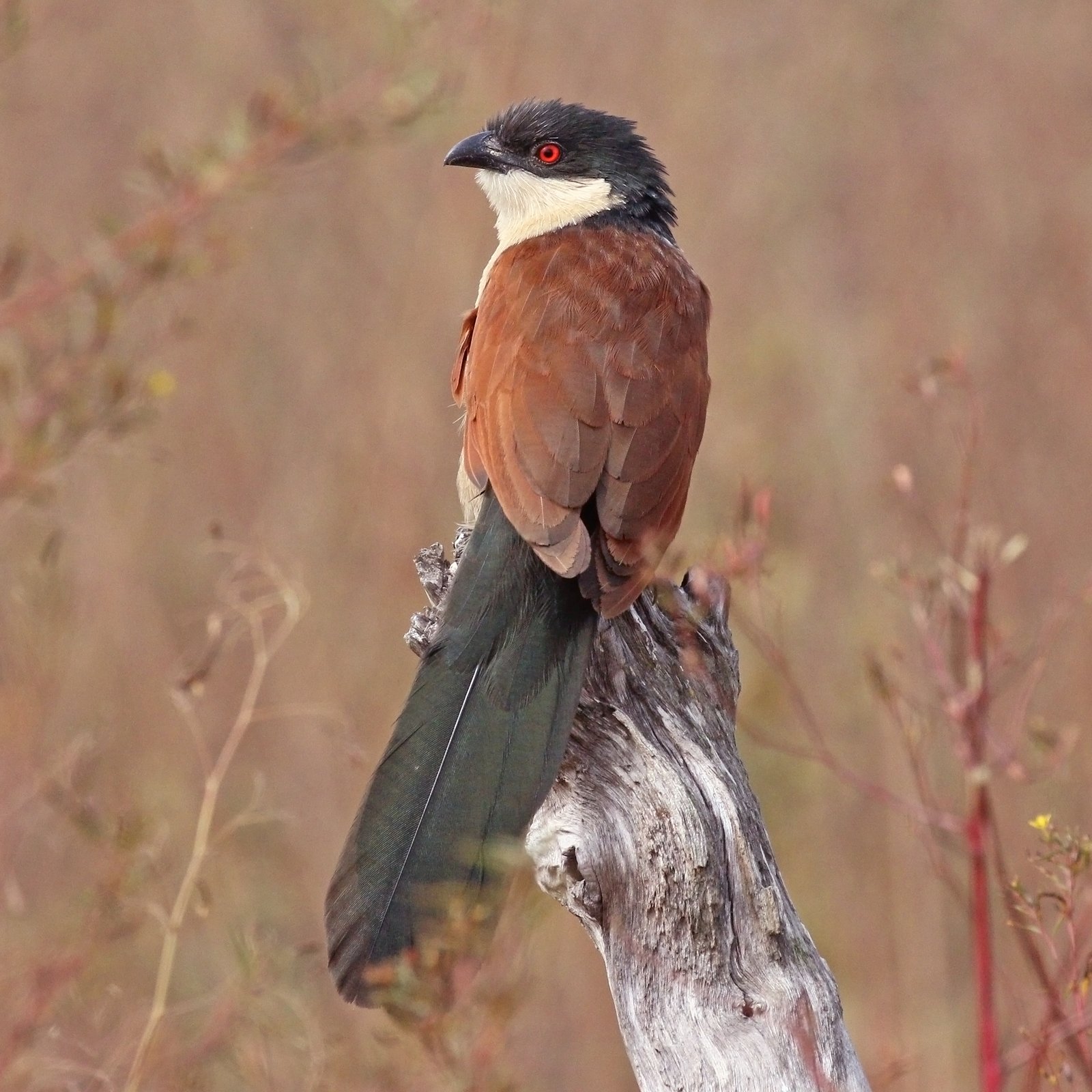
A large, heavy cuckoo with chestnut wings and a long black tail, which in the region lives only in the Nile Delta and Nile Valley. There it is a familiar sight in reedbeds, gardens and orchards, half walking, half clambering through dense cover. Unlike most cuckoos it raises its own young and is not a brood parasite.
Voice
A bubbling series of hollow notes, hoo-hoo-hoo-hoo-hoo, first falling and accelerating, then rising and slowing again, like water poured from a bottle. Often in duet, especially early in the morning, in the evening and in the hottest months. When alarmed a harsh chak or a hissing sound.
Recording: Julien Birard — CC BY-NC-SA 4.0 · shortened to the first 60 s, mono · xeno-canto
Identification
Crown, hindneck and sides of the head glossy black, without a supercilium. Mantle rufous-brown, wings bright chestnut with dark tips. Underparts white to cream. Rump and uppertail coverts blackish and unbarred; the long, broad tail is black with a green gloss. Heavy black bill, red eye, grey legs with a long, straight hind claw. Juveniles have finely barred upperparts, a pale supercilium and a dark eye. Flight is heavy and short, fast wingbeats alternating with glides, before it drops quickly back into cover.
Confusion species
In the region it overlaps with no other coucal: White-browed Coucal (Centropus superciliosus) occurs only in south-west Arabia and has a white supercilium, a finely white-streaked head and neck and a barred rump. A juvenile Senegal Coucal with a pale supercilium closely resembles that species, but the two do not meet in Egypt. With its chestnut wings and red eye it is otherwise unmistakable.
Habitat
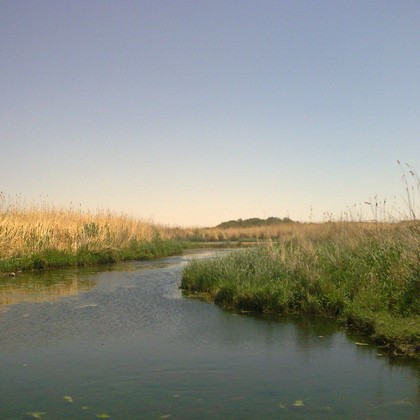
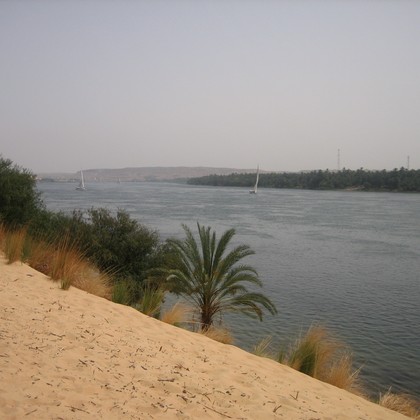
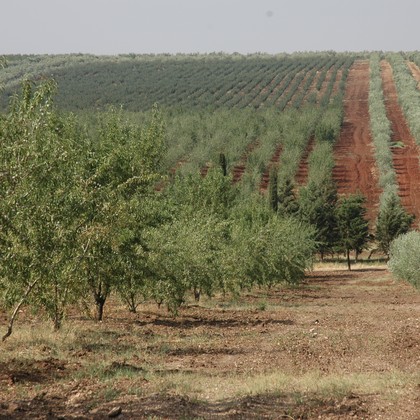
Dense, damp vegetation in the fertile Nile country: reedbeds along canals and irrigation ditches, rank growth on the banks of the Nile and the delta lakes, orchards, mango and citrus plantations, rice fields with bushes, and gardens in villages and on town edges. It takes large insects, lizards, frogs, snails and the eggs or young of other birds, mainly on the ground and in low bushes.
Where the bird is most at home, classified by the habitats of North Africa and the Middle East.
Range and movements
In the region only in Egypt, resident throughout the Nile Delta and along the Nile upstream to Aswan and Lake Nasser; also in the Faiyum and the oases close to the Nile. In Cairo and Alexandria in parks and gardens. Beyond the region from Senegal and Gambia through the Sahel and East Africa to Angola and northern southern Africa; Egyptian birds belong to the subspecies aegyptius.
- Resident
- Summer visitor (c. Apr–Sep)
- Winter visitor (c. Oct–Mar)
- Passage (Mar–Apr, Oct–Nov)
- dark = core range, pale = thinly spread
How and when to look
Along canals and field edges in the delta, for example around Abbassa or at the botanical garden in Aswan, it is easiest to find early in the morning, when it suns itself on top of a bush or reed plume. Listen for the gurgling duet: afterwards it often stays visible for a while before slipping away.
Conservation status
Not globally threatened and still common in Egypt. Locally it suffers from the loss of rank vegetation and reedbeds through agricultural intensification and urban growth in the delta, but it adapts well to gardens and orchards.
Scientific name
Centropus senegalensis | (Linnaeus, 1766)
Linnaeus described the species in 1766 as Cuculus senegalensis; because it was later moved to another genus, the author and year stand in brackets. The genus Centropus was introduced in 1811 by Illiger. Centropus comes from the Greek kentron, 'spur, goad', and pous, 'foot' — for the long, straight hind claw, a feature of all coucals. senegalensis means 'from Senegal', where the first specimen came from. The specimen the first description was based on came from Senegal.