All species › Passerines › Chats and flycatchers › Rufous-Tailed Rock Thrush
Rufous-Tailed Rock Thrush | Monticola saxatilis
Rode rotslijster | Roquero rojo
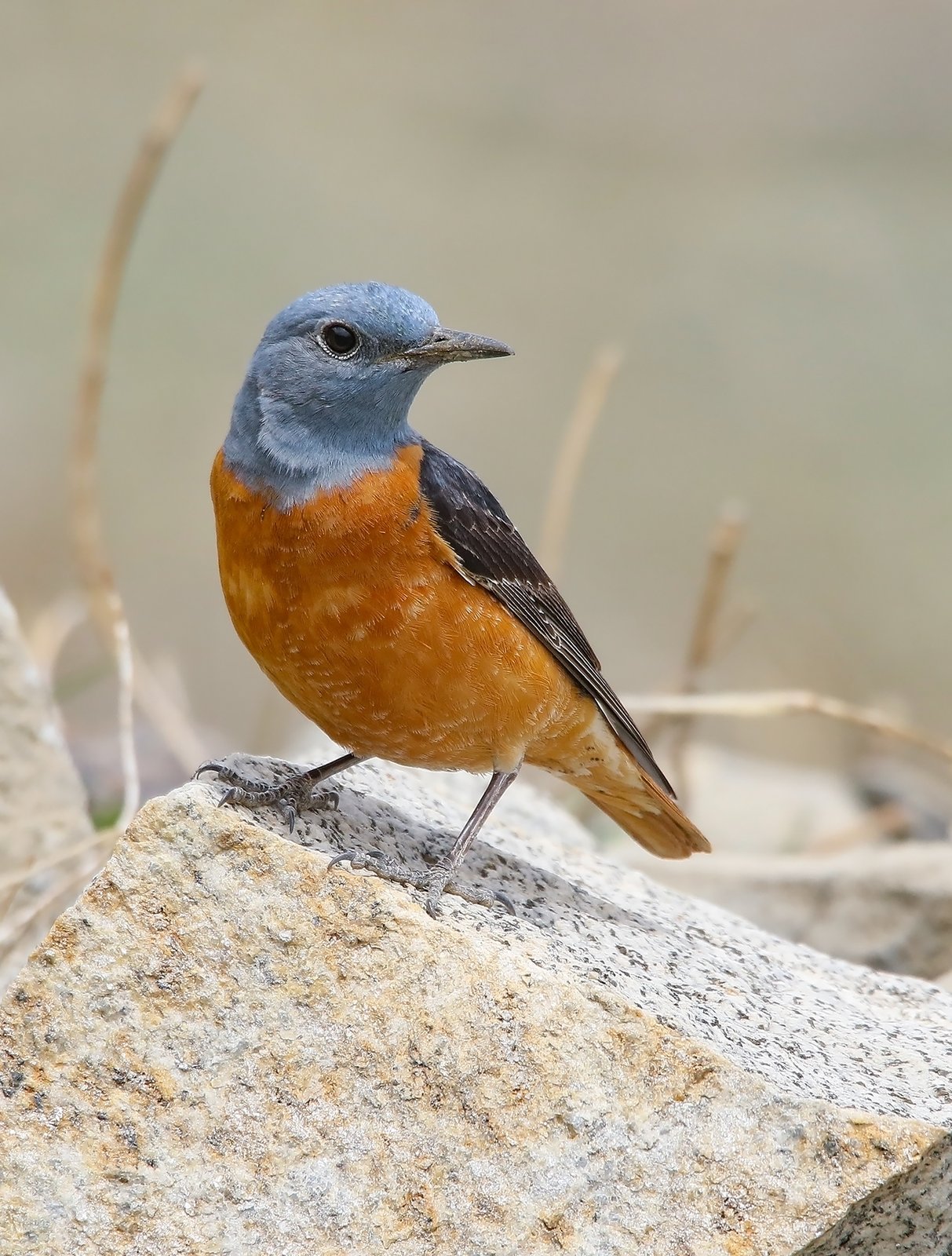
The Rufous-tailed Rock Thrush is a colourful breeding bird of the high, rocky slopes of the Atlas and the mountains of the Levant. On migration to and from sub-Saharan Africa it crosses the whole region, but is then much less conspicuous, being quiet and shy. The singing male often delivers his song in a short song flight.
Voice
The call is a soft chak and a whistled dyoo. The song is a clear, melodious and somewhat melancholy whistling with short, rippling phrases, often with mimicry, given from a rock or in a short, fluttering song flight.
Recording: Xavier Riera — CC BY-NC-SA 4.0 · converted to mono · xeno-canto
Identification
18–20 cm. A compact thrush with a fairly long bill, a short tail and long wings. The breeding male has a blue-grey head, throat and mantle, a white patch in the middle of the back, dark wings and orange-red breast and belly; the tail is orange-red with a brown central pair. The female is brown with fine pale spotting above and orange-buff, darkly scaled underparts, and has the same rufous tail. In autumn males resemble females owing to pale and dark feather fringes.
Confusion species
Female Blue Rock-Thrush (Monticola solitarius) is darker, longer-tailed and has a dark tail without red. Little Rock Thrush (Monticola rufocinereus) is smaller, lacks the white back patch and has a dark terminal band to the tail. Kurdish Wheatear (Oenanthe xanthoprymna) and Red-tailed Wheatear (Oenanthe chrysopygia) also have a red tail, but with a black terminal band, and are slimmer. Common Redstart (Phoenicurus phoenicurus) is much smaller and slimmer.
Habitat
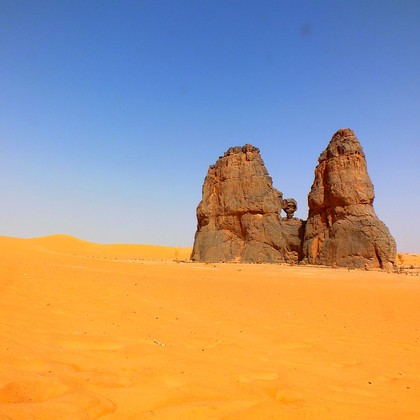
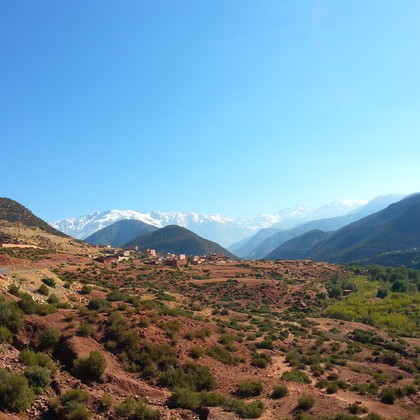
Breeds on open, rocky mountain slopes with grassland, scree and scattered bushes, often above the tree line, in the Atlas to over 3,000 m; also in ruins and quarries. On migration on rocky hills, in wadis and in open terrain with stones and low vegetation.
Where the bird is most at home, classified by the habitats of North Africa and the Middle East.
Range and movements
Breeds in Morocco in the High and Middle Atlas and the Rif, in the mountains of northern Algeria (including the Djurdjura and the Aurès) and very locally in western Tunisia. In the east in the mountains of Lebanon and Syria, on Mount Hermon and in the mountains of Kurdistan in northern Iraq. On passage scattered throughout the Maghreb, Libya and Egypt, the Levant and Iraq and across the Arabian Peninsula, more conspicuous in spring than in autumn. A small number winter in southern Arabia and Oman; most winter in the savannas of sub-Saharan Africa. Beyond the region the species breeds from southern Europe via Turkey and the Caucasus to Central Asia and northern China.
- Summer visitor (c. Apr–Sep)
- Winter visitor (c. Oct–Mar)
- Passage (Mar–Apr, Oct–Nov)
- dark = core range, pale = thinly spread
How and when to look
In May and June at Oukaimeden and on the Tizi-n-Tichka in the High Atlas; in Israel on the slopes of Mount Hermon. Migrants can be seen in April at Eilat and in the wadis of Sinai.
Conservation status
Not globally threatened. In Europe the population has declined in recent decades, partly through the loss of extensive grazing of mountain grasslands; little is known about the trend in the Atlas and the Levant.
Scientific name
Monticola saxatilis | (Linnaeus, 1766)
Linnaeus described the species in 1766 as [Turdus] saxatilis; because it was later moved to another genus, the author and year stand in brackets. The genus Monticola was introduced in 1822 by Boie. Monticola is Latin for 'mountain-dweller', from mons, montis 'mountain' and colere 'to dwell'. saxatilis is Latin for 'rock-frequenting', from saxum 'stone'. The specimen the first description was based on came from Switzerland.