All species › Parrots › Old World parakeets › Rose-Ringed Parakeet
Rose-Ringed Parakeet | Psittacula krameri
Halsbandparkiet | Cotorra de Kramer
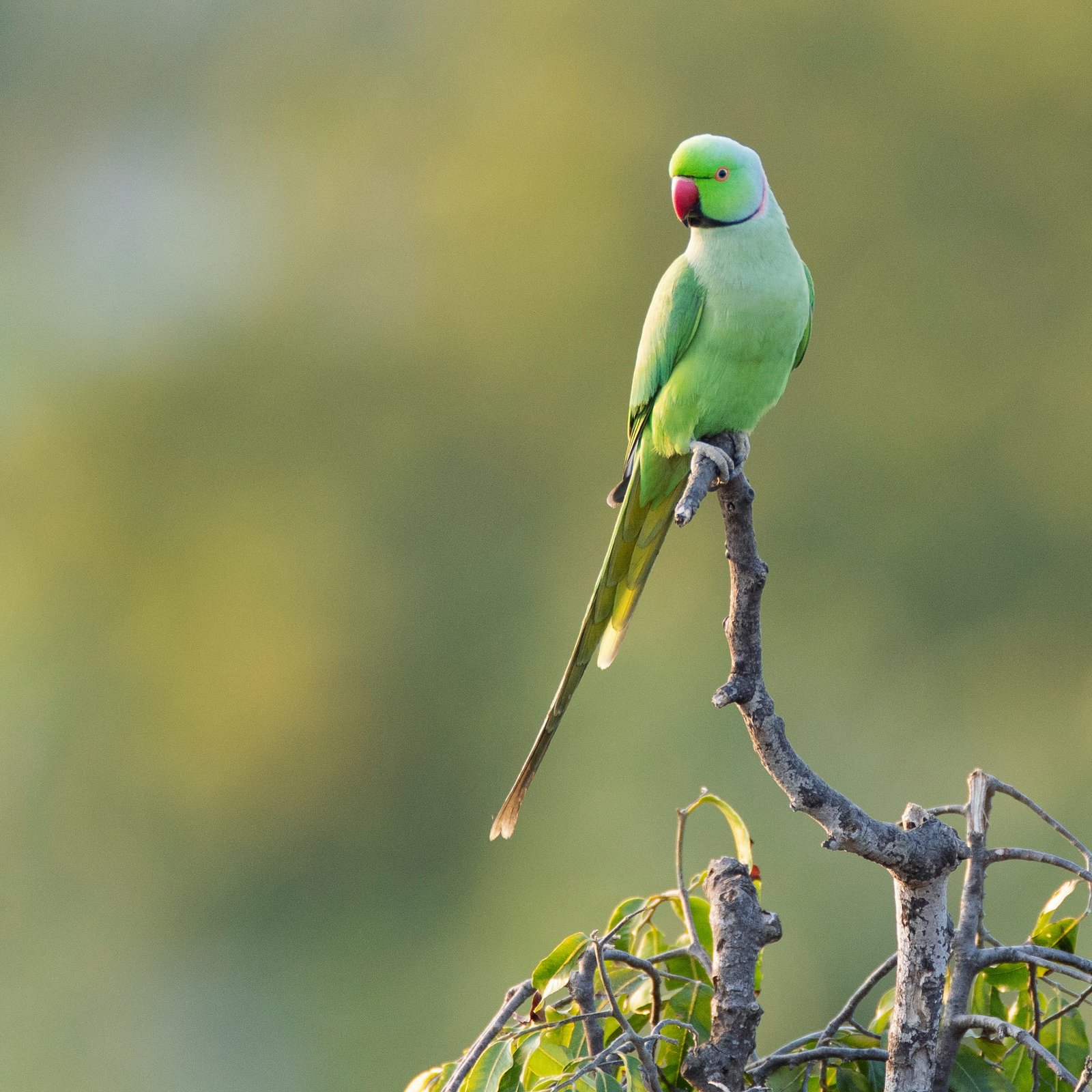
The Rose-ringed Parakeet is the commonest parakeet of the region: a shrilly screeching, grass-green arrow with a long tail, seen in almost every large town in Israel and the Gulf states. In this region it is an introduced species; the native range lies in the Sahel south of the Sahara and in South Asia.
Voice
A hard, shrill kee-ak or keee-yak, usually in short series and almost always in flight. At the roost a deafening chorus of hundreds of birds.
Recording: Sam Hambly — CC BY-NC-SA 4.0 · converted to mono · xeno-canto
Identification
39–43 cm, wingspan 42–48 cm, more than half of the length being tail. A slender, grass-green parakeet with a very long, pointed tail. Red upper mandible with a black lower mandible, yellow eye with a red ring, blue-green wash on the hindcrown. The adult male has a black chin and throat patch continuing into a thin black collar, edged pink behind; females and juveniles lack the collar and have a shorter tail. The flight is fast and dead straight, with short, shallow wingbeats.
Confusion species
Alexandrine Parakeet (Psittacula eupatria) is a third larger, with a much heavier, deep red bill and a maroon shoulder patch in all plumages; its call is lower and harsher and its wingbeats slower. Monk Parakeet (Myiopsitta monachus) is stocky and short-tailed, with a grey forehead and scaly grey breast, and builds a stick nest.
Habitat
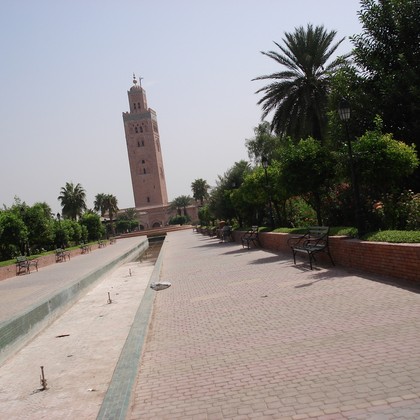
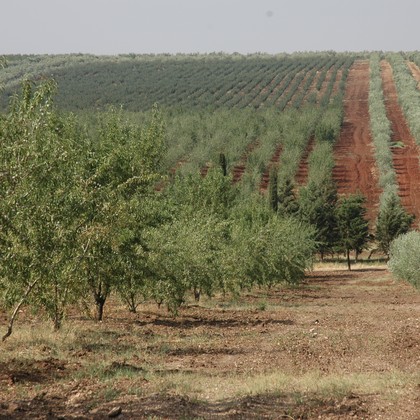
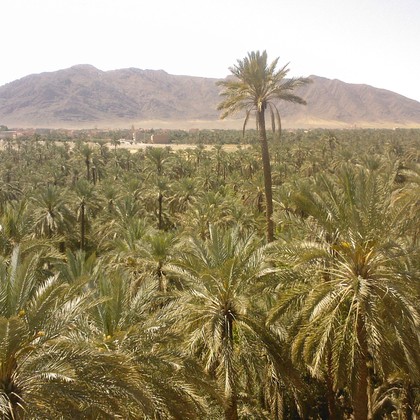
Towns and villages with trees: parks, avenues, gardens, cemeteries and university campuses, and also orchards, date-palm gardens, oases and irrigated farmland. Nests in tree holes, in palms and in holes in walls and buildings. Feeds on seeds, buds, blossom, fruit and dates, and locally causes heavy damage to fruit crops.
Where the bird is most at home, classified by the habitats of North Africa and the Middle East.
Range and movements
The native range runs through the Sahel from Senegal to Sudan and Ethiopia, and across Pakistan, India and Sri Lanka; the species is not native to this region. The population derives from escaped and released cage birds. Very common in Israel, especially on the coastal plain, in the north and in Jerusalem, and in Samaria and Judea; common in the UAE, Oman (Muscat and the Batinah), Qatar, Bahrain, Kuwait and eastern and central Saudi Arabia (Riyadh, Dhahran) and in Jeddah. In Egypt established in Cairo and Giza and scattered along the Nile valley; further in Jordan (Amman, Aqaba), Iraq (Baghdad, Basra) and Lebanon. In the Maghreb small urban populations in Rabat, Marrakech and Algiers; elsewhere only odd birds. Beyond the region also established in Europe, East Asia and North America.
- Resident
- Summer visitor (c. Apr–Sep)
- Winter visitor (c. Oct–Mar)
- Passage (Mar–Apr, Oct–Nov)
- dark = core range, pale = thinly spread
How and when to look
Almost any city park in Tel Aviv, Dubai, Abu Dhabi or Muscat. Visit a roost at sunset and watch the waves of parakeets arriving with loud screeches; Alexandrine Parakeets may be among them.
Conservation status
Not globally threatened; common in its native range and locally an agricultural pest. In this region a rapidly increasing introduced species. In Israel introduced parakeets cause considerable damage to fruit growing; there is also competition for nest holes with native hole-nesters such as hoopoes, woodpeckers and bats, although the effect on their populations is still uncertain.
Scientific name
Psittacula krameri | (Scopoli, 1769)
Scopoli described the species in 1769 and placed it straight away in the genus where it still stands. The genus Psittacula was introduced in 1800 by Cuvier, GLCFD. Psittacula is Latin, a diminutive of psittacus 'parrot', so 'little parrot'. krameri honours the physician and naturalist Wilhelm Heinrich Kramer (died 1765). The specimen the first description was based on came from Senegal.