All species › Parrots › Old World parakeets › Alexandrine Parakeet
Alexandrine Parakeet | Psittacula eupatria
Grote alexanderparkiet | Cotorra alejandrina
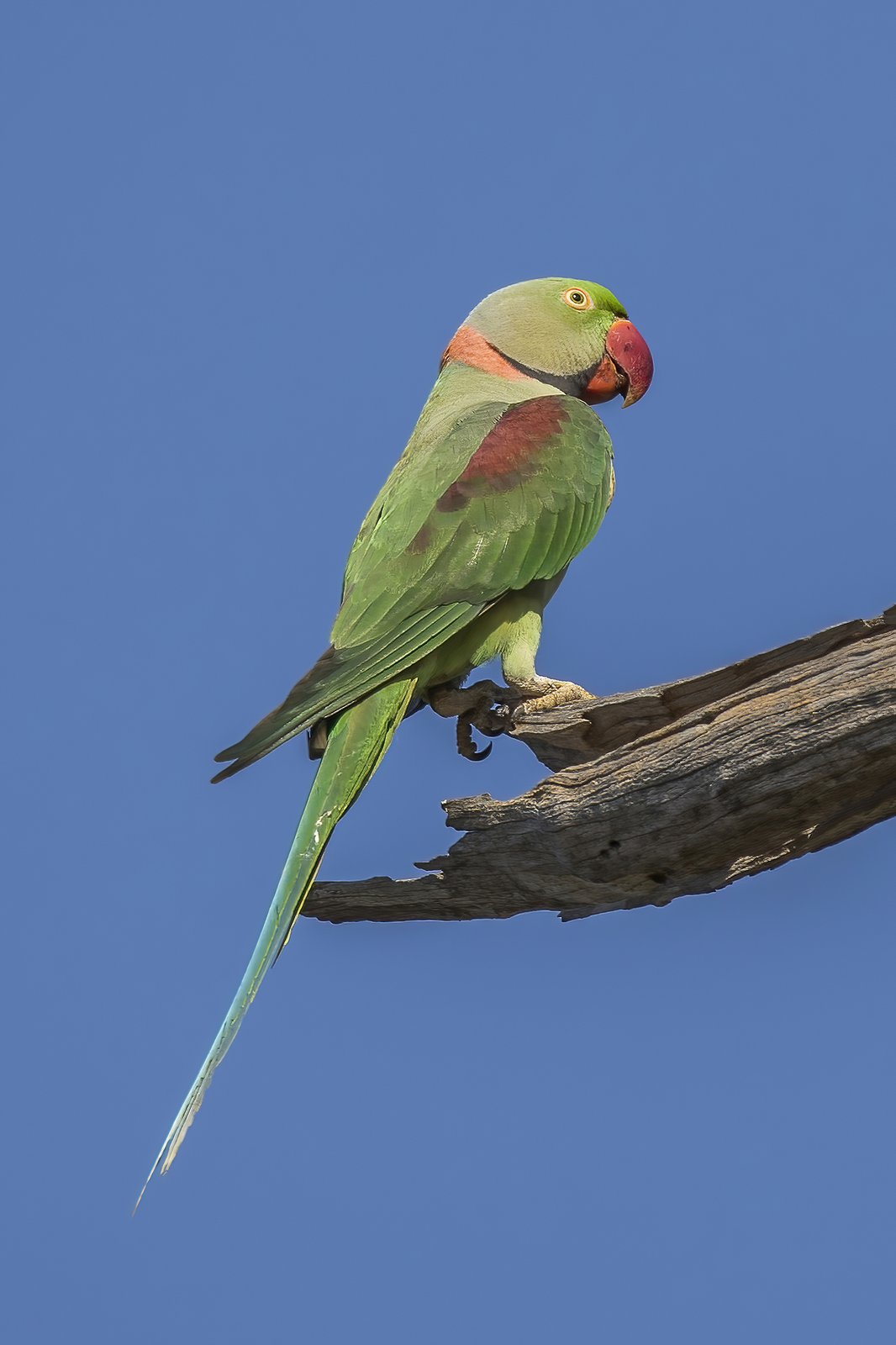
The Alexandrine Parakeet is the largest free-flying parakeet of the region: over half a metre long including the tail, with a heavy blood-red bill. The species comes from South Asia and has become established as an introduced species in the cities of the Gulf states, and more recently also in Cairo and Israel.
Voice
Deep, harsh and resonant: a loud kee-arr or keeyah and a rolling rwaaa, clearly lower and fuller than the screech of Rose-ringed Parakeet. Chattering of short, yapping notes at roost and nest.
Recording: David Darrell-Lambert — CC BY-NC-SA 4.0 · converted to mono · xeno-canto
Identification
56–62 cm, wingspan 69–77 cm, more than half of the length being tail. Grass-green, with a blue-grey wash on hindcrown and cheeks and a yellow-green belly. Two features are diagnostic: the massive, deep blood-red bill with a pale tip, and a maroon patch on the inner wing coverts, present in all plumages. The male has a black chin and cheek stripe merging into a pink band on the hindneck; females and juveniles lack this pattern. The long tail has yellow tips.
Confusion species
Rose-ringed Parakeet (Psittacula krameri) is a third smaller and more slender, with a finer bill, no shoulder patch, a higher, shriller call and faster wingbeats; the two often share roosts. Monk Parakeet (Myiopsitta monachus) is stocky and short-tailed, with a grey forehead and grey-scaled breast. Escapes of other Psittacula species occur regularly in the Gulf states.
Habitat
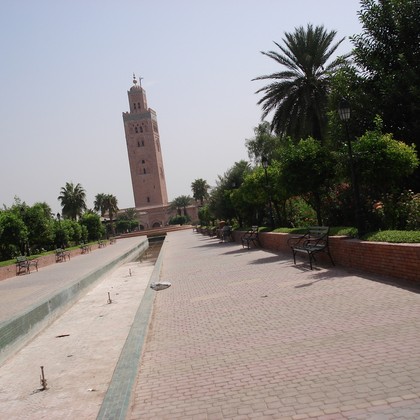
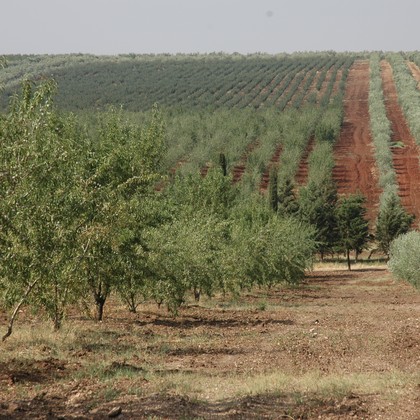
City parks, avenues, gardens and villa districts with old trees, date-palm gardens and orchards on the urban fringe. Nests in roomy tree holes, also in palms. Feeds on seeds, buds, blossom and fruit, and roosts in groups of tens to hundreds, often with Rose-Ringed Parakeets.
Where the bird is most at home, classified by the habitats of North Africa and the Middle East.
Range and movements
The native range is in South Asia and Indochina, from eastern Afghanistan and Pakistan through India and Sri Lanka to Indochina; the species is therefore not native to this region. The population derives from escaped cage birds. The stronghold is in the UAE (Dubai, Abu Dhabi, Al Ain); further established in Doha (Qatar), Muscat and the Batinah (Oman), Bahrain, Kuwait, eastern Saudi Arabia and Iraq. In Cairo and Giza (Egypt) and in northern and central Israel the species has increased strongly since the 2010s. Elsewhere, as in Morocco, only odd escaped birds. Beyond the region established in the Netherlands, Germany, Belgium, Turkey and Iran, among others.
- Resident
- Summer visitor (c. Apr–Sep)
- Winter visitor (c. Oct–Mar)
- Passage (Mar–Apr, Oct–Nov)
- dark = core range, pale = thinly spread
How and when to look
Go at sunset to a large city park in Dubai or Abu Dhabi, where parakeets gather for the night. In the flock of Rose-Ringed Parakeets look for larger birds with slower wingbeats and a longer tail, and check with binoculars for the red shoulder patch. The deep call is the easiest clue in a mixed flock.
Conservation status
Globally Near Threatened (IUCN) and declining in its native range through trapping for the cage-bird trade and loss of old forest. In this region an introduced species that is increasing quickly. Possible competition for tree holes with native hole-nesters and damage to fruit and dates have hardly been studied.
Scientific name
Psittacula eupatria | (Linnaeus, 1766)
Linnaeus described the species in 1766 and placed it straight away in the genus where it still stands. The genus Psittacula was introduced in 1800 by Cuvier, GLCFD. Psittacula is Latin, a diminutive of psittacus 'parrot', so 'little parrot'. eupatria is Greek, from eu 'well, noble' and patria 'descent', compare eupatridēs 'of noble birth'. The specimen the first description was based on came from Gingee, India.