All species › Passerines › Buntings › Rock Bunting
Rock Bunting | Emberiza cia
Grijze gors | Escribano montesino
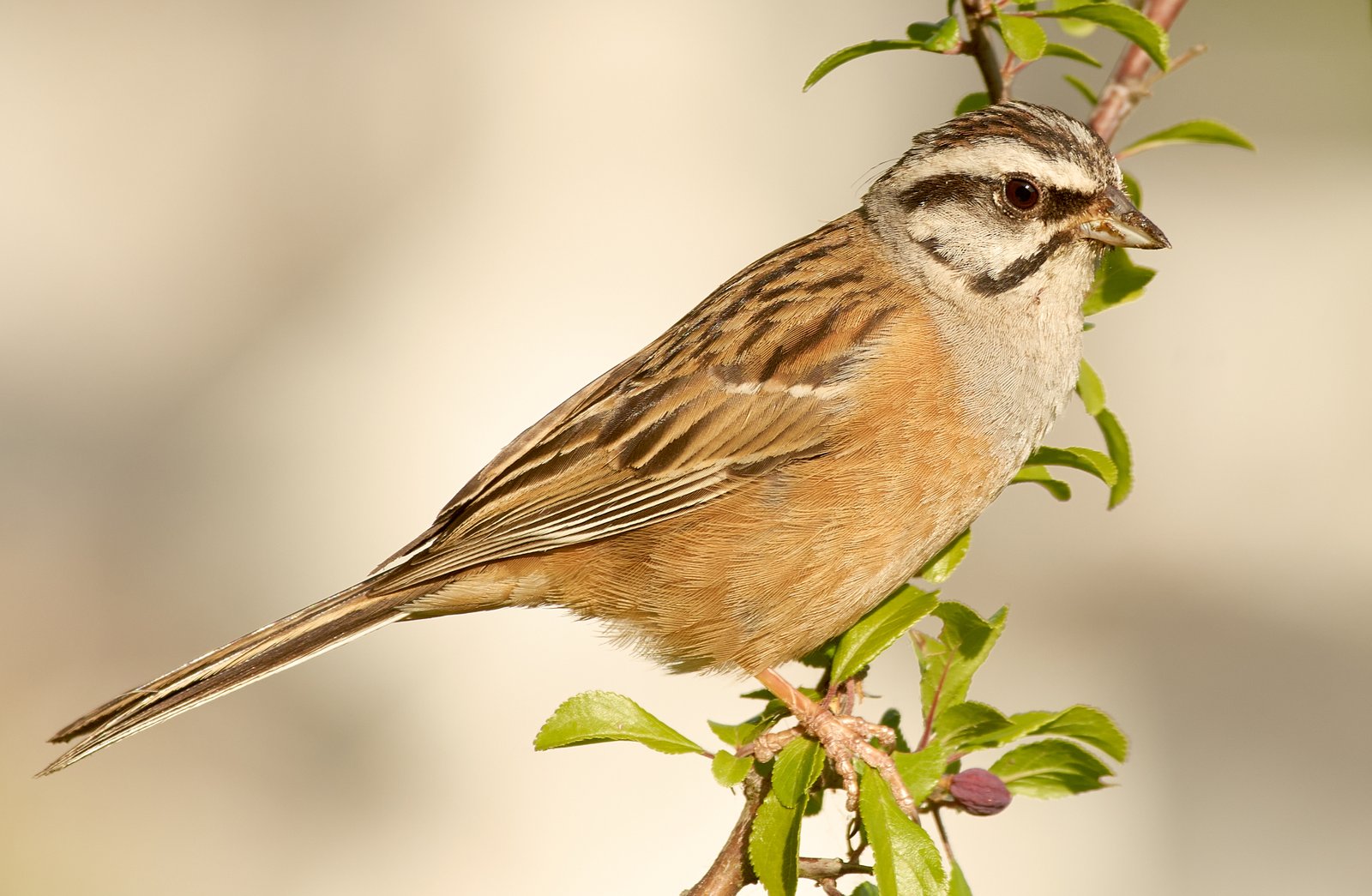
Rock Bunting is a slim, long-tailed bunting of sunny, rocky mountain slopes, with a blue-grey head full of sharp black stripes and an unstreaked orange-brown belly. In the region it breeds in the Atlas and the mountains of the Maghreb and in the uplands of the Levant and northern Iraq; in winter it moves down to valleys and lower slopes.
Voice
The song is a high, thin, rapid series of sibilant notes and ticks, faster and more irregular than Yellowhammer's: tsi-tsi-tsirri-tsi-tsu. It sings from March into July from a rocky point, a wall or the top of a low bush. The call is a thin, sharp tsii and a short tsip.
Recording: Bo Shunqi 薄顺奇 — CC BY-NC-SA 4.0 · shortened to the first 60 s, mono · xeno-canto
Identification
15–16.5 cm. Slim and long-tailed, with white outer tail feathers and a grey bill. The male has a pale blue-grey head with three sharp black bands: along the side of the crown, through the eye and along the lower edge of the cheek. Throat and upper breast are grey, the rest of the underparts unstreaked orange-brown. The back is rufous with black streaks, the rump warm cinnamon. The female is duller, with less sharp head stripes and fine streaks on crown and breast; juveniles are brown and streaked but already show the cinnamon rump and underparts.
Confusion species
No other bunting in the region combines a grey head with bold black stripes and an unstreaked orange-brown belly. House Bunting (Emberiza sahari), often on the same rocks in Morocco and Algeria, is smaller and shorter-tailed, with a finely streaked grey head and throat and no white in the tail. Striolated Bunting (Emberiza striolata) in the Levant is also smaller, with fine black streaks on a grey head and throat. Cirl Bunting (Emberiza cirlus) has a black throat, yellow on the face and an olive-grey rump; Ortolan Bunting (Emberiza hortulana) and Cretzschmar's Bunting (Emberiza caesia) have a plain head with a pale eye-ring and a pink bill.
Habitat
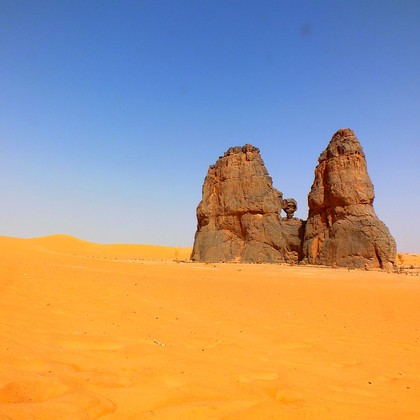
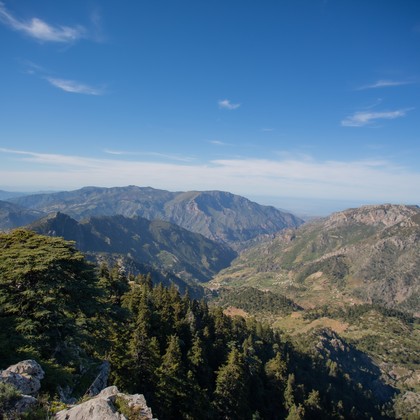
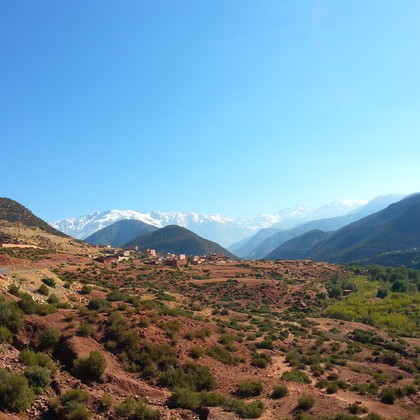
Dry, sunny, rocky mountain slopes with scattered bushes and trees: open oak, cedar and juniper woodland, maquis, terraces and vineyards, above the tree line in the High Atlas, mostly between 800 and 2,500 m. In winter on lower stony slopes, in valleys and at field edges.
Where the bird is most at home, classified by the habitats of North Africa and the Middle East.
Range and movements
Year-round in the Rif, Middle and High Atlas and Anti-Atlas of Morocco, in northern Algeria and in north-western Tunisia. In the east it breeds in Lebanon, on Mount Hermon and the Golan, in the mountains of western and northern Syria and in the uplands of northern Iraq. In winter small numbers wander to northern Israel, Samaria, Jordan and the lower parts of Syria and Iraq. Beyond the region it breeds from Iberia and southern Europe through Turkey and the Caucasus to Central Asia and the Himalayas.
- Resident
- Summer visitor (c. Apr–Sep)
- Winter visitor (c. Oct–Mar)
- Passage (Mar–Apr, Oct–Nov)
- dark = core range, pale = thinly spread
How and when to look
Look for it in the High Atlas, for example on the stony slopes above Imlil or along the road to Oukaïmeden, and on Mount Hermon: listen for the thin, rapid song, then scan the boulders and bush tops. In winter it often feeds unobtrusively on the ground among stones and low shrubs.
Conservation status
Not globally threatened (IUCN: Least Concern). Fairly common in the mountains of Morocco and Algeria; in the Levant scarcer and more local, but as far as known stable.
Scientific name
Emberiza cia | Linnaeus, 1766
Linnaeus described the species in 1766 and placed it straight away in the genus where it still stands. The genus Emberiza was introduced in 1758 by Linnaeus. Emberiza comes from Old German Embritz, a name for a bunting. cia comes from a local Italian name for the bird, related to zirlare, 'to chirp'. The specimen the first description was based on came from Lower Austria.