All species › Waders, gulls and terns › Plovers and lapwings › Red-Wattled Lapwing
Red-Wattled Lapwing | Vanellus indicus
Indische kievit | Avefría india
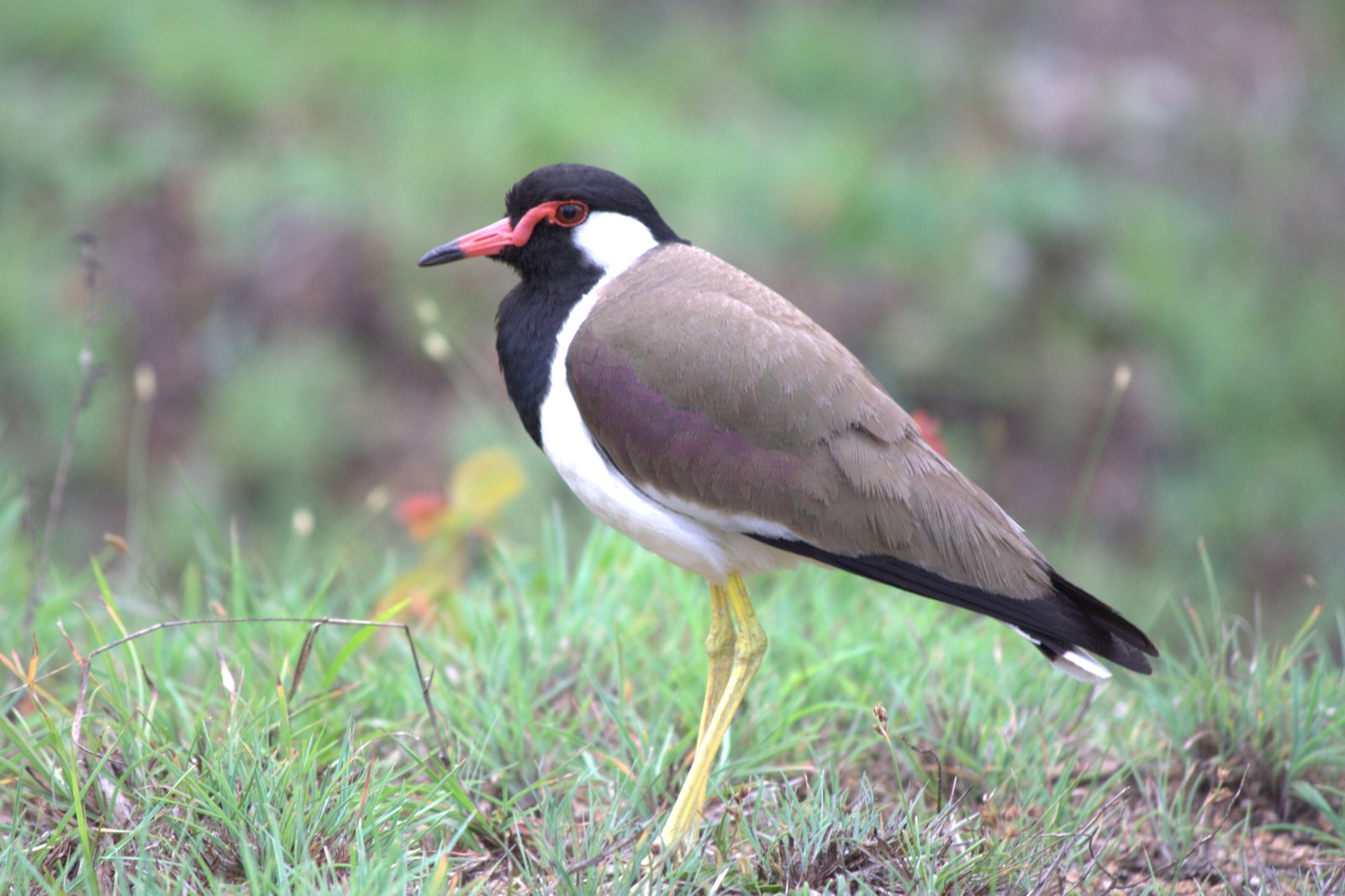
A large, long-legged lapwing with a black head, a red wattle in front of the eye and a voice heard day and night. In the region it lives in Mesopotamia and around the Persian Gulf, where it is steadily gaining ground thanks to irrigation, parks and golf courses.
Voice
Very noisy, also at night. A shrill, piercing did-he-do-it, often repeated, and a short cheek; near the nest a persistent, agitated calling.
Recording: Frantz Barrault — CC BY-NC-SA 4.0 · converted to mono · xeno-canto
Identification
Large and slender, with long bright yellow legs. Head, foreneck and breast are black, with a broad white band running from behind the eye down the side of the neck to the white belly. A fleshy red wattle sits in front of the eye; the bill is red with a black tip. The upperparts are olive-brown with a slight gloss; birds in Iraq and the Gulf (race aigneri) are paler brown than Indian birds. In flight a white wingbar across the greater coverts, black flight feathers and a white tail with a black subterminal band. Juveniles have a browner head with a white chin and smaller, duller wattles.
Confusion species
Spur-winged Lapwing (Vanellus spinosus) has black legs, white cheeks and a black breast and flanks, without wattles. White-tailed Lapwing (Vanellus leucurus) also has long yellow legs, but a plain grey-brown head without black and an all-white tail. Northern Lapwing (Vanellus vanellus) has a crest and short dark legs.
Habitat
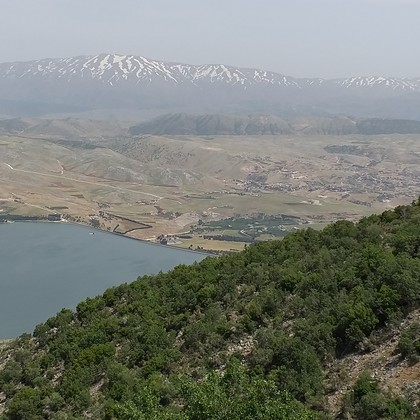
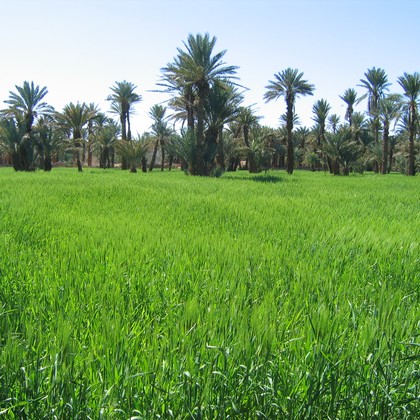
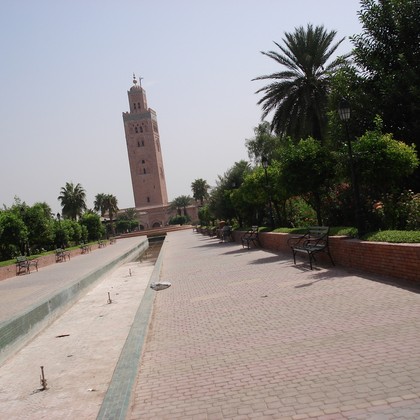
Always near water: banks of irrigation canals, ponds, wet fields, sewage pools and date palm gardens, and in the Gulf states also town parks, golf courses and sports fields. The nest is on bare ground or among stones, sometimes on a flat roof or a roundabout.
Where the bird is most at home, classified by the habitats of North Africa and the Middle East.
Range and movements
Resident in Iraq, along the Tigris and Euphrates and in the southern marshes, and in Kuwait (especially Jahra and the farms of Abdali and Wafra). In the Gulf states an established breeder in Bahrain, Qatar and the United Arab Emirates, and in northern Oman. In Saudi Arabia scarce but increasing in the Eastern Province, with records at Jubail, Dammam, Hofuf, Shaybah and Riyadh; the first confirmed breeding was near Jubail in June 2020. Rare in eastern Syria; elsewhere in the region a vagrant at most. Beyond the region from south-eastern Turkey and Iran through Afghanistan and the Indian subcontinent to South-East Asia.
- Resident
- Summer visitor (c. Apr–Sep)
- Winter visitor (c. Oct–Mar)
- Passage (Mar–Apr, Oct–Nov)
- dark = core range, pale = thinly spread
How and when to look
In the Emirates and Qatar parks, golf courses and irrigated lawns are the easiest places; go early in the morning, before the sprinklers and the public. In Kuwait the Jahra pools are good. You usually hear it before you see it.
Conservation status
Not globally threatened and increasing in the region. Irrigation, green town fringes and artificial wetlands have carried it within a few decades from Iraq and Kuwait to eastern Saudi Arabia and the Emirates; locally it suffers from disturbance and hunting.
Scientific name
Vanellus indicus | (Boddaert, 1783)
Boddaert described the species in 1783 as Tringa Indica; because it was later moved to another genus, the author and year stand in brackets. The genus Vanellus was introduced in 1760 by Brisson. Vanellus is Latin for 'little fan', the diminutive of vannus 'winnowing fan'. indicus is Latin for 'Indian', after the Indian part of its range. The specimen the first description was based on came from Goa, India.