All species › Passerines › Chats and flycatchers › Red-Tailed Wheatear
Red-Tailed Wheatear | Oenanthe chrysopygia
Roodstaarttapuit | Collalba afgana
Red-tailed Wheatear is a small, plain grey-brown wheatear with a rusty rump and tail base, breeding from the Caucasus and Iran to Afghanistan. In the region it is a winter visitor, most numerous in the hills and wadis of the Emirates and northern Oman; it closely resembles Kurdish Wheatear.
Voice
Almost silent in winter. The call is a short, hard chak and a thin, rising whistle; in territorial disputes a rapid rattle. In February and March it sometimes gives some soft song, a simple whistle with scratchy and clicking notes.
Recording: David Darrell-Lambert — CC BY-NC-SA 4.0 · converted to mono · xeno-canto
Identification
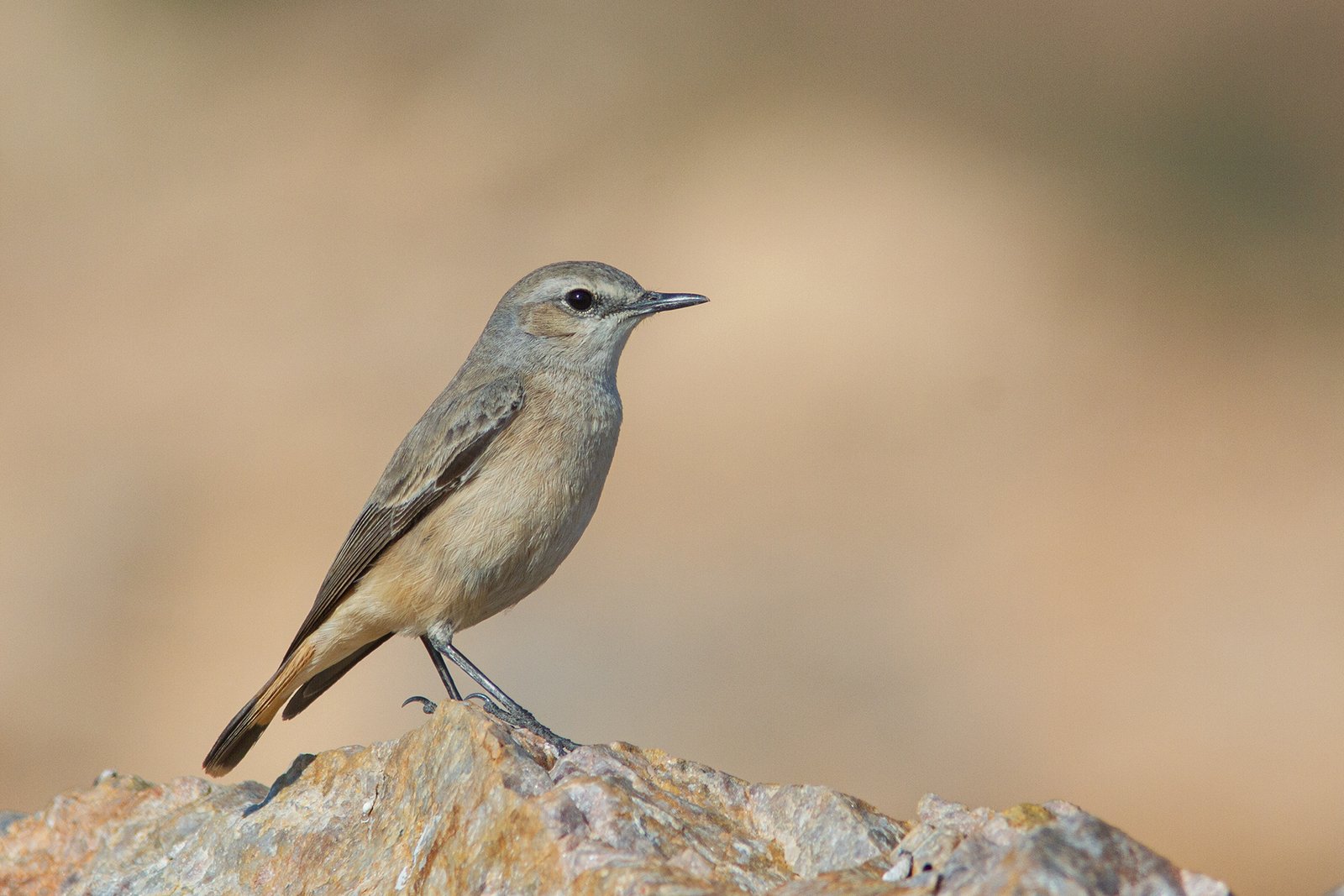
14.5–15 cm. Small, with a plain, unmarked face. Upperparts plain grey-brown, with a faint pale supercilium most obvious in front of the eye; the ear-coverts are often warm rusty. Underparts greyish-white with a buff wash across the breast and soft orange undertail-coverts, without a sharp border. Rump and tail base bright orange-rufous, with black central feathers and a broad black terminal band, an inverted T on a rusty background. Bill and legs black. The sexes are very similar; the male at most has dark lores, but never black in the throat.
Confusion species
Kurdish Wheatear (Oenanthe xanthoprymna) has the same tail pattern, but the male has a black throat and a white belly sharply set off against orange flanks; females and winter birds often cannot be safely separated. Red-rumped Wheatear (Oenanthe moesta) has an almost all-black tail. Black Redstart (Phoenicurus ochruros) and Common Redstart (Phoenicurus phoenicurus) have an all-rufous tail without a terminal band and constantly quiver it. Desert Wheatear (Oenanthe deserti) has a white rump and an all-black tail; Isabelline Wheatear (Oenanthe isabellina) a white rump.
Habitat
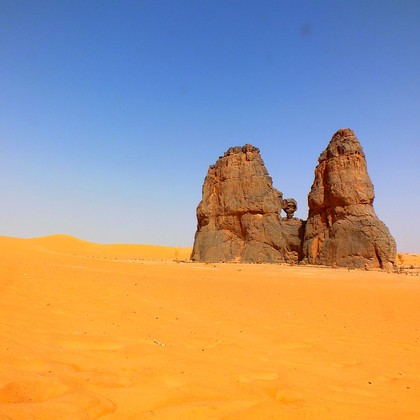
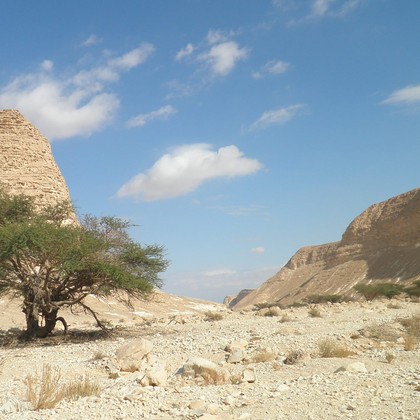
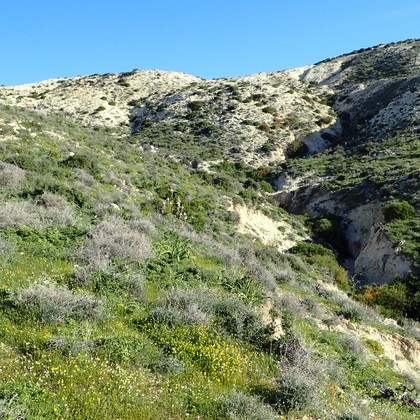
In winter on dry, stony hills and slopes with scattered shrubs, in rocky wadis, on gravel plains at the foot of mountains and in neglected fields and gardens at the desert edge. Holds its own winter territory and perches low, on stones and small shrubs.
Where the bird is most at home, classified by the habitats of North Africa and the Middle East.
Range and movements
A fairly common winter visitor to the United Arab Emirates and northern Oman, especially at the foot of the Hajar Mountains, and less numerous in Bahrain, Qatar, Kuwait, southern Iraq and eastern and central Saudi Arabia; scarce south to southern Arabia and Yemen. In the southern Levant a rare winter visitor to the Arava and the Negev in Israel and to southern Jordan; a vagrant in Egypt. Beyond the region it breeds from eastern Turkey and the southern Caucasus across Iran to Afghanistan and south-central Asia, and also winters in southern Iran, Pakistan and north-western India.
- Summer visitor (c. Apr–Sep)
- Winter visitor (c. Oct–Mar)
- Passage (Mar–Apr, Oct–Nov)
- dark = core range, pale = thinly spread
How and when to look
In the Emirates from November to March easily seen on the stony slopes and gravel plains at the foot of Jebel Hafeet near Al Ain and in the wadis of the Hajar Mountains. It likes to perch on a low shrub or stone and flicks its tail, flashing the rusty rump.
Conservation status
Not globally threatened. In the region only as a winter visitor; fairly common in the Emirates and Oman, scarce elsewhere. Because of its similarity to Kurdish Wheatear its western winter limit in the region is uncertain.
Scientific name
Oenanthe chrysopygia | (de Filippi, 1863)
De Filippi described the species in 1863 as Dromolaea chrysopygia; because it was later moved to another genus, the author and year stand in brackets. The genus Oenanthe was introduced in 1816 by Vieillot. Oenanthe was used by Aristotle for a bird that can no longer be identified; the word comes from the Greek oinos, oinoē 'wine, vine' and anthos 'flower, bloom'. chrysopygia is Greek, from khrusos 'gold' and pugē 'rump', after the orange-red rump and tail. The specimen the first description was based on came from Mount Damavand, Iran.