All species › Passerines › Chats and flycatchers › Buff-Breasted Wheatear
Buff-Breasted Wheatear | Oenanthe bottae
Bruinborsttapuit | Collalba de Botta
The Buff-breasted Wheatear is a bulky, long-legged brown wheatear with a warm orange-buff breast, found only in the highlands of south-western Saudi Arabia and Yemen. It is one of the typical birds of the Arabian highland plateaux, together with Arabian Wheatear and Yemen Thrush.

Voice
The song is a short, untidy phrase of scratchy and chirping notes with a few whistles and imitations, from a stone, a wall or in a short song flight. The call is a hard chak and a soft whistled hweet.
Recording: Gregory Askew — CC BY-NC-SA 4.0 · shortened to the first 60 s, mono · xeno-canto
Identification
15–16 cm. Large and upright, with a big head, long legs and a short tail. Upperparts grey-brown to warm sandy brown, unmarked; wings dark brown with pale fringes. A narrow white supercilium above a black lore. Throat white to creamy, breast and flanks warm orange-buff to rusty buff, belly and undertail coverts paler. Tail with a white base and a broad black terminal band, so it shows more black than white. Sexes alike; juveniles are lightly spotted.
Confusion species
Isabelline Wheatear (Oenanthe isabellina), which occurs in winter in the lower parts of Asir and Yemen, is paler and more uniformly sandy, with a white to pale buff breast and a pale wing with a dark alula. Female Northern Wheatears (Oenanthe oenanthe) are smaller, with a narrower terminal band and a less warm breast. Arabian Wheatear (Oenanthe lugentoides) is black and white.
Habitat
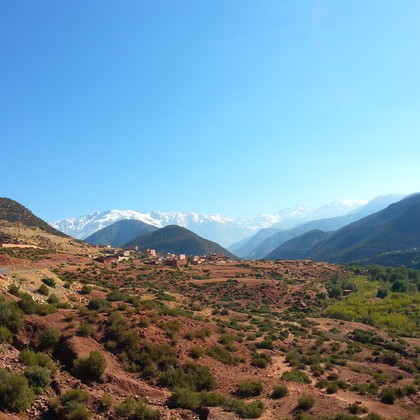
Open plateaux and rolling slopes with short grass, terraced fields, fallow land and stony pastures with scattered bushes, mostly above 1800–2000 m. Nests in rodent burrows or among the stones of terrace walls.
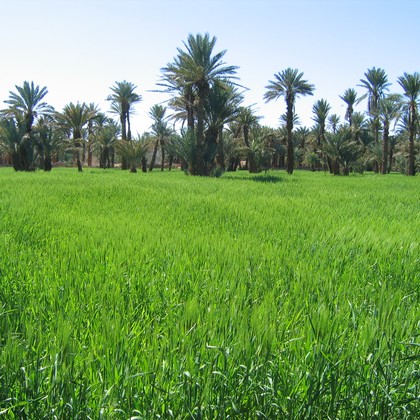
Where the bird is most at home, classified by the habitats of North Africa and the Middle East.
Range and movements
Endemic to south-western Arabia: in Saudi Arabia in the Hejaz highlands around Taif and in Asir to the Yemen border, in Yemen in the central and western highlands to around Sana'a and Taiz. Not elsewhere in the region. The African forms of Ethiopia and West Africa were formerly included in this species; they are now treated as separate species.
- Resident
- Summer visitor (c. Apr–Sep)
- Winter visitor (c. Oct–Mar)
- Passage (Mar–Apr, Oct–Nov)
- dark = core range, pale = thinly spread
How and when to look
On the plateau around Taif, Al Baha or Abha: in early spring singing on the walls along the terraced fields. Look in places with short grass and bare ground, not in the dense juniper woods.
Conservation status
Not globally threatened and locally common within its small range. Agricultural intensification on the plateaux and the abandonment of terraced fields may have local effects.
Scientific name
Oenanthe bottae | (Bonaparte, 1854)
Bonaparte described the species in 1854 as Campicola bottae; because it was later moved to another genus, the author and year stand in brackets. The genus Oenanthe was introduced in 1816 by Vieillot. Oenanthe was used by Aristotle for a bird that can no longer be identified; the word comes from the Greek oinos, oinoē 'wine, vine' and anthos 'flower, bloom'. bottae honours the French diplomat, naturalist and archaeologist Paul-Émile Botta (1802–1870). The specimen the first description was based on came from Yemen.