All species › Waders, gulls and terns › Sandpipers and snipes › Red Phalarope
Red Phalarope | Phalaropus fulicarius
Rosse franjepoot | Falaropo picogrueso
A small, seagoing wader that lives on the open ocean outside the breeding season, bobbing like a miniature gull. Large numbers migrate and winter in the cold, food-rich upwelling waters off north-west Africa; from the Moroccan coast it is seen mainly after westerly gales, while elsewhere in the region it is a rare vagrant.
Voice
A short, sharp pit or wit, often heard from passing small flocks.
Recording: Avery Bartels — CC BY-NC-SA 4.0 · converted to mono · xeno-canto
Identification
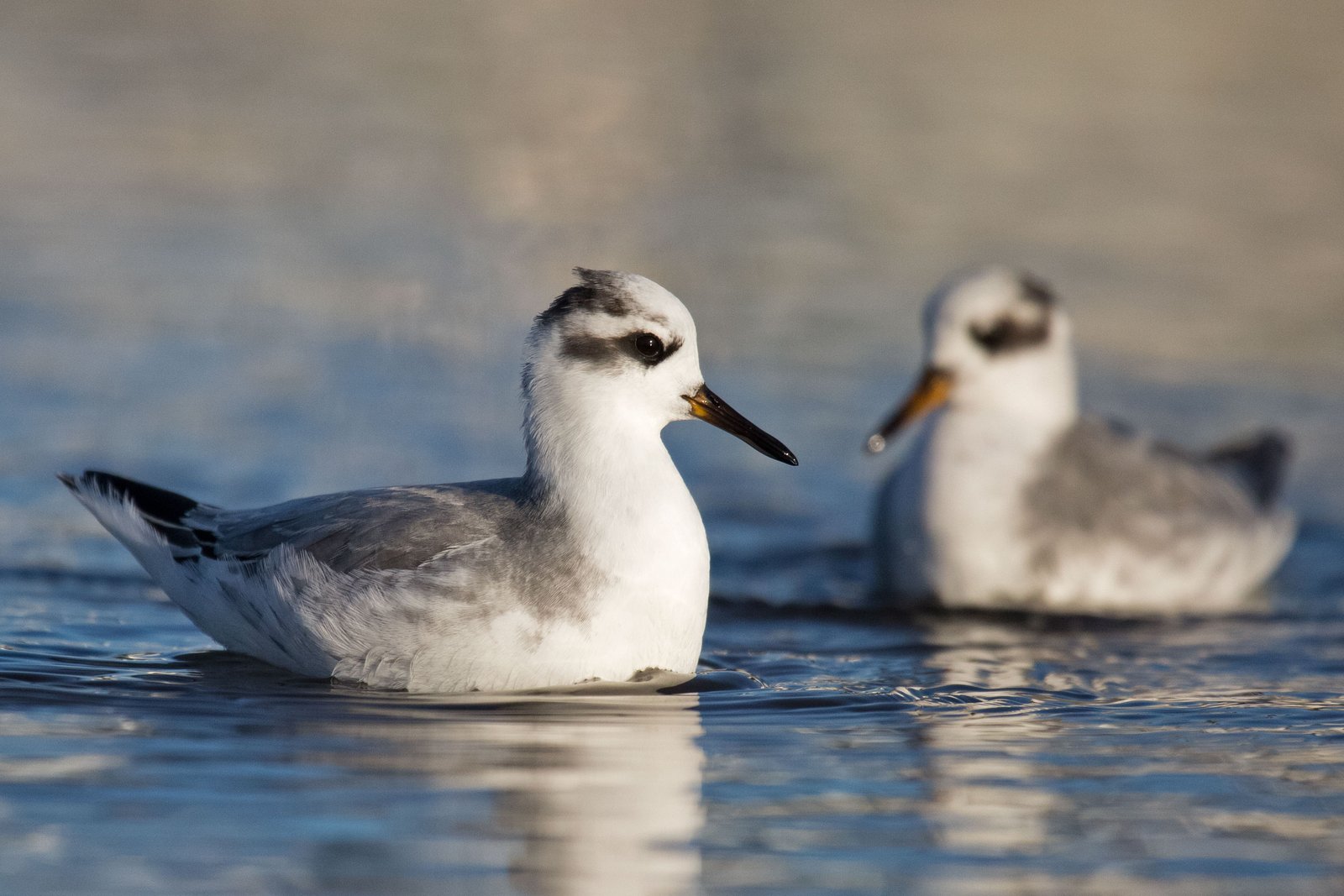
Stocky, with a thick neck, a fairly short bill broad at the base (yellow with a black tip in summer, largely black in winter) and lobed toes. In winter plumage plain pale grey above and white below, with a white head, a black patch behind the eye and a dark hindcrown. Breeding plumage, rarely seen in the region, is deep rusty-red below with a white face patch and a black-streaked back. Juveniles in autumn still have blackish, buff-edged feathers on the back. In flight a clear white wingbar.
Confusion species
Red-necked Phalarope (Phalaropus lobatus) is smaller and slighter, with a needle-fine bill and in winter plumage a darker, white-striped back. Wilson's Phalarope (Phalaropus tricolor) is slimmer and longer-legged, with no white wingbar. Sanderling (Calidris alba) resembles a winter Red Phalarope, but runs along the beach and does not swim.
Habitat
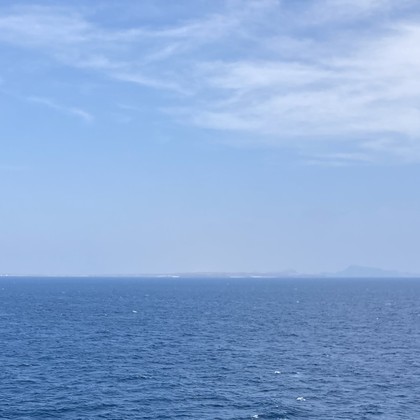
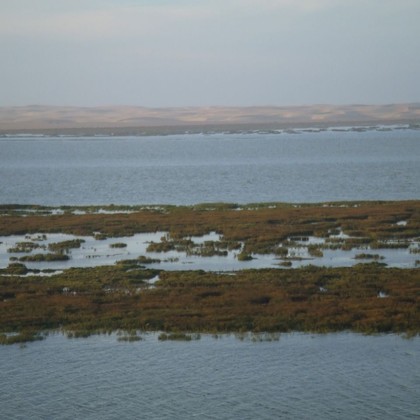
Outside the breeding season on the open sea, especially over cold upwelling water and along current fronts and weed drifts, where it picks plankton from the surface; after storms also close inshore, in harbours, lagoons and salt pans.
Where the bird is most at home, classified by the habitats of North Africa and the Middle East.
Range and movements
Off the Atlantic coast of Morocco and Western Sahara a regular, at sea sometimes numerous, passage migrant and winter visitor, mainly from October to March; from land seen mostly after westerly gales, for example at Essaouira, Agadir, Tarfaya and Dakhla, and then sometimes in harbours and lagoons. Rare in the Mediterranean, with scattered records along the coasts of Morocco, Algeria, Tunisia, Libya and Egypt. In the Middle East a rare vagrant: among others in Israel, and five records in Kuwait, all around Jahra Bay, plus a few in Saudi Arabia, the Emirates and Oman. Breeds on the high-Arctic tundra of Canada, Greenland, Svalbard and Siberia and winters mainly at sea off West and south-western Africa and off the west coast of South America.
- Winter visitor (c. Oct–Mar)
- Passage (Mar–Apr, Oct–Nov)
- dark = core range, pale = thinly spread
How and when to look
Seawatching from headlands such as Cap Ghir or from the pier at Essaouira after a strong westerly gale in autumn offers the best chance; a pelagic trip from Dakhla or Agadir sometimes produces small flocks riding the water like corks. Vagrants are often remarkably tame.
Conservation status
Not globally threatened. Its dependence on food-rich upwelling water makes it sensitive to changes in ocean currents and to oil pollution; on the breeding grounds Arctic warming plays a role.
Scientific name
Phalaropus fulicarius | (Linnaeus, 1758)
Linnaeus described the species in 1758 as Tringa fulicaria; because it was later moved to another genus, the author and year stand in brackets. The genus Phalaropus was introduced in 1760 by Brisson. Phalaropus comes through French phalarope from Greek phalaris 'coot' and pous 'foot': like coots, phalaropes have lobed toes. fulicarius derives from Latin fulica 'coot', for those same lobed toes. The specimen the first description was based on came from Hudson Bay.