All species › Cranes, rails and allies › Rails and crakes › Red-Knobbed Coot
Red-Knobbed Coot | Fulica cristata
Knobbelmeerkoet | Focha moruna
The African counterpart of Eurasian Coot, which within the region occurs almost exclusively in Morocco and the extreme north-east of Algeria. Morocco holds the most important population in the Mediterranean, spread over the merjas of the Atlantic coastal plain and the lakes of the Middle Atlas.
Voice
A deep, disyllabic klook-klook or hoo-hook, lower and rounder than Eurasian Coot, and a groaning krok. The sharp, high pix of Eurasian Coot is lacking.
Recording: African Bioacoustics Community — CC BY-NC-SA 4.0 · converted to mono · xeno-canto
Identification
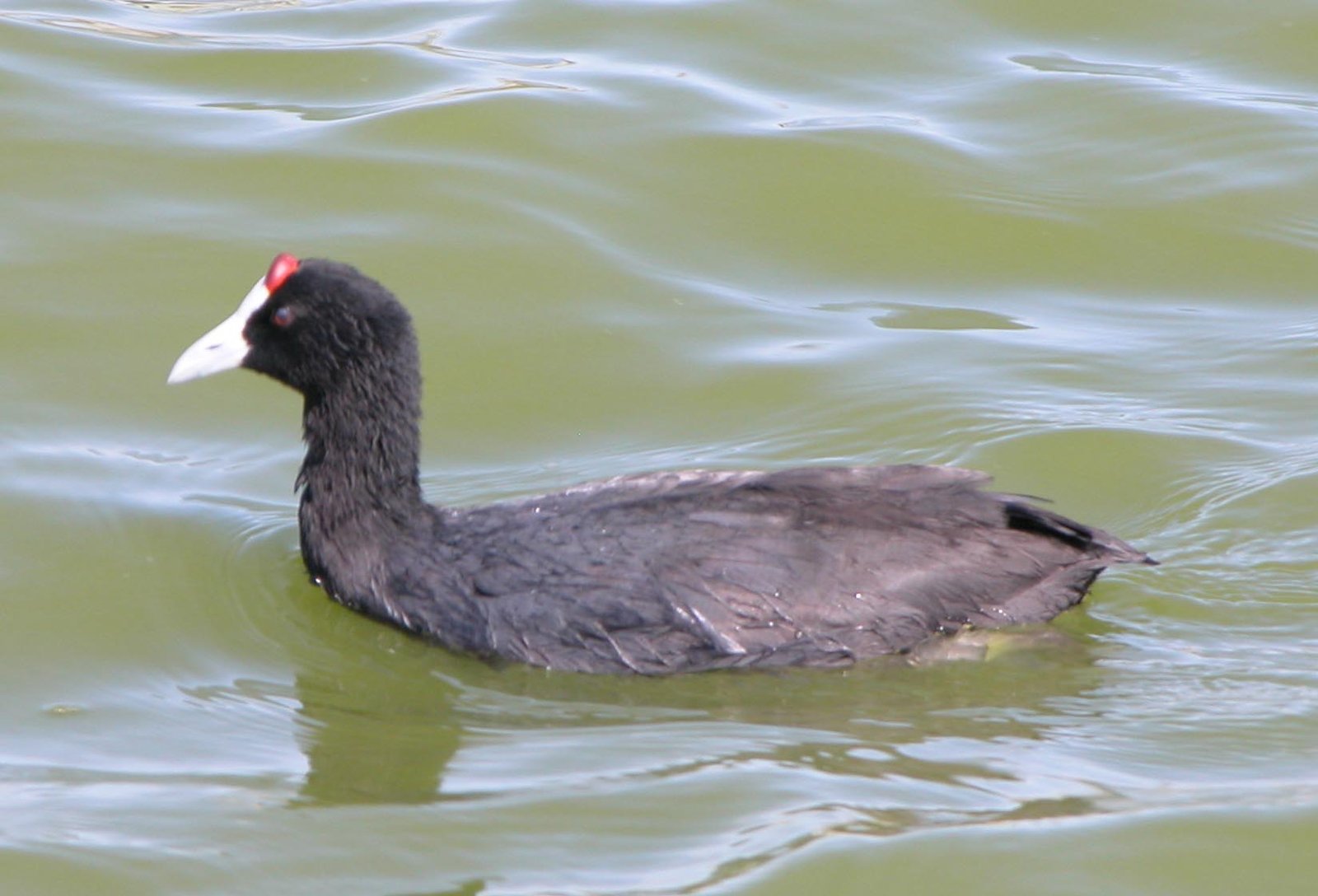
Very like Eurasian Coot, but slightly larger, with a longer neck and a straighter, more angular back. The white frontal shield ends rounded at the top and does not extend as a point into the crown feathers; above it two dark red knobs that swell in the breeding season and are small and hard to see at other times. The white shield and bill often show a bluish tinge. In flight no white trailing edge to the wing. Juveniles are greyish-brown like young Eurasian Coots.
Confusion species
Eurasian Coot (Fulica atra) is the only real pitfall: note the sharp point of the shield between bill and crown, the white trailing edge of the inner wing in flight and the absence of knobs. In juveniles separation is often impossible. Eurasian Moorhen (Gallinula chloropus) is smaller, with a red shield and a white flank line.
Habitat
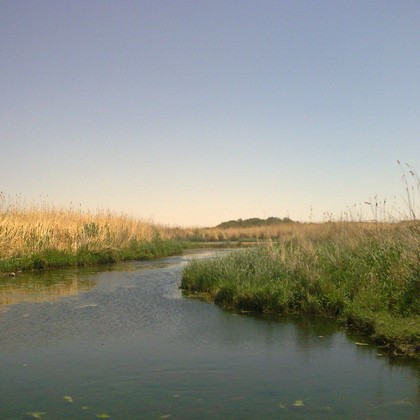
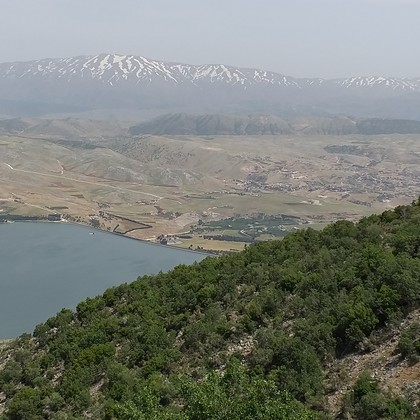
Shallow, nutrient-rich freshwater lakes and marshes with abundant submerged vegetation and a reed fringe, often temporary or fluctuating waters: the merjas of the Gharb, natural lakes in the Middle Atlas and shallow reservoirs. In dry years it moves to permanent waters.
Where the bird is most at home, classified by the habitats of North Africa and the Middle East.
Range and movements
Morocco: widespread but local, mainly on the merjas of the Atlantic coastal plain (Merja Zerga, Sidi Bou Ghaba, Bas-Loukkos, Merja Fouarate), on the lakes of the Middle Atlas (including Dayet Aoua and Aguelmam Afennourir) and on shallow reservoirs; south to Souss-Massa. Algeria: small numbers in the north-east, on the lakes around El Kala (Lac Tonga and Lac Oubeïra). Rare and irregular in Tunisia. Outside the region a small population in southern Spain, and widespread in eastern and southern Africa and on Madagascar.
- Resident
- Summer visitor (c. Apr–Sep)
- Winter visitor (c. Oct–Mar)
- Passage (Mar–Apr, Oct–Nov)
- dark = core range, pale = thinly spread
How and when to look
The Middle Atlas lakes near Ifrane and Merja Zerga are the best sites; in March and April the knobs are largest and the birds easiest to identify. Look in a flock of Eurasian Coots for birds with a rounded rather than pointed shield, and check the trailing edge of the wing when they take off. A telescope is essential.
Conservation status
Not globally threatened and common in sub-Saharan Africa. The North African population is small and fluctuates strongly with rainfall; it suffers from drought, the drying out and drainage of merjas, overgrazing of banks and disturbance. In Spain and Morocco the species is regarded as particularly vulnerable.
Scientific name
Fulica cristata | Gmelin, 1789
Gmelin described the species in 1789 and placed it straight away in the genus where it still stands. The genus Fulica was introduced in 1758 by Linnaeus. Fulica is the Latin word for a coot. cristata is Latin for 'crested', from crista 'crest', after the two red knobs above the frontal shield. The specimen the first description was based on came from Madagascar.