All species › Gannets and cormorants › Cormorants › Pygmy Cormorant
Pygmy Cormorant | Microcarbo pygmaeus
Dwergaalscholver | Cormorán pigmeo
The smallest cormorant of the region, a shy marsh bird of reedbeds and fishponds. In the region it breeds in the marshes of southern Iraq and is elsewhere mainly a winter visitor to the Levant, with the largest numbers in the Jordan and Hula valleys of Israel.
Voice
Almost silent away from the breeding colony. At the nest a low, grating krrah and cackling series like ka-ka-ka-ka; at roosts sometimes soft croaks.
Recording: Stanislas Wroza — CC BY-NC-SA 4.0 · converted to mono · xeno-canto
Identification
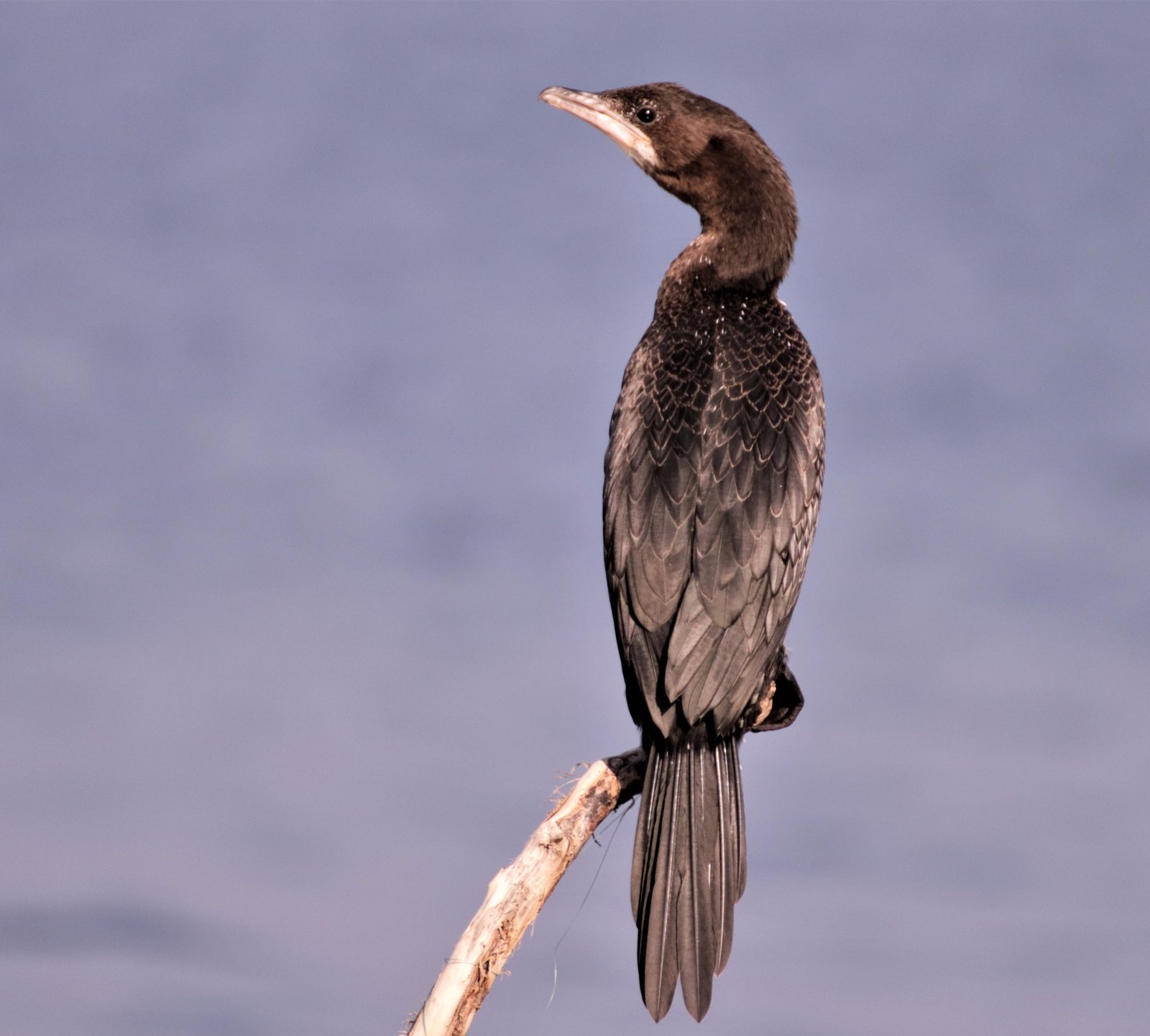
Small and compact, with a long tail often held cocked, a small round head with a steep forehead and a short, thin bill lacking the heavy jaw of Great Cormorant. In breeding plumage black with a green gloss, with a dark chestnut-brown head and fine white filoplumes on head and neck; the back and wing feathers are greyish with dark edges. Outside the breeding season the head is dull brown with a pale throat, and juveniles are brown with a paler breast and belly. The eye is dark. In flight it stands out by its small size, fast wingbeats and straight neck: short in front, long behind.
Confusion species
Great Cormorant (Phalacrocorax carbo) is almost twice as heavy, with a heavy bill, a short tail and a white chin patch; perched or flying the difference in silhouette is immediately clear. Reed Cormorant (Microcarbo africanus) is very similar, but in the region occurs only on Lake Nasser in southern Egypt; it has a red eye, a short frontal crest and more clearly scaly, silver-grey upperparts. At a distance a swimming bird can recall a diving duck until the long tail shows.
Habitat
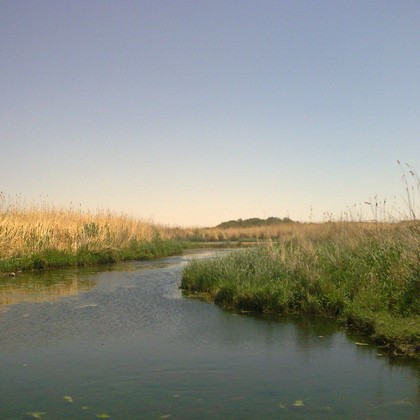
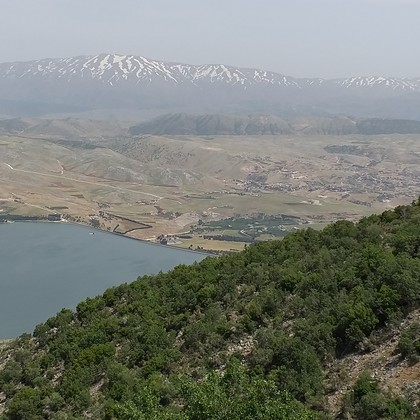
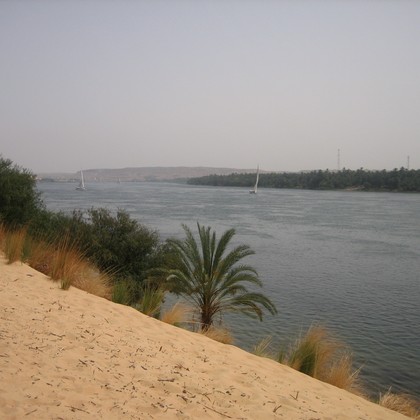
Fresh and slightly brackish water with plenty of cover: reed marshes, flooded willow and tamarisk thickets, rivers, reservoirs and above all fishponds. Breeds in mixed colonies with herons and ibises in bushes and trees over water. Fishes alone or in small groups in shallow water and in winter gathers at communal roosts in trees, sometimes hundreds together.
Where the bird is most at home, classified by the habitats of North Africa and the Middle East.
Range and movements
Breeds in the marshes of southern Iraq, along the Euphrates and Tigris and in the Hawizeh, Central and Hammar marshes, where it is again widespread since the marshes were restored; also locally present in Syria along the Euphrates. In Israel mainly a winter visitor, with hundreds in the fishpond areas of the Bet She'an and Hula valleys and around the Sea of Galilee; it formerly bred in the Hula marsh. Elsewhere in Lebanon, Jordan and Syria a scarce winter visitor. An extremely rare vagrant to Kuwait (two records), the Gulf states and Egypt. In North Africa it bred in north-eastern Algeria in the 19th century but has gone; today there are only isolated records from Algeria, Tunisia and Morocco. Beyond the region it breeds in south-eastern Europe, Turkey, around the Black and Caspian Seas and in Iran east to the Aral basin.
- Resident
- Summer visitor (c. Apr–Sep)
- Winter visitor (c. Oct–Mar)
- Passage (Mar–Apr, Oct–Nov)
- dark = core range, pale = thinly spread
How and when to look
In winter the fishponds at Kfar Ruppin and Neve Ur in the Bet She'an valley are the best site: towards evening flocks fly in to roost in the eucalyptus trees. In the Hula Nature Reserve and at Agamon Hahula they are also often seen perched on branches by the water.
Conservation status
Not globally threatened, after a strong recovery in Europe since the 1990s. In the region it was lost as a breeder from Algeria and Israel through marsh drainage, and the Iraqi population crashed when the Mesopotamian marshes were drained in the 1990s; it has returned since their partial restoration. Hunting, netting, disturbance and persecution at fishponds remain threats.
Scientific name
Microcarbo pygmaeus | (Pallas, 1773)
Pallas described the species in 1773 as Pelecanus pygmeus; because it was later moved to another genus, the author and year stand in brackets. The genus Microcarbo was introduced in 1856 by Bonaparte. Microcarbo combines Greek mikros 'small' with the genus name Carbo, and thus means 'small cormorant'. pygmaeus is Latin, from Greek pugmaios 'dwarfish', after the bird's small size. The specimen the first description was based on came from the Caspian Sea.