All species › Pelicans, herons and ibises › Herons and bitterns › Purple Heron
Purple Heron | Ardea purpurea
Purperreiger | Garza imperial
A slender, dark heron of dense reed marshes, more snake-necked and shyer than Grey Heron. In the region it breeds in the large marshes of the Maghreb, the Nile Delta, the Levant and above all southern Iraq; on passage it crosses the Sahara and Arabia on a broad front.
Voice
Less noisy than Grey Heron; a hoarse, higher and thinner kraak or krek on take-off. Gargling and bill-clapping in the colony.
Recording: João Ferreira Tomás — CC BY-NC-SA 4.0 · converted to mono · xeno-canto
Identification
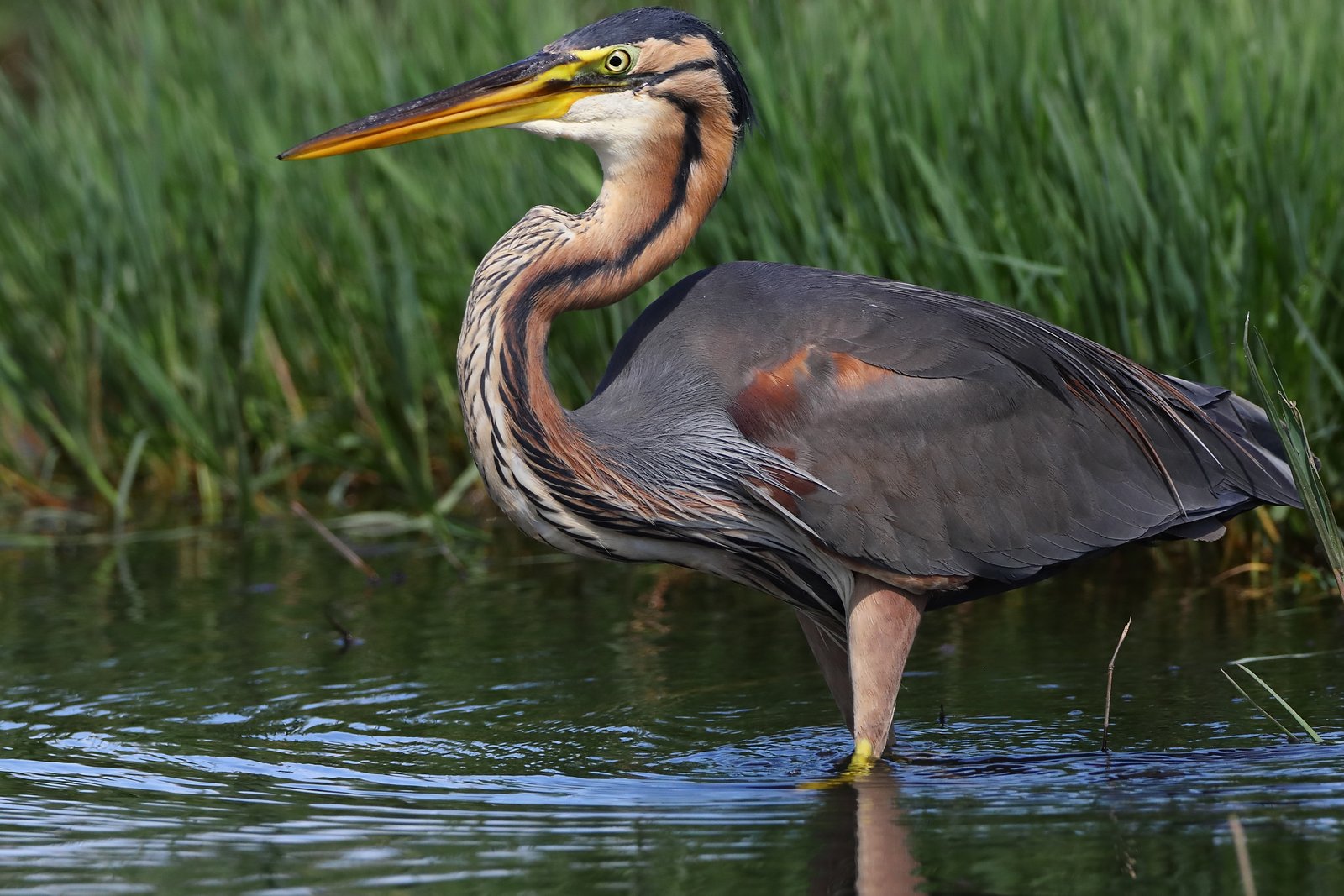
Smaller, slimmer and darker than Grey Heron, with a thin, snaky neck and a long, narrow bill. Adults have a rufous head and neck with a black crown and a black stripe down the side of the neck, a dark grey back with long chestnut mantle plumes and a dark chestnut belly. Juveniles are plainer sandy-brown, without black neck stripes. In flight dark, with a noticeably sagging neck (a "bulge" below the retracted neck) and large, projecting feet with long toes.
Confusion species
Grey Heron (Ardea cinerea) is larger and greyer, with a white neck and a heavier bill; juvenile Grey Herons are grey, not brown. Juvenile Purple Herons can recall Eurasian Bittern (Botaurus stellaris), but that species is stockier and densely mottled. Goliath Heron (Ardea goliath) has a similar colour pattern but is huge, with a massive bill and no black crown. Black-headed Heron (Ardea melanocephala) has a black head and neck and no rufous.
Habitat
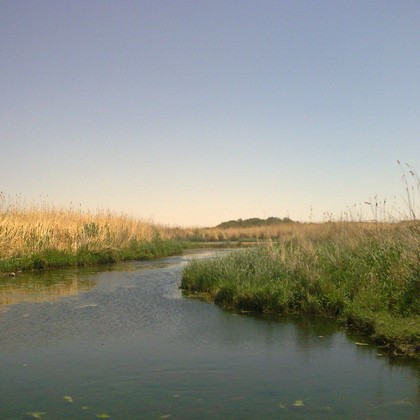
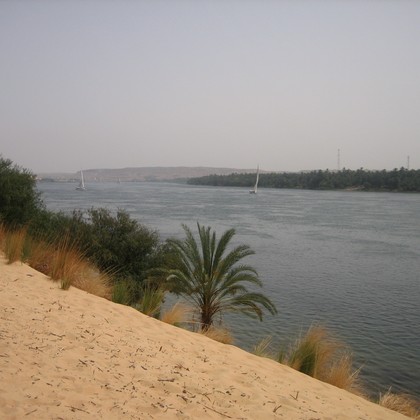
Extensive, dense reed marshes and reedmace beds with shallow water, overgrown channels and the reedy fringes of lakes; on passage also in rice fields, along irrigation channels and at oases. Hunts patiently from cover for fish, frogs and large insects. Breeds in loose colonies in reeds, less often in bushes or trees.
Where the bird is most at home, classified by the habitats of North Africa and the Middle East.
Range and movements
Breeds in Morocco (Merja Zerga, Bas Loukkos and the Moulouya), in north-east Algeria (El Kala, Lac Tonga) and locally in Tunisia. In Egypt a scarce breeder on the delta lakes and along the Nile, with a few wintering. In the east it breeds in Israel (Hula Valley), Syria and above all in the marshes of southern Iraq, which hold an important population. On passage throughout the region: across the Sahara and through Libya, through the Jordan Valley and past Eilat, and widely in Saudi Arabia, Kuwait, the Gulf states, Oman and Yemen, where small numbers also winter on the Red Sea coast. Beyond the region it breeds from southern and central Europe to Central Asia and in South and East Asia, and in sub-Saharan Africa; Palearctic birds winter in tropical Africa.
- Resident
- Summer visitor (c. Apr–Sep)
- Winter visitor (c. Oct–Mar)
- Passage (Mar–Apr, Oct–Nov)
- dark = core range, pale = thinly spread
How and when to look
The best chance of a breeding Purple Heron is in May and June in the Hula Valley or at Merja Zerga, especially early in the morning when birds fly over the reeds. On passage, in April and September, they sometimes rest at sewage ponds and oases in the Arava and the Negev, and at the pools of Eilat.
Conservation status
Not globally threatened, but declining in Europe and North Africa through the loss of reed marshes and drought in the Sahel, where Palearctic birds winter. In Iraq the draining of the marshes in the 1990s hit the population hard; it has partly returned since reflooding.
Scientific name
Ardea purpurea | Linnaeus, 1766
Linnaeus described the species in 1766 and placed it straight away in the genus where it still stands. The genus Ardea was introduced in 1758 by Linnaeus. Ardea is the Latin word for 'heron'. purpurea is Latin for 'purple-coloured', after the reddish plumage. The specimen the first description was based on came from France.