All species › Passerines › Sunbirds › Palestine Sunbird
Palestine Sunbird | Cinnyris osea
Palestijnse honingzuiger | Suimanga palestino
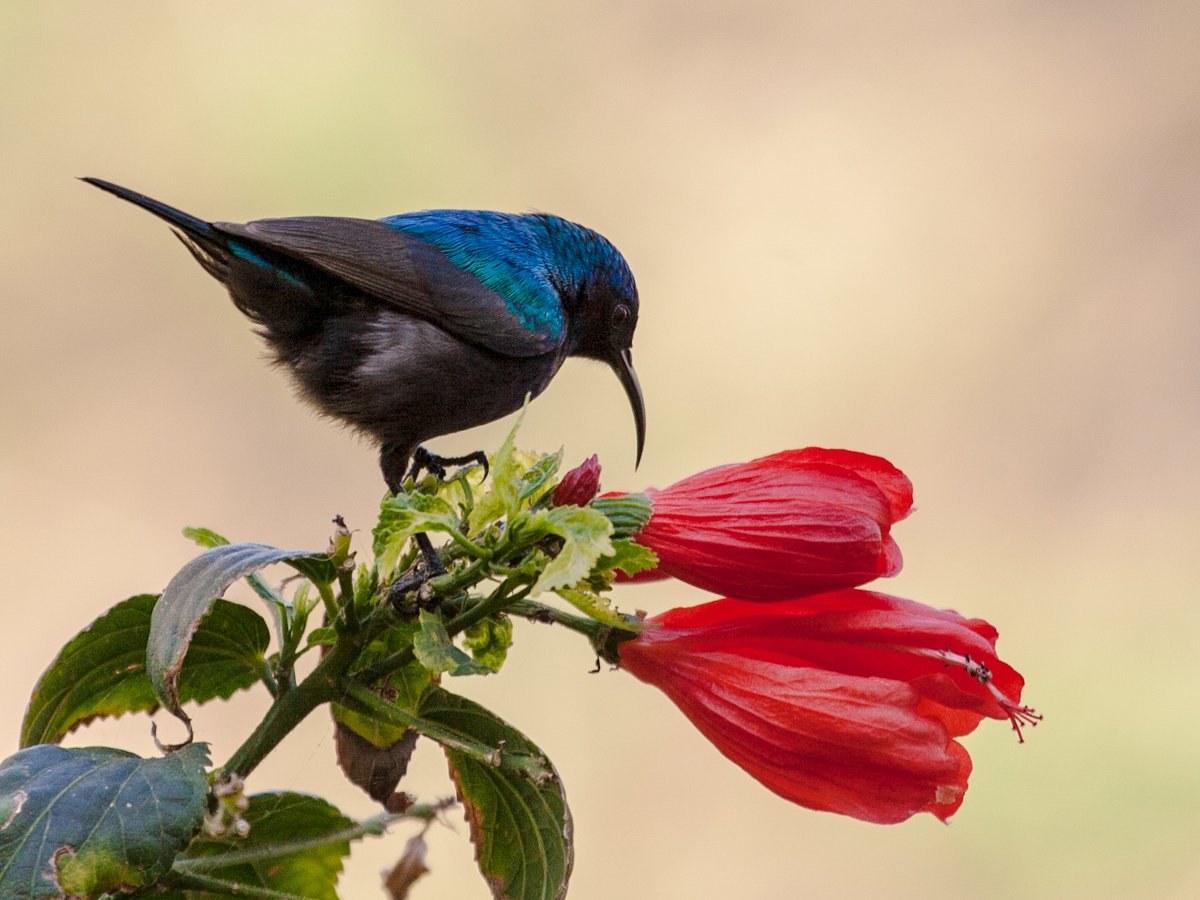
The Palestine Sunbird is the sunbird of the Levant and western Arabia and the only member of its family that reaches the Mediterranean. In gardens in Israel and Jordan it is a familiar sight.
Voice
Very vocal. The call is a loud, rising tchwee or tchweet; the song is a fast, rattling series of high notes, chiwi-chiwi-chiwi, accelerating towards the end, heard all year.
Recording: David Darrell-Lambert — CC BY-NC-SA 4.0 · shortened to the first 60 s, mono · xeno-canto
Identification
10–11 cm. Small, with a long, strongly curved bill and a rather short tail. The breeding male looks black at a distance, but in sunlight glosses metallic blue, green and violet on head, breast and back; when the wings are raised, orange-red and yellow pectoral tufts show below the shoulders. The non-breeding male (summer–autumn) is female-like with a dark wing and some scattered glossy feathers. The female is plain grey-brown above, paler grey below, unstreaked and without any yellow; the tail is darker.
Confusion species
The female Purple Sunbird (Cinnyris asiaticus), only in Oman and the UAE, is yellowish below. Arabian Sunbird (Cinnyris hellmayri) in south-west Arabia is larger; the male has a red breast band and a dark belly. Nile Valley Sunbird (Hedydipna metallica) has a shorter bill, and the male has yellow underparts and tail streamers. Females may recall Common Chiffchaff (Phylloscopus collybita), but the curved bill is decisive.
Habitat
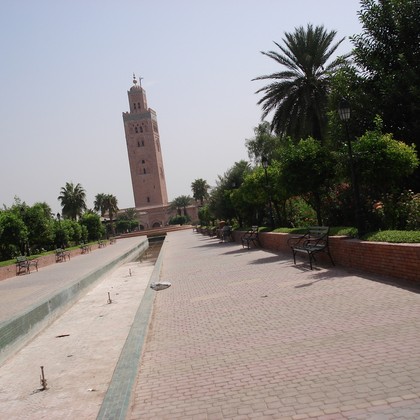
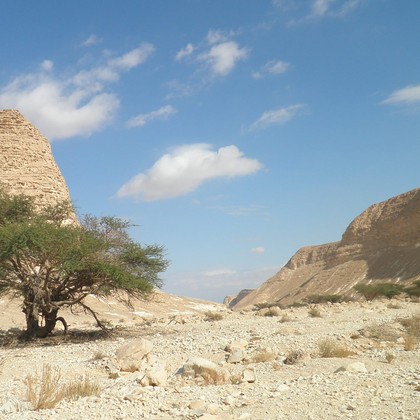
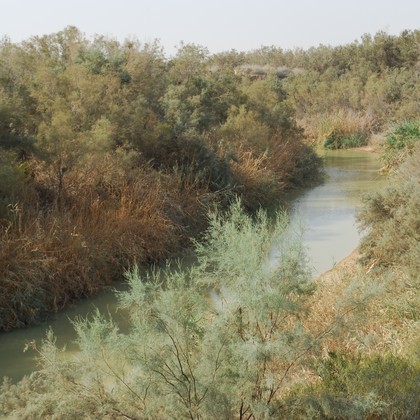
Gardens, parks and villages with flowering ornamentals, orchards and riverside trees; in desert areas wadis and oases with acacias, Calotropis and mistletoe (Loranthus), up into the mountains of south-west Arabia above 2000 m.
Where the bird is most at home, classified by the habitats of North Africa and the Middle East.
Range and movements
Widespread in Israel and Jordan, from the coastal plain to the Jordan Valley and Aqaba; also in Lebanon and western Syria, and in Sinai (mainly the south). In Saudi Arabia in the Hejaz and Asir, then in Yemen and in Dhofar (southern Oman). Beyond the region it has colonised southern Turkey (Hatay); a separate subspecies lives in central Africa from Chad to Uganda.
- Resident
- Summer visitor (c. Apr–Sep)
- Passage (Mar–Apr, Oct–Nov)
- dark = core range, pale = thinly spread
How and when to look
In Eilat, the Jordan Valley and the gardens of Jerusalem and Amman it often sits on flowering ornamental shrubs and against windows. In the breeding season follow the rattling song to a bare twig: in sunlight the male flashes blue and violet.
Conservation status
Not globally threatened (IUCN: Least Concern). It benefits strongly from gardens and ornamental planting; its range expanded northwards in the 20th century, including into Lebanon and southern Turkey.
Scientific name
Cinnyris osea | Bonaparte, 1856
Bonaparte described the species in 1856 and placed it straight away in the genus where it still stands. The genus Cinnyris was introduced in 1816 by Cuvier, GLCFD. Cinnyris is from the Ancient Greek kinnuris, an unidentified small bird mentioned by Hesychius of Alexandria. osea derives from the Ancient Greek hosia 'holy'. The specimen the first description was based on came from the plain of Jericho.