All species › Passerines › Wagtails and pipits › Paddyfield Pipit
Paddyfield Pipit | Anthus rufulus
Oriëntaalse pieper | Bisbita oriental
The Paddyfield Pipit is a resident of the Indian subcontinent and South-East Asia that reaches the region only exceptionally, so far mainly in the United Arab Emirates. It looks like a small Richard's Pipit.

Voice
The call is a short, fairly soft chip or chip-chip, thinner and less hoarse than the shreep of Richard's Pipit.
Recording: Ramit Singal — CC BY-NC-SA 4.0 · converted to mono · xeno-canto
Identification
15–16 cm. Medium-sized, compact and fairly short-tailed, with flesh-coloured legs and a fairly short, thin bill. Warm brown above with dark streaks on the crown and mantle, pale buff below with warmer flanks and a narrow band of short streaks across the upper breast. A pale supercilium, pale lores and a narrow malar stripe. The hind claw is shorter than in Richard's Pipit. The outer tail feathers are white.
Confusion species
Richard's Pipit (Anthus richardi) is clearly larger, longer-tailed and longer-legged, with a heavier bill, a very long hind claw and a loud, hoarse call; in winter it is much commoner at the same sites. Blyth's Pipit (Anthus godlewskii) is longer-tailed and paler and has square-cut dark centres to the median coverts. Tawny Pipit (Anthus campestris) is paler, almost unstreaked and has dark lores.
Habitat
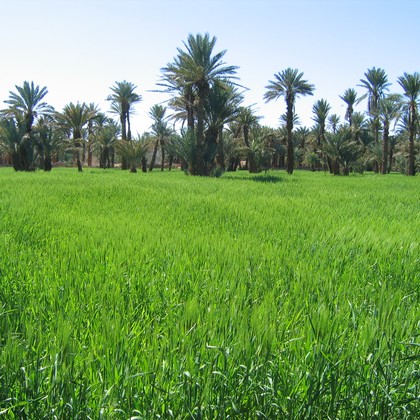
Short, often damp grassland, irrigated fields and fodder crops; in the region seen on irrigated farms.
Where the bird is most at home, classified by the habitats of North Africa and the Middle East.
Range and movements
Known in the region only as a vagrant: three records in the United Arab Emirates, the third of two to three birds at Wamm Farms in December 2023 and January 2024. It is to be expected elsewhere in eastern Arabia, particularly Oman, on irrigated farms. Beyond the region resident from Pakistan and India to southern China, Indochina, the Philippines and the Lesser Sundas.
How and when to look
In winter check flocks of pipits on irrigated farms in the United Arab Emirates and Oman: a small, short 'Richard's Pipit' with a soft chip deserves attention. A photograph or sound recording is needed for acceptance.
Conservation status
Not globally threatened and common in its range. In the region a very rare vagrant that does not originate from the region itself.
Scientific name
Anthus rufulus | Vieillot, 1818
Vieillot described the species in 1818 and placed it straight away in the genus where it still stands. The genus Anthus was introduced in 1805 by Bechstein. Anthus is the Latin word for a small bird of grasslands mentioned by Pliny the Elder. rufulus is Latin for 'reddish', a diminutive of rufus 'red'. The specimen the first description was based on came from Bengal, India and Bangladesh.