All species › Birds of prey › Ospreys › Osprey
Osprey | Pandion haliaetus
Visarend | Águila pescadora
A large, long-winged raptor that lives entirely on fish, which it snatches from the water in a steep feet-first plunge. In the region it has two faces: a sedentary breeder on the coral islands and rocky coasts of the Red Sea, the Gulf and Oman, and a common passage migrant and winter visitor from Europe and western Asia along coasts, lakes and the Nile.
Voice
Fairly vocal around the nest: a series of short, plaintive whistles, chewp-chewp-chewp or kyee-kyee-kyee, rapid and rising in display; alarm a sharp kyuk. Migrants and winterers are mostly silent.
Recording: David Darrell-Lambert — CC BY-NC-SA 4.0 · converted to mono · xeno-canto
Identification
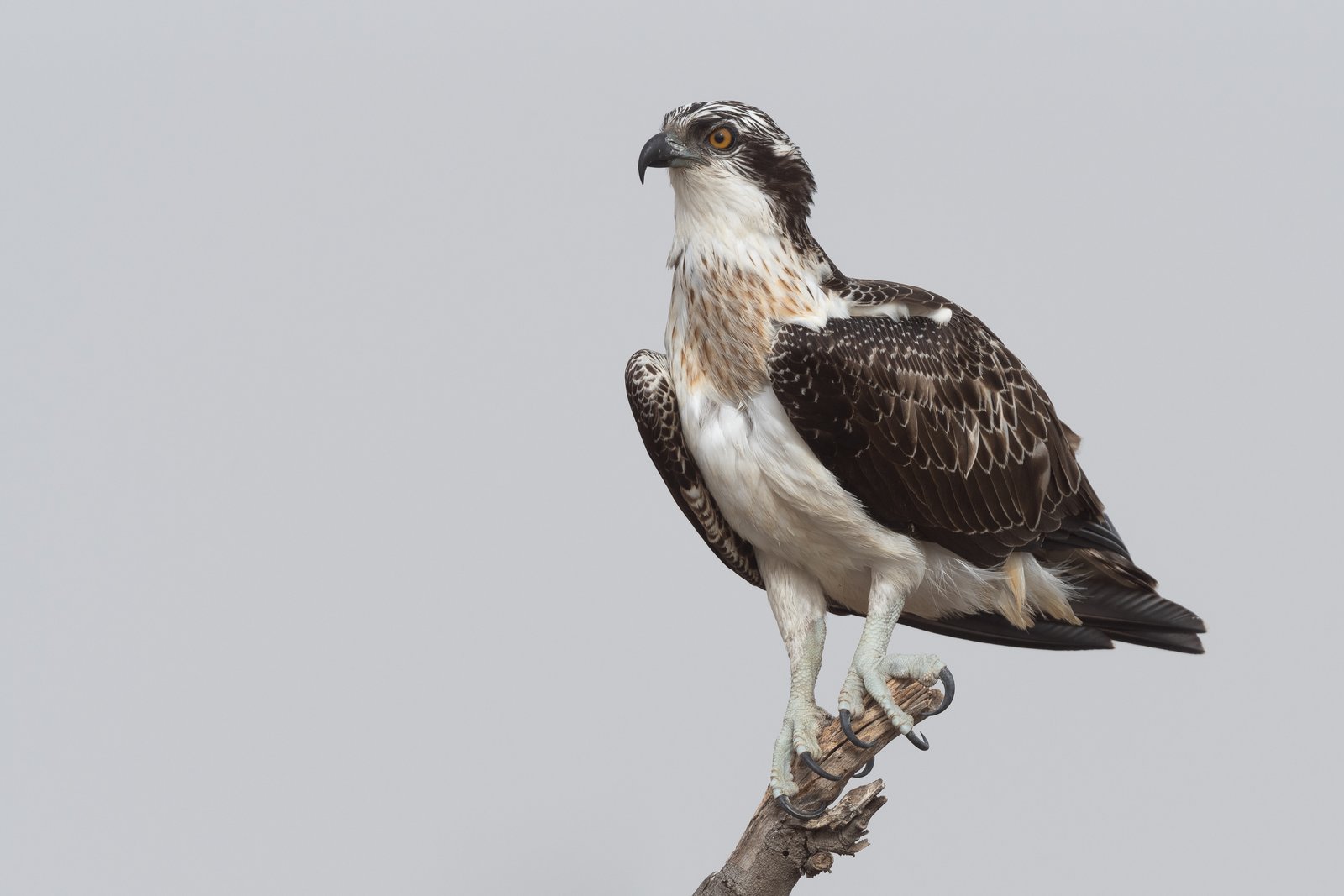
Dark chocolate-brown above, bright white below, with a white head and a broad black eye-stripe running into the nape; often a brownish breast band, usually more marked in females than males. In flight the long, narrow wings are held distinctly kinked, with the hand slightly lowered (the silhouette of a large gull); white below with a black carpal patch, a dark bar across the greater coverts and barred flight feathers. The tail is short and barred. Juveniles have pale fringes to the upperparts, giving a scaly look, and orange eyes. Breeders of the Red Sea and Arabia are on average smaller and paler, with a narrow or no breast band and a whiter head.
Confusion species
At a distance mainly a large gull such as Yellow-legged Gull (Larus michahellis) or Lesser Black-backed Gull (Larus fuscus): note the short barred tail, the black carpal patch and the steady, gliding flight with hovering stops over the water. Short-toed Snake-Eagle (Circaetus gallicus) also hovers, but has a large round head, broad wings without a carpal patch and lacks the black eye-stripe. Pale-morph Booted Eagle (Hieraaetus pennatus) is much smaller, with black flight feathers and a pale panel across the upperwing.
Habitat
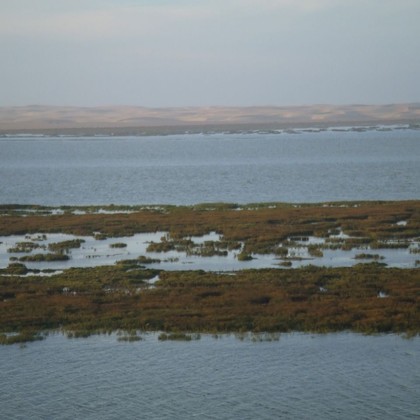
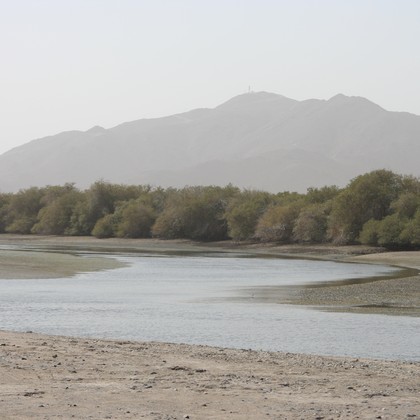
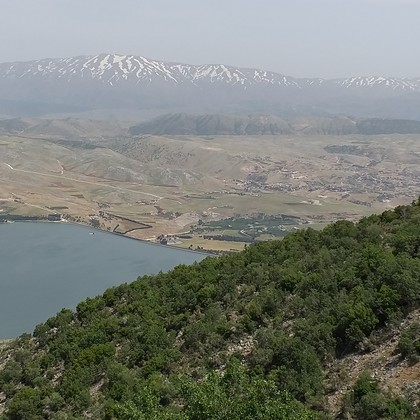
Clear water rich in fish: coral coasts with shallow reefs, mangroves, rocky islets and lagoons, and inland lakes, reservoirs, fish ponds and large rivers. Red Sea and Gulf breeders nest on the ground, on rocks or on bare islets, sometimes on old buildings or masts, building a large stick pile that grows year after year. Migrants also rest at oases and ponds deep in the desert.
Where the bird is most at home, classified by the habitats of North Africa and the Middle East.
Range and movements
Breeds year-round along the whole Red Sea: on the islands and coasts of Egypt (Hurghada, the islands off Safaga and Wadi Gimal), the Saudi coast with the Farasan Islands, and Yemen with the Red Sea islands and Socotra. In the Persian Gulf it breeds on the islands of the Emirates (especially Abu Dhabi's western islands), Qatar and Bahrain, and in Oman along the whole coast and on the islands (Daymaniyat, Masirah, Hallaniyat). In North Africa a few dozen pairs remain on the rocky coast between Al Hoceima (Morocco) and western Algeria, where numbers have fallen by more than a third since the 1980s. As a migrant it occurs everywhere, including over the desert and through the Jordan Valley and Eilat, and it winters along Morocco's Atlantic coast, the Mediterranean, the Nile and delta lakes, Israel's fish ponds and the Gulf. Beyond the region it breeds almost worldwide except Antarctica; European birds winter in West Africa.
- Resident
- Summer visitor (c. Apr–Sep)
- Winter visitor (c. Oct–Mar)
- Passage (Mar–Apr, Oct–Nov)
- dark = core range, pale = thinly spread
How and when to look
At Eilat and Aqaba it fishes offshore and over the fish ponds year-round, and many pass along the mountains in autumn. On Egypt's Red Sea coast breeding birds can be seen from boat trips to the islands off Hurghada and Wadi Gimal; in Oman at the Daymaniyat Islands and on Masirah. The Moroccan breeders occupy the cliffs of Al Hoceima National Park.
Conservation status
Not globally threatened and recovering in Europe. The small North African breeding population is vulnerable to dynamite and poison fishing, disturbance and coastal building. On the Red Sea and the Gulf, tourism on breeding islands, coastal development and power lines threaten numbers locally; elsewhere shooting and poisoning at fish ponds are the main problems.
Scientific name
Pandion haliaetus | (Linnaeus, 1758)
Linnaeus described the species in 1758 as Falco Haliaetus; because it was later moved to another genus, the author and year stand in brackets. The genus Pandion was introduced in 1809 by De Savigny. Pandion is taken from Pandion, the mythical king of Athens and grandfather of Theseus. haliaetus comes through Latin from the Greek haliaetos 'sea eagle', from hals 'sea' and aetos 'eagle'. The specimen the first description was based on came from Sweden.