All species › Owls › Typical owls › Desert Owl
Desert Owl | Strix hadorami
Palestijnse bosuil | Cárabo árabe
A small, pale tawny owl of rocky desert gorges, one of the true specialities of the region: it occurs almost only from Sinai and the Dead Sea to south-west Arabia. For more than a century it was called Strix butleri, until in 2015 the type of that name proved to belong to Omani Owl; since then it has borne the name Strix hadorami.
Voice
The male's call is a rhythmic, soft hooo… hu-hu hu-hu, somewhat recalling the rhythm of a Eurasian Collared-Dove; the female calls lower and less clearly. Mainly February to April, in the first hours after dusk. Female and young beg with a high, hoarse kweek.
Recording: Paulo Alves — CC BY-NC-SA 4.0 · shortened to the first 60 s, mono · xeno-canto
Identification
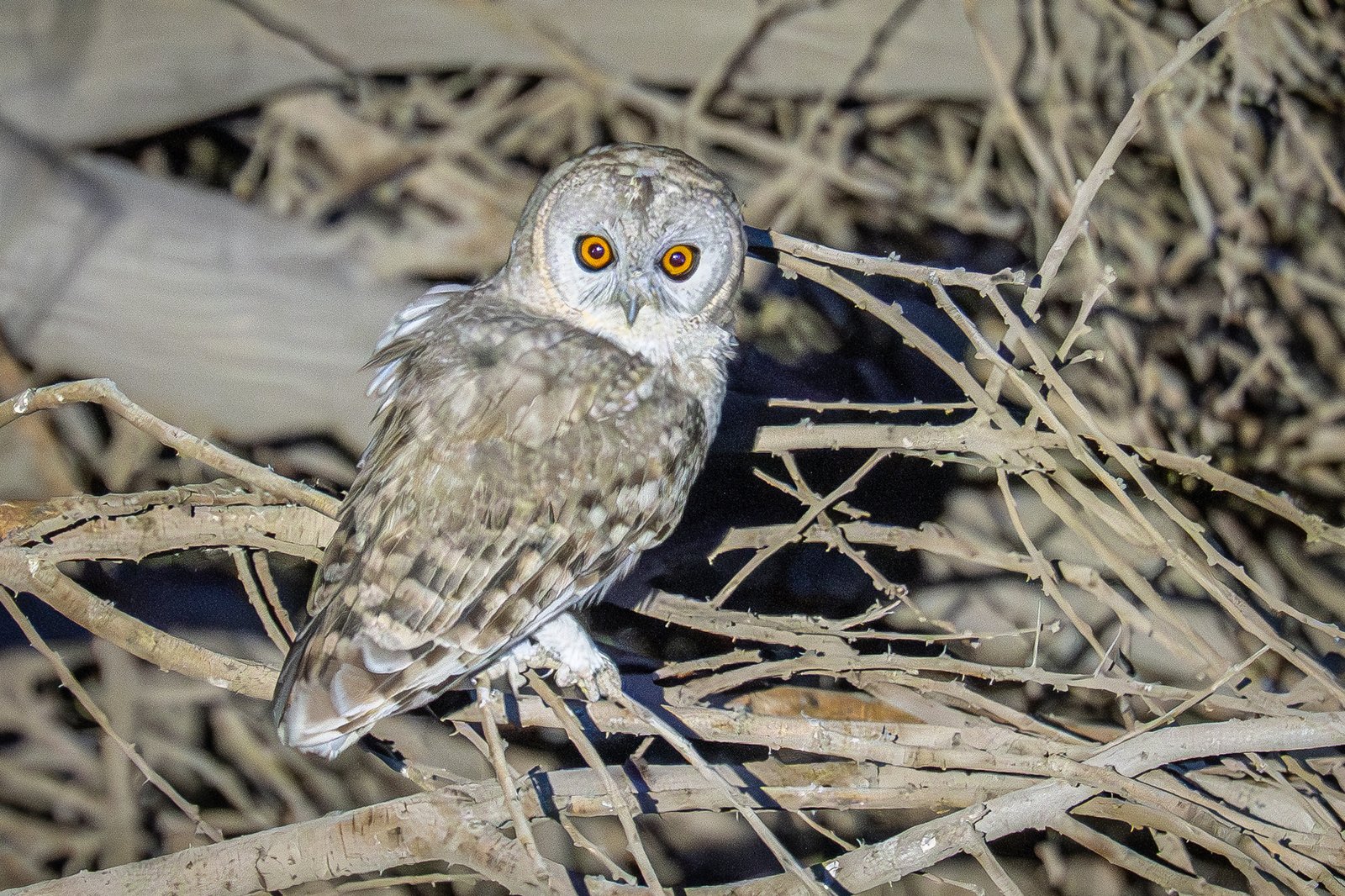
A small, slim owl with a round head without ear tufts, long legs and striking orange-yellow eyes. The upperparts are pale sandy to golden-buff with fine grey speckling; the underparts pale yellowish to white with faint, fine rufous barring. The face is pale, almost white, without a dark rim. In flight pale with dark bands on the flight feathers and tail and a dark carpal patch on the underwing.
Confusion species
Tawny Owl (Strix aluco) is larger and darker, with black eyes and a dark-rimmed face, and lives in woodland. Omani Owl (Strix butleri) of northern Oman is darker grey-brown, with a dark facial disc and a different call. Western Barn Owl (Tyto alba) has a heart-shaped face and black eyes; Pharaoh Eagle-Owl (Bubo ascalaphus) is much larger and has ear tufts.
Habitat
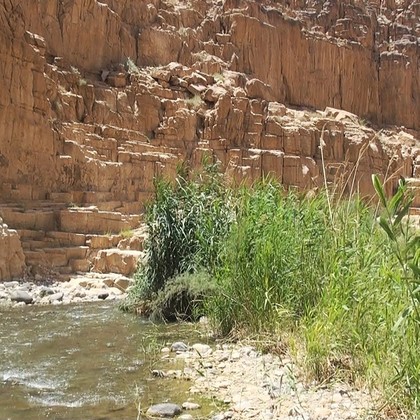
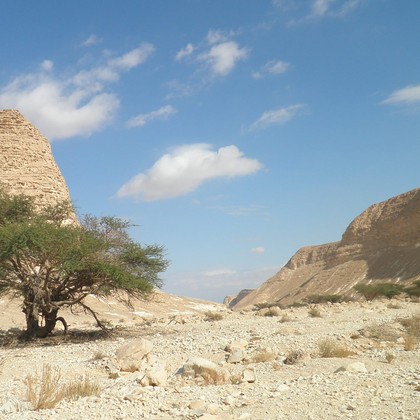
Steep rocky gorges, dry wadis and canyons in barren desert, often near a spring, a small oasis or a clump of date palms, from below sea level at the Dead Sea to over 1500 m. Hunts rodents, insects and small birds. The nest is in a crevice or hole in a cliff.
Where the bird is most at home, classified by the habitats of North Africa and the Middle East.

Range and movements
In Israel and the West Bank along the Dead Sea, in the Judean Desert, the Arava and the mountains near Eilat. In Jordan along the eastern edge of the Rift Valley, from the Dead Sea to Petra, Dana and Wadi Rum. In Egypt in Sinai and the Red Sea mountains of the Eastern Desert. In Arabia in the Hejaz and Asir mountains of western Saudi Arabia, in Yemen and in Oman (Dhofar); in northern Oman its relationship with Omani Owl is not yet fully clear. Beyond the region possibly in the hills of the Sudanese Red Sea coast.
- Winter visitor (c. Oct–Mar)
- dark = core range, pale = thinly spread
How and when to look
The classic site is Ein Gedi on the Dead Sea, where birds call in spring after dusk in the gorges of Nahal Arugot and Nahal David. In Jordan, Wadi Mujib and the gorges around Petra are good sites. Be restrained with playback; birds at Ein Gedi are already much disturbed.
Conservation status
Not globally threatened, but with a small and fragmented range. Threats are disturbance by birders and tourists, traffic on the roads in the Rift Valley, rodent poisoning and the loss of springs and small oases.
Scientific name
Strix hadorami | Kirwan, Schweizer & Copete, 2015
Kirwan, Schweizer & Copete described the species in 2015 and placed it straight away in the genus where it still stands. The genus Strix was introduced in 1758 by Linnaeus. Strix is the Latin word for 'owl'; in classical lore the strix was a night bird said to suck the blood of infants. hadorami honours the Israeli ornithologist Hadoram Shirihai.