All species › Passerines › Chats and flycatchers › Northern Wheatear
Northern Wheatear | Oenanthe oenanthe
Tapuit | Collalba gris
The Northern Wheatear is the most widespread wheatear in the world and in the region mainly a passage migrant: in spring and autumn it moves through deserts, oases and coastal plains in large numbers. It also breeds high in the mountains of Lebanon and Syria; the breeding birds of the Atlas are now treated as a separate species, Seebohm's Wheatear.

Voice
The song is a short, hurried phrase of scratchy, squeaky and whistled notes, often with mimicry, from a stone or in a short song flight. The call is a hard tsak or tak-tak, often preceded by a thin hweet.
Recording: Stanislas Wroza — CC BY-NC-SA 4.0 · converted to mono · xeno-canto
Identification
14.5–15.5 cm. Slim, upright and short-tailed; constantly bobs and flicks. The tail pattern is the key feature: a broad white rump and tail base with a black inverted T formed by the terminal band and central feathers; the terminal band is narrow to medium. The breeding male is blue-grey above, with a black mask, white supercilium, black wings and an orange-buff breast. Females and autumn birds are sandy brown with a pale supercilium and brown wings with pale fringes. The Levant form libanotica is paler above.
Confusion species
Isabelline Wheatear (Oenanthe isabellina) is bulkier, longer-legged and uniformly sandy, with a pale wing, a dark alula and a broader black terminal band. Females of Pied Wheatear (Oenanthe pleschanka) and Western Black-eared Wheatear (Oenanthe hispanica) show more white along the tail sides and a narrower, often uneven terminal band. Seebohm's Wheatear (Oenanthe seebohmi), the breeding bird of the Atlas, has in the male a black face and throat merging with the mask, and black underwing coverts; females often cannot be separated without good views of throat and underwing. Desert Wheatear (Oenanthe deserti) has an almost entirely black tail with only a white base.
Habitat
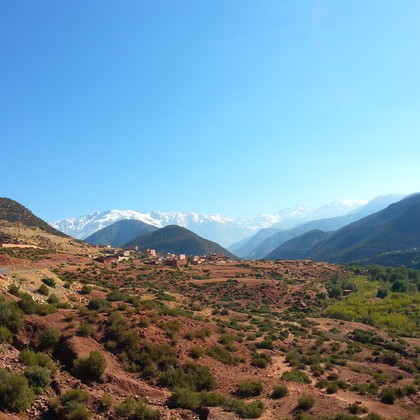
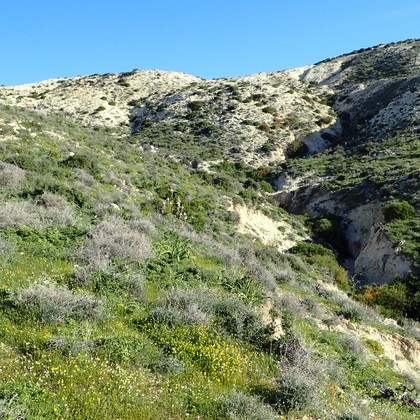
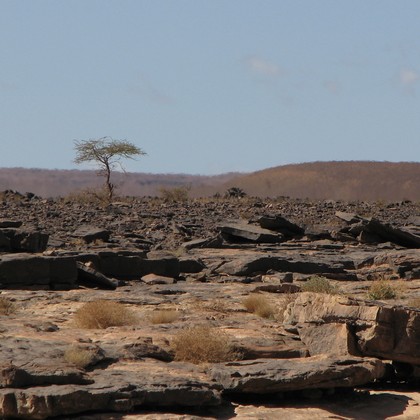
Breeds on open, stony mountain slopes, alpine grassland and high plateaux with boulders. On passage in any open country: stony desert, steppe, fields, coastal plains, sports fields and oases.
Where the bird is most at home, classified by the habitats of North Africa and the Middle East.
Range and movements
Breeds in the higher mountains of Lebanon, Syria (Anti-Lebanon, Hermon) and northern Iraq; the breeding birds of the Atlas are Seebohm's Wheatear (Oenanthe seebohmi). A common passage migrant throughout the region, from Morocco and the Sahara to Egypt, the Levant, Saudi Arabia, Yemen, Oman, the United Arab Emirates and the Gulf states; in spring conspicuous in Sinai, the Negev and Eilat. The odd bird winters in southern Arabia. Beyond the region it breeds from Europe and Siberia to Alaska, Canada and Greenland; all populations winter in sub-Saharan Africa.
- Resident
- Summer visitor (c. Apr–Sep)
- Winter visitor (c. Oct–Mar)
- Passage (Mar–Apr, Oct–Nov)
- dark = core range, pale = thinly spread
How and when to look
In March and April in any desert valley from Morocco to Oman: the grey males are the first to catch the eye among the other wheatears. The black-throated breeding birds of the High Atlas, for instance at Oukaïmeden, are Seebohm's Wheatears.
Conservation status
Not globally threatened. Declining in Europe through the loss of poor grasslands; little is known about the breeding birds of the Levant, but they appear stable.
Scientific name
Oenanthe oenanthe | (Linnaeus, 1758)
Linnaeus described the species in 1758 as Motacilla oenanthe; because it was later moved to another genus, the author and year stand in brackets. The genus Oenanthe was introduced in 1816 by Vieillot. Oenanthe was used by Aristotle for a bird that can no longer be identified; the word comes from the Greek oinos, oinoē 'wine, vine' and anthos 'flower, bloom'. The specific name repeats the genus name. The specimen the first description was based on came from Sweden.