All species › Passerines › Chats and flycatchers › European Stonechat
European Stonechat | Saxicola rubicola
Roodborsttapuit | Tarabilla europea
The European Stonechat is a common resident in the Maghreb in maquis, broom and rough field edges, and a common winter visitor from Europe and Turkey across the rest of the region. It nearly always perches on top of a bush, stem or wire, flicking wings and tail and giving its hard call.
Voice
The call is a hard weet-chek-chek, like two pebbles knocked together. The song is a short, scratchy phrase of squeaky and whistled notes, often from the top of a bush or in a short song flight.
Recording: Louis-Marie Gourmelon — CC BY-NC-SA 4.0 · converted to mono · xeno-canto
Identification
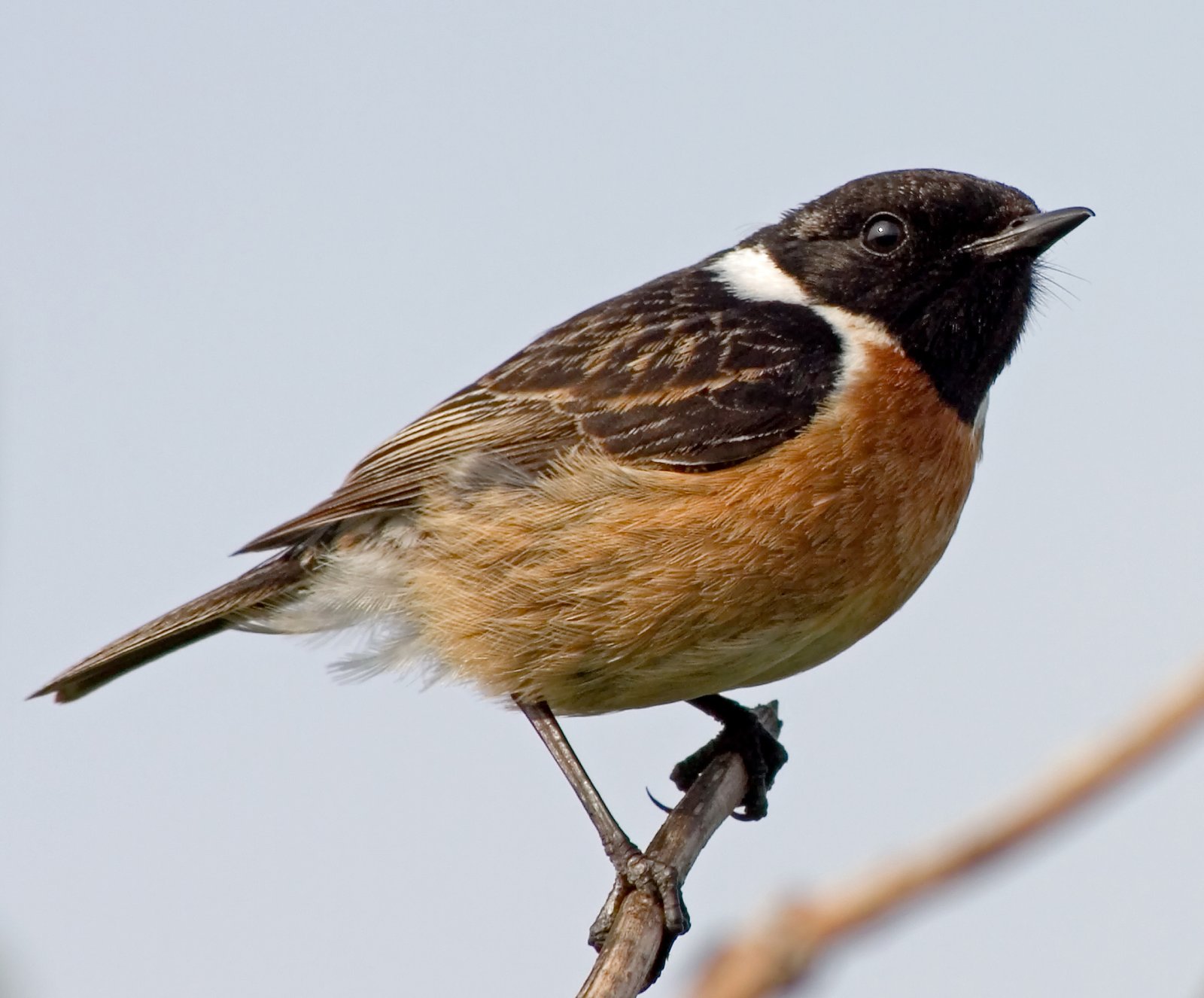
11.5–13 cm. Small, compact and short-tailed, with a round head. The male has a black head and throat, a white neck patch, dark brown back, a narrow white wing patch and a deep orange breast extending onto the flanks; the rump is dark or has a small, streaked white patch. The female is browner, with a dark brown, finely streaked head, a faint pale neck patch and an orange-brown breast. In winter brown fringes partly hide the male's black. Juveniles are spotted.
Confusion species
Siberian Stonechat (Saxicola maurus) is paler, with a large unstreaked pale rump, black axillaries and less orange below; they overlap in winter in the east of the region. African Stonechat (Saxicola torquatus) in the highlands of south-west Arabia has a smaller, deep chestnut breast patch and a white belly. Whinchat (Saxicola rubetra) has a broad pale supercilium, a streaked rump and white patches at the tail base.
Habitat
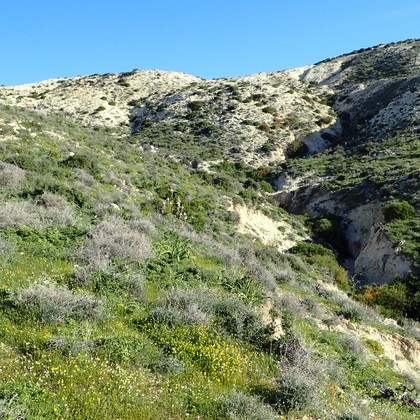
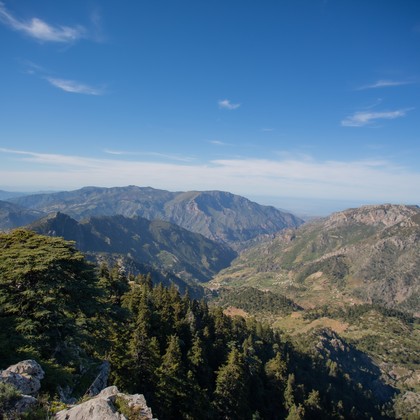
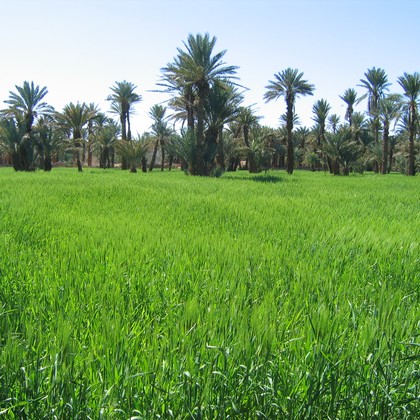
Maquis, garrigue, broom and dwarf-palm scrub, rough grassland, field edges, roadsides and fallow, from the coast high into the Atlas. In winter also in fields, irrigated land, reed fringes, parks and scrub at the edge of semi-desert.
Where the bird is most at home, classified by the habitats of North Africa and the Middle East.
Range and movements
Breeds in northern Morocco, Algeria and Tunisia, from the Atlantic lowlands and the Rif to the Middle and High Atlas and the Tell, and sparingly in north-west Libya; also in small numbers in Lebanon and Syria. In winter, from October to March, birds from Europe and Turkey spread across the whole Maghreb to the northern edge of the Sahara, coastal Libya, the Nile Delta, the Nile Valley and Sinai, and across Israel, Jordan, Lebanon, Syria and Iraq. Further into Arabia it is a common winter visitor to Kuwait, northern and eastern Saudi Arabia, Bahrain, Qatar and the Emirates, and scarcer in Oman. Beyond the region the species breeds in western and southern Europe, Turkey and the Caucasus.
- Resident
- Summer visitor (c. Apr–Sep)
- Winter visitor (c. Oct–Mar)
- Passage (Mar–Apr, Oct–Nov)
- dark = core range, pale = thinly spread
How and when to look
In Morocco it sits in maquis and dwarf-palm scrub along roadsides everywhere, for example between Rabat and Larache. In winter it is a regular on fields and fallow in Israel and Egypt; in the Emirates and Oman also check the stonechats for a Siberian Stonechat.
Conservation status
Not globally threatened. Common in the Maghreb, though declining locally through agricultural intensification and loss of rough margins; hard winters in Europe can temporarily reduce the number of winter visitors.
Scientific name
Saxicola rubicola | (Linnaeus, 1766)
Linnaeus described the species in 1766 as [Motacilla] Rubicola; because it was later moved to another genus, the author and year stand in brackets. The genus Saxicola was introduced in 1802 by Bechstein. Saxicola is Latin, from saxum 'stone, rock' and -cola 'dweller', from colere 'to inhabit': 'rock dweller', after the open stony ground these birds keep to. rubicola is Latin, from rubus 'bramble' and incola 'dweller': 'dweller among the brambles'. The specimen the first description was based on came from Seine-Maritime, Normandy.