All species › Passerines › Sylvia warblers › Moltoni's Warbler
Moltoni's Warbler | Curruca subalpina
Moltoni's baardgrasmus | Curruca de Moltoni
Moltoni's Warbler breeds on the islands and coasts around the Tyrrhenian Sea and winters in the western Sahel. To get there it must cross the Sahara, yet in North Africa it has been reliably recorded only a few times: subalpine warblers are hard to separate on migration, and almost all records are trapped birds or birds identified by call.
Voice
The call is the key: a dry, fast rattle trrrrt lasting half a second to a second, like a wren or Long-tailed Tit. The song is a fast, high chatter in which that rattle keeps recurring.
Recording: Zsombor Károlyi — CC BY-NC-SA 4.0 · converted to mono · xeno-canto
Identification
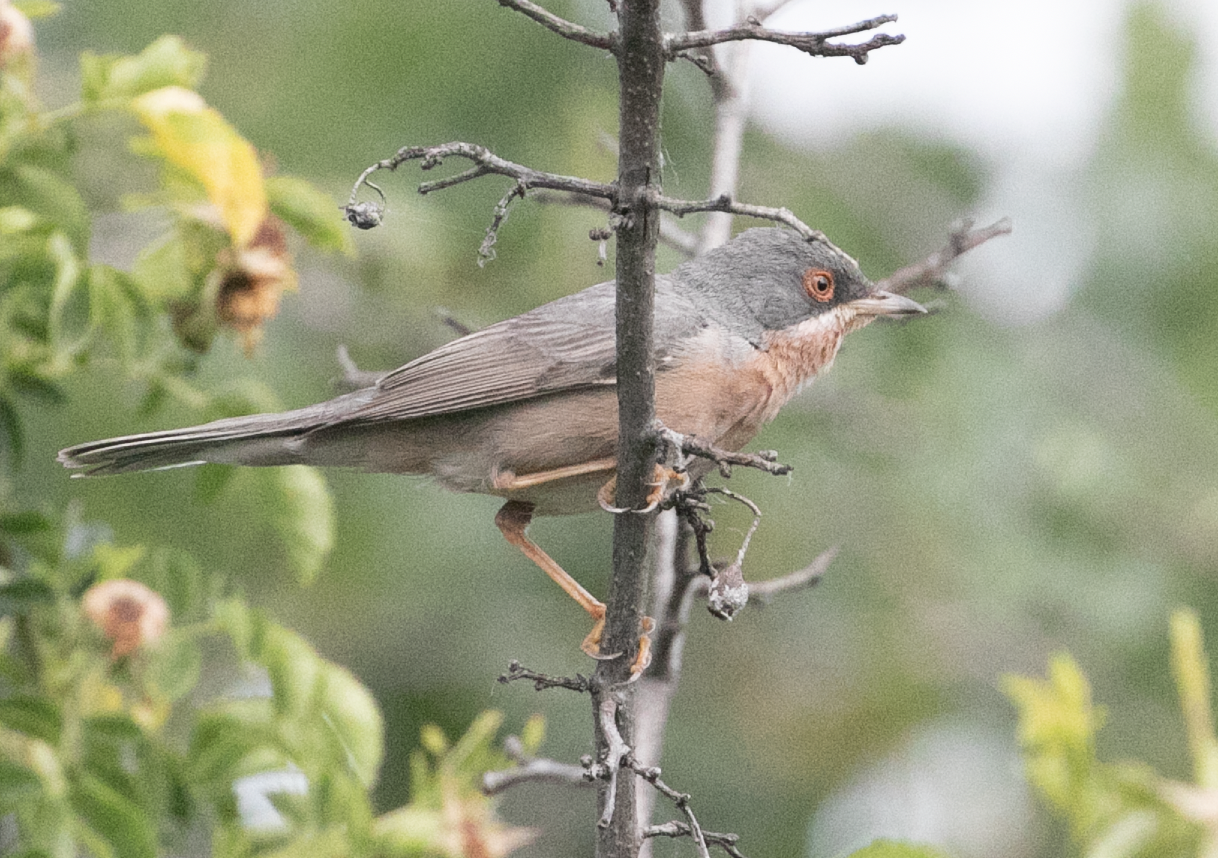
12–13 cm. Small and long-tailed, with a red eye-ring. The male is cool bluish grey above and pale salmon-pink from chin to belly, without a sharp border; the white moustache is short and narrow. A square white tip on the penultimate tail feather. The female is brownish grey above and creamy white with a faint pinkish wash below. Birds moult their flight feathers only in winter quarters and look uniform and little worn in spring.
Confusion species
Western Subalpine Warbler (Curruca iberiae), which breeds in the Maghreb and passes through in numbers, has a warmer, deeper orange-red male; Eastern Subalpine Warbler (Curruca cantillans) a deep brick-red throat and breast sharply demarcated from a white belly and a narrow white wedge on the penultimate tail feather. In females and young birds only the call is decisive: a dry rattle in Moltoni's, against a single tek in Western and a doubled t-tret in Eastern Subalpine.
Habitat
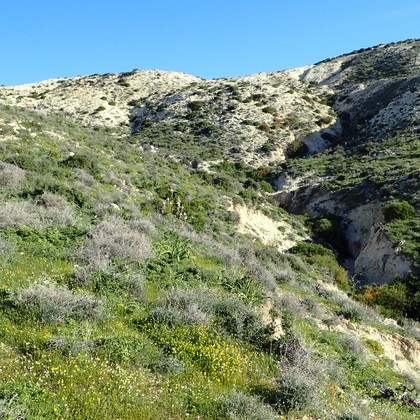
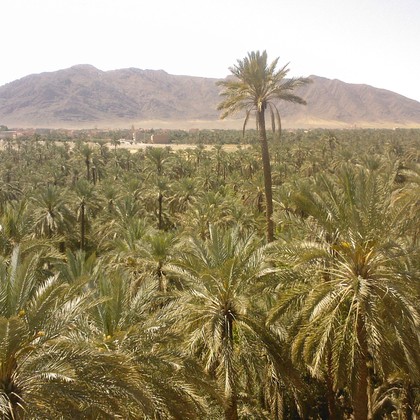
On migration in any scrub: coastal maquis and garrigue, bushes in alfa steppe and above all oases and gardens in the Sahara, where migrants concentrate. Breeds in maquis and open oak woodland.
Where the bird is most at home, classified by the habitats of North Africa and the Middle East.

Range and movements
In the region a vagrant: in Morocco four records had been accepted by 2019, including a bird ringed at Merzouga on 18 April 2019; in Algeria the species was first recorded in 2019, among others at El Borma in the Sahara (7 April 2019), and a few times since. The migration route from Sardinia and Corsica to the Sahel probably crosses Tunisia and Algeria, where the species is likely more regular on passage than known. Beyond the region it breeds on the Balearics, Corsica, Sardinia and in northern and central Italy, and winters in the western Sahel.
How and when to look
In April, check subalpine warblers in oases and gardens of the Algerian and Tunisian Sahara for birds that rattle rather than tick, and record the call: a recording is the strongest evidence here. Ringing stations such as the one at Merzouga have produced most records.
Conservation status
Not globally threatened. The species was only recognised as distinct in 2013, so older North African records are lumped under Subalpine Warbler and its true status on passage is still largely unknown.
Scientific name
Curruca subalpina | (Temminck, 1820)
Temminck described the species in 1820 as Sylvia subalpina; because it was later moved to another genus, the author and year stand in brackets. The genus Curruca was introduced in 1802 by Bechstein. Curruca is Latin, the name of an unidentified small bird mentioned by the Roman poet Juvenal. subalpina is Latin for 'below the Alps', from sub 'under' and alpinus 'of the Alps'. The specimen the first description was based on came from Italy.