All species › Owls › Typical owls › Marsh Owl
Marsh Owl | Asio capensis
Afrikaanse velduil | Búho moro
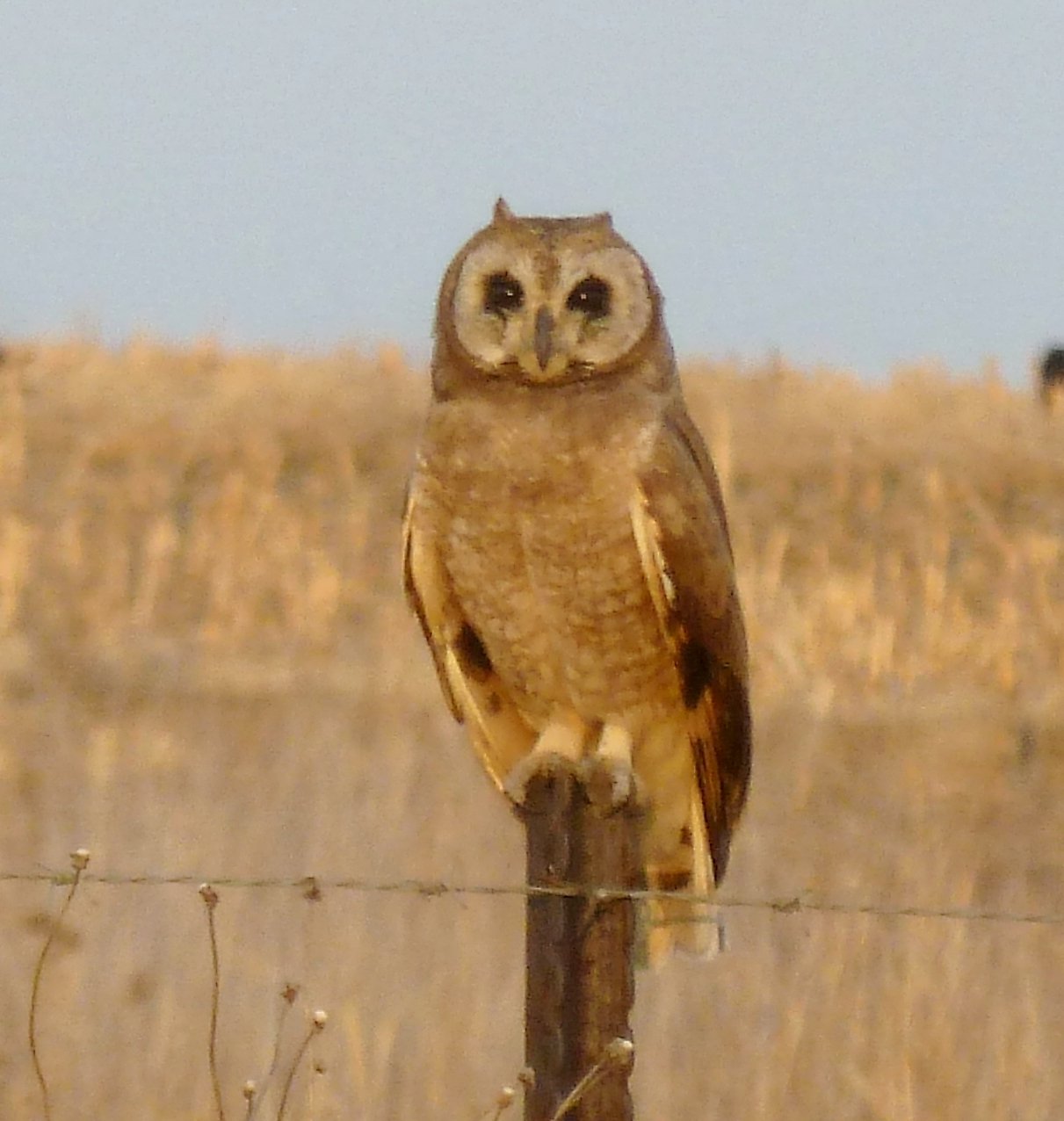
A medium-sized, uniformly dark brown owl of marshes and damp grassland, which in the region now breeds only in north-west Morocco, in an isolated population (tingitanus) thousands of kilometres from the rest of the species south of the Sahara. It hunts at dusk low over the grass, like a harrier.
Voice
A harsh, rasping kraaak, like tearing cloth, especially in flight and around the nest. In display flight the male claps its wings.
Recording: Tony Archer — CC BY-NC-SA 4.0 · converted to mono · xeno-canto
Identification
Upperparts, head and breast plain dark earth-brown, belly paler and finely barred. The facial disc is light brown with dark patches around the dark brown eyes; the ear tufts are short and often barely visible. In flight the long wings show an ochre patch at the base of the primaries, a dark carpal patch and a barred wingtip. The flight is slow and gliding, with the wings held in a shallow V.
Confusion species
Short-eared Owl (Asio flammeus), in the same area in winter, is paler and heavily streaked, with yellow eyes in dark surrounds, a white trailing edge to the wing and paler underparts. Long-eared Owl (Asio otus) has long ear tufts, orange eyes and a streaked belly, and rarely hunts over open marsh. Western Barn Owl (Tyto alba) is much paler, golden-buff and white.
Habitat
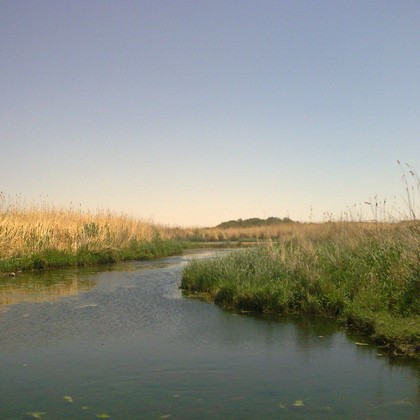
Marsh edges, wet grassland and rank vegetation around lagoons and merjas, floodplains and damp meadows and fields on the edges of wetlands. Nests on the ground in tall grass or among rushes. Hunts low over the grass for rodents, large insects and small birds.
Where the bird is most at home, classified by the habitats of North Africa and the Middle East.
Range and movements
In the region only in north-west Morocco: almost the whole population lives around Merja Zerga and the surrounding wetlands, between the lower Loukkos and Sidi Bou Ghaba. Formerly widespread from Tangier to the Sidi Moussa-Oualidia marshes and inland to around Meknès, and historically also in north-eastern Algeria (El Kala), where it has not been reliably recorded since. Recent isolated records south of the breeding area: Sidi Moussa (October 2014, the first since 1984), Casablanca (November 2015) and two birds near Benslimane (August 2018). Beyond the region widespread in Africa south of the Sahara and on Madagascar.
- Resident
- Winter visitor (c. Oct–Mar)
- Passage (Mar–Apr, Oct–Nov)
- dark = core range, pale = thinly spread
How and when to look
At Moulay Bousselham on Merja Zerga it hunts at sunset over the wet meadows and rough ground on the eastern and southern edges of the lagoon; local guides know the spots. Go in the last hours of light, and do not walk through tall grass in the breeding season.
Conservation status
Globally not threatened, but seriously threatened in Morocco: its range contracted sharply through the drainage of large marshes from the 1950s and further degradation of the remaining breeding sites. The population is small and almost entirely dependent on Merja Zerga, where overgrazing, mowing, farming and disturbance threaten breeding.
Scientific name
Asio capensis | (Smith, 1834)
Smith described the species in 1834 as Otus Capensis; because it was later moved to another genus, the author and year stand in brackets. The genus Asio was introduced in 1760 by Brisson. Asio is the Latin name of a horned or eared owl. capensis means 'of the Cape', after the Cape Colony in South Africa, where the species was described. The specimen the first description was based on came from South Africa.