All species › Woodpeckers and allies › Woodpeckers › Levaillant's Woodpecker
Levaillant's Woodpecker | Picus vaillantii
Levaillants specht | Pito bereber
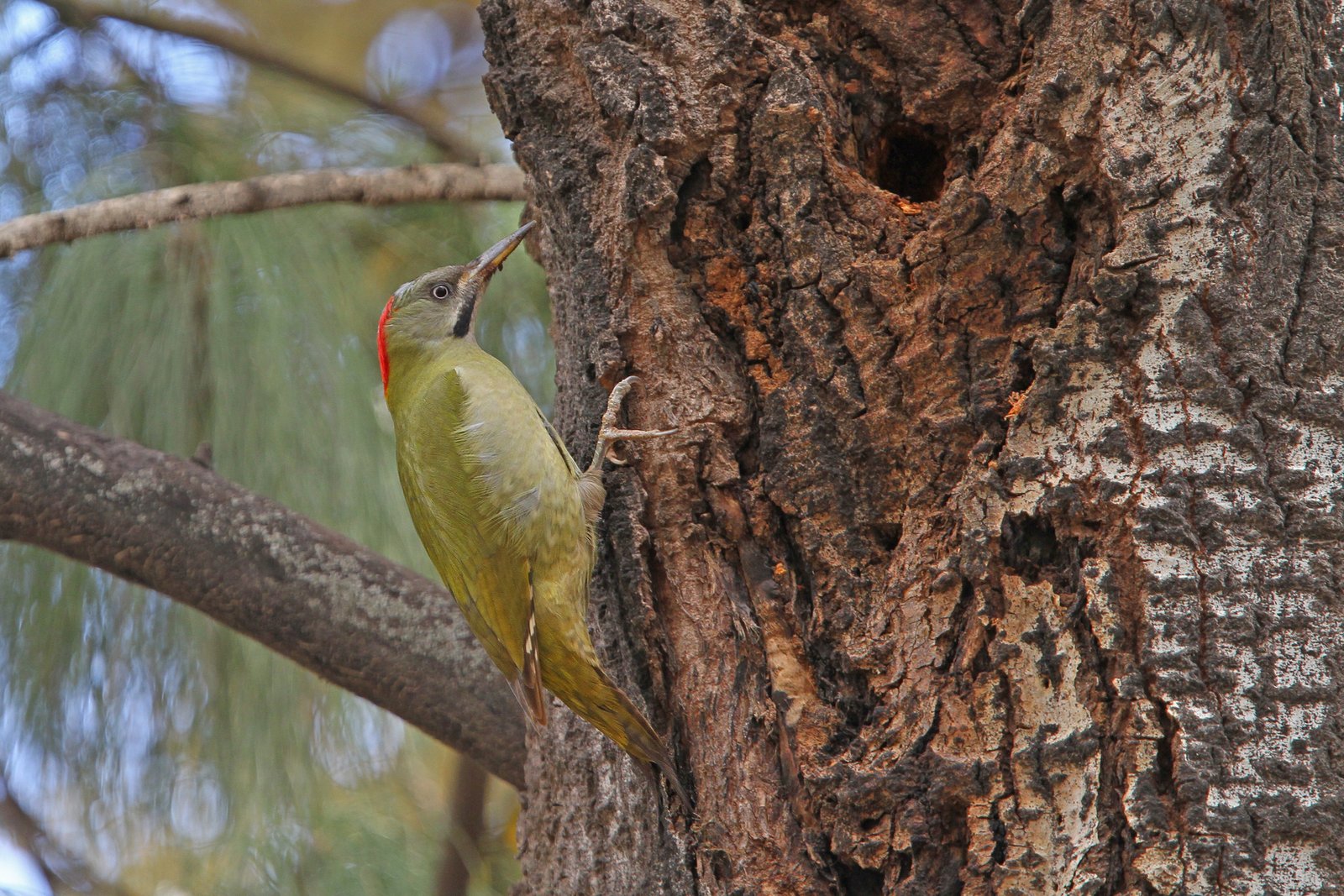
The green woodpecker of North Africa, a Maghreb endemic found only in Morocco, Algeria and Tunisia. It lives in oak, cedar and pine forest from the coast to high in the Atlas and, like its European relatives, spends much time on the ground searching for ants.
Voice
A loud, laughing kyu-kyu-kyu-kyu, a little higher and less strident than the yaffle of European Green Woodpecker and often accelerating; in flight a short kyak. Rarely drums.
Recording: Stanislas Wroza — CC BY-NC-SA 4.0 · shortened to the first 60 s, mono · xeno-canto
Identification
A large green woodpecker with a yellowish rump, greyish face and pale grey, unmarked underparts. The male has a red crown and nape and a red moustache with a narrow black border; the female has only the hindcrown and nape red, the forecrown grey, and an all-black moustache. A key feature is the grey lores and cheek, without a black mask around the eye. The bill is long and grey with a yellow base to the lower mandible, the eye whitish. Juveniles are streaked and spotted dark on the underparts and flanks. Undulating flight showing a striking yellow rump.
Confusion species
There is no other green woodpecker in the region. Visitors from Europe will compare it with European Green Woodpecker (Picus viridis), which has a black mask around the eye, and with Iberian Green Woodpecker (Picus sharpei), which like Levaillant's lacks black around the eye but is greener on the face and underparts and has a fully red crown in the female; the female Levaillant's has only the hindcrown red and the forecrown grey. At a distance a juvenile on the ground can suggest a large thrush until it shows the yellow rump.
Habitat
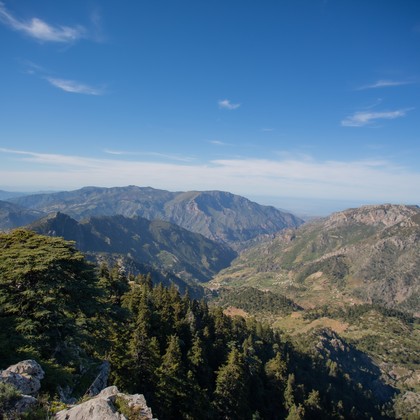
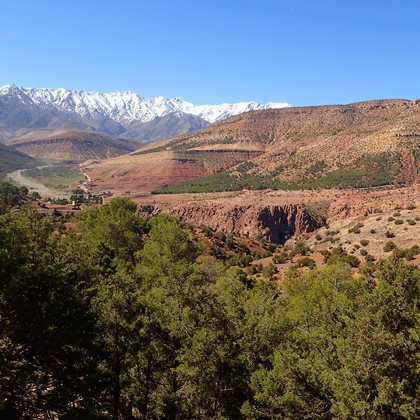
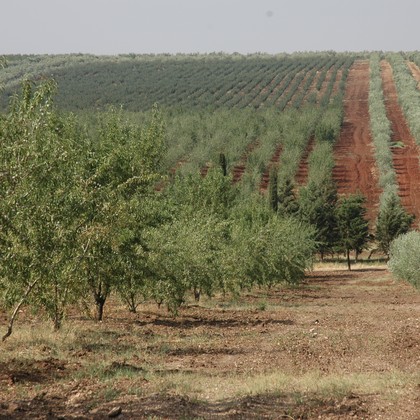
Woodland with old trees: cork and holm oak forest, cedar forest, Aleppo and maritime pine woods, also open woodland with grassy clearings, old olive groves and forest edges; from sea level to about 2,400 m in the High Atlas. Feeds much on the ground for ants and excavates its nest hole in a soft or decaying tree.
Where the bird is most at home, classified by the habitats of North Africa and the Middle East.
Range and movements
Endemic to the Maghreb. In Morocco widespread through the Rif, Middle Atlas and High Atlas, with outposts in the western Anti-Atlas, and in the lowlands in the Mamora cork-oak forest and around Rabat; in Algeria in the wooded Tell and the Saharan Atlas east to the Aurès; in Tunisia in the north-west (Kroumirie, Mogods) and locally in the mountains of the Dorsale. Absent from Libya and further east. It does not occur outside the region.
- Resident
- Summer visitor (c. Apr–Sep)
- Winter visitor (c. Oct–Mar)
- Passage (Mar–Apr, Oct–Nov)
- dark = core range, pale = thinly spread
How and when to look
The cedar forests around Ifrane and Azrou in the Middle Atlas and the Mamora forest near Rabat are the best-known sites. In the Tunisian Kroumirie, around Aïn Draham, it is fairly common. Listen early in the morning for the laugh and scan forest clearings for a green bird on the ground.
Conservation status
Not globally threatened and fairly common within its small range. It depends on woodland with old trees; overgrazing, logging and firewood cutting, forest fires and the loss of old olive groves reduce its habitat locally.
Scientific name
Picus vaillantii | (Malherbe, 1847)
Malherbe described the species in 1847 as Chloropicus Vaillantii; because it was later moved to another genus, the author and year stand in brackets. The genus Picus was introduced in 1758 by Linnaeus. Picus is the Latin word for 'woodpecker' and also the name of Picus, in Roman mythology the first king of Latium, who was turned into a woodpecker by the sorceress Circe. vaillantii honours the French explorer, collector and ornithologist François Levaillant (1753–1824). The specimen the first description was based on came from Algeria.