All species › Passerines › Waxbills › Indian Silverbill
Indian Silverbill | Euodice malabarica
Loodbekje | Capuchino picoplata
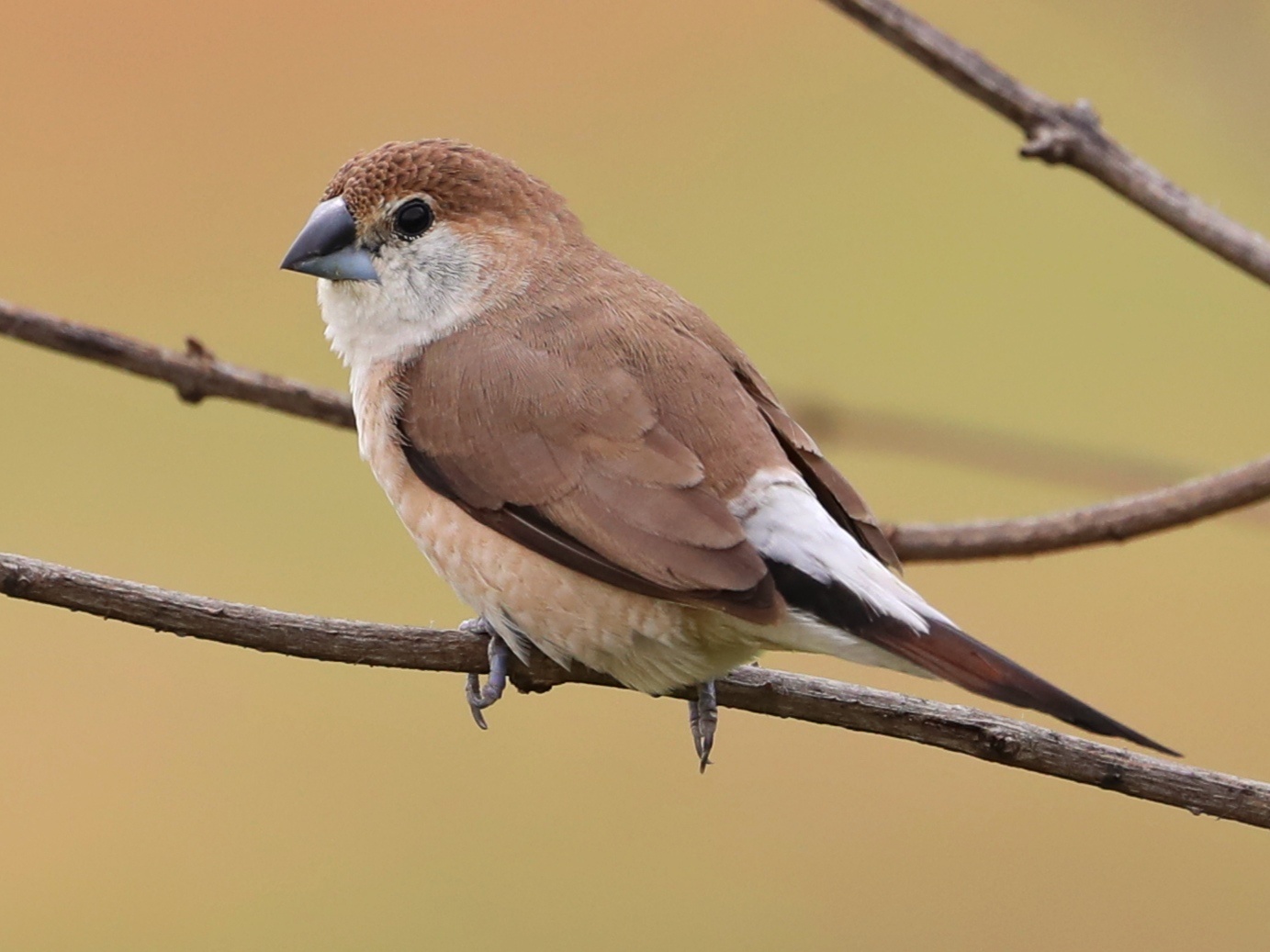
The Indian Silverbill is a small, pale estrildid with a silvery-grey bill and a long, pointed black tail, roaming in small flocks through the dry scrub and fields of Arabia and Mesopotamia. In recent decades it has also become established in the southern Levant and, lately, in Egypt.
Voice
A soft, constant, squeaky chip-chip or tsip, exchanged continuously while feeding and giving away a flock hidden in dense scrub; faster and sharper on take-off. The song is a long, very quiet, rambling ditty of squeaky and trilling notes.
Recording: David Darrell-Lambert — CC BY-NC-SA 4.0 · converted to mono · xeno-canto
Identification
11–11.5 cm, a good part of it the pointed tail. The heavy, conical bill is silvery-grey to bluish-grey and stands out even at a distance. Upperparts pale sandy brown, with dark brown wings contrasting with the pale back; underparts creamy white to white, unstreaked, with a buff wash on the flanks. The rump is white and shows on take-off between the dark wings and the black tail. Sexes alike; juveniles are buffier below and shorter-tailed.
Confusion species
African Silverbill (Euodice cantans) of south-western Arabia and the Sahara has a black instead of white rump, finely vermiculated upperparts and a slightly darker face; where both occur the rump colour on take-off is decisive. Scaly-breasted Munia (Lonchura punctulata) has a dark, almost black bill, a chocolate-brown head and scaled underparts; the juvenile munia is plain brown, darker and shorter-tailed. From a young House Sparrow (Passer domesticus) the silverbill differs in its silvery bill, unstreaked underparts and long pointed tail.
Habitat
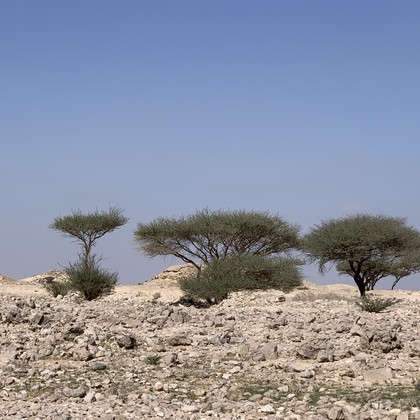
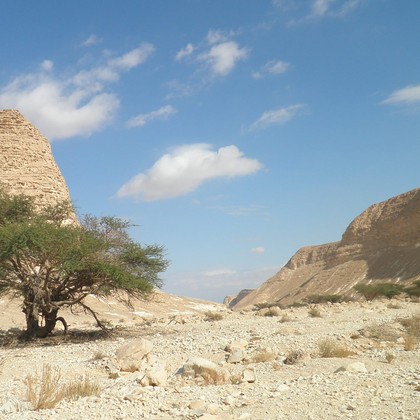
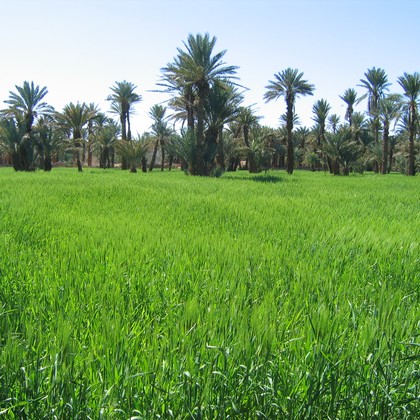
Dry open country with scattered bushes and acacias, wadis, the edges of irrigated fields, alfalfa and cereal fields, date-palm gardens, kibbutz fields and the green fringes of towns and villages; stays within reach of drinking water. Feeds on the ground and on grass heads, taking small seeds. The nest is an untidy ball of grass in a thorn bush, sometimes in an old nest of another species.
Where the bird is most at home, classified by the habitats of North Africa and the Middle East.
Range and movements
Common in Saudi Arabia outside the south-western highlands, in Kuwait, Bahrain, Qatar, the United Arab Emirates and Oman, and locally in Yemen; in Iraq in the Tigris and Euphrates valleys and in the south. Established since the late twentieth century in Israel (from the Arava and Eilat north to the Dead Sea, the Negev and the coastal plain) and Jordan (Aqaba, the Dead Sea and the Jordan Valley), probably partly from escaped cage birds; since about 2019 also established in Egypt. Beyond the region from Iran and Afghanistan through Pakistan and India to Sri Lanka; introduced in Puerto Rico, Hawaii and southern Europe among other places.
- Resident
- Winter visitor (c. Oct–Mar)
- Passage (Mar–Apr, Oct–Nov)
- dark = core range, pale = thinly spread
How and when to look
In the fields and kibbutz plots around Eilat, in the date-palm gardens of the Gulf states or in a vegetated wadi, listen for a fine, constant squeaking from a bush. A flushed flock shows the white rump and long black tail tip; in south-western Arabia and Dhofar always check the rump because of African Silverbill.
Conservation status
Not globally threatened. Common and increasing in the region, helped by irrigated agriculture and green urban fringes that have made the desert suitable for it. Trapped and traded as a cage bird; the spread into the Levant and Egypt is probably partly due to that trade.
Scientific name
Euodice malabarica | (Linnaeus, 1758)
Linnaeus described the species in 1758 as Loxia malabarica; because it was later moved to another genus, the author and year stand in brackets. The genus Euodice was introduced in 1863 by Reichenbach. Euodice is Greek, from eu 'good' and ōdikos 'singing', so roughly 'good singer'. malabarica refers to Malabar, the coastal region of south-western India. The specimen the first description was based on came from Malabar, India.