All species › Waterfowl › Ducks, geese and swans › Greater White-Fronted Goose
Greater White-Fronted Goose | Anser albifrons
Kolgans | Ánsar careto
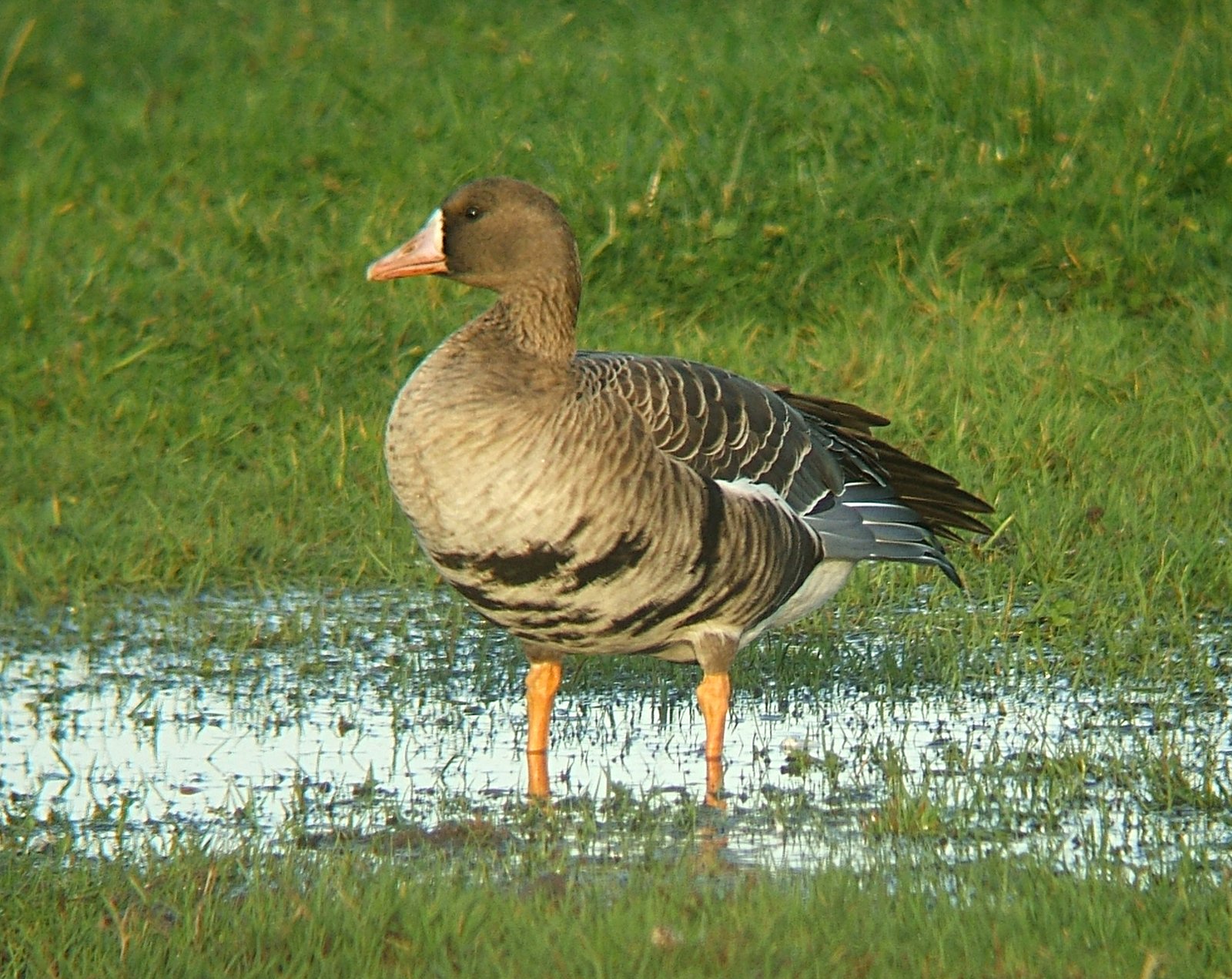
A medium-sized grey-brown goose with a white blaze at the base of the bill and black bars across the belly. In the region Greater White-fronted Goose is above all a winter visitor to Mesopotamia, where flocks graze on the fields and in the marshes along the Tigris and Euphrates.
Voice
Higher and more musical than Greylag Goose: a laughing, disyllabic kow-lyow or lyo-lyok; flocks in flight produce a melodious, babbling chorus.
Recording: Vandousselaere Patrick — CC BY-NC-SA 4.0 · converted to mono · xeno-canto
Identification
Medium-sized and fairly slim, darker grey-brown than Greylag Goose, with a rounded head. Adults have a white blaze around the bill base that reaches no further than the forehead below the eye, and irregular black bars on the belly. The bill is pink (in the Eurasian form albifrons), the legs orange. A narrow eye-ring is absent or dark. Juveniles lack blaze and belly bars and have a dark-tipped bill. In flight it looks darker and slimmer than Greylag Goose, without a pale forewing.
Confusion species
Lesser White-fronted Goose (Anser erythropus) is smaller, with a shorter bill, a blaze reaching higher and a yellow eye-ring. Greylag Goose (Anser anser) is larger and paler, without a blaze, with pink legs and a pale forewing. Tundra Bean-Goose (Anser serrirostris) has a dark head and a black bill with an orange band, without blaze or belly bars.
Habitat
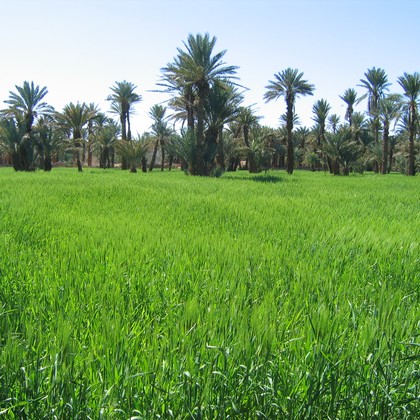
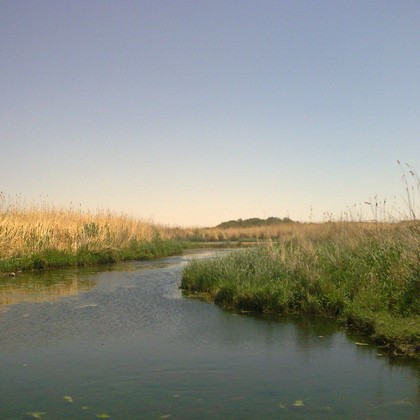
Fields of winter cereals, short grassland, floodplains and stubble near large marshes, lakes and rivers. Roosts on open water or exposed mud and flies to the feeding areas at dusk and dawn.
Where the bird is most at home, classified by the habitats of North Africa and the Middle East.
Range and movements
In Iraq a widespread winter visitor to the Mesopotamian marshes and along the Tigris and Euphrates, formerly in tens of thousands; also in Syria. Scarce in Kuwait and northern Saudi Arabia, and in small numbers in Israel (Hula Valley). In Egypt formerly regular in the Nile Delta, now scarce. Rare in Morocco, Algeria, Tunisia and Libya, usually a few birds among Greylag Geese. Breeds on the Arctic tundra from Russia to North America and Greenland and winters in western Europe, around the Black and Caspian Seas, in the Middle East, eastern Asia and North America.
- Resident
- Summer visitor (c. Apr–Sep)
- Winter visitor (c. Oct–Mar)
- dark = core range, pale = thinly spread
How and when to look
The best chance is from December to February in the marshes of southern Iraq and on fields in the north of the country. In Israel a few Greater White-Fronted Geese can occasionally be found in the Hula Valley among the cranes and Greylag Geese. Check every flock for a smaller bird with a yellow eye-ring: a Lesser White-fronted Goose.
Conservation status
Not threatened. Numbers in the region fell sharply after the drainage of the Mesopotamian marshes in the 1990s, and hunting remains a problem there. Following the partial restoration of the marshes, part of the wintering population has returned.
Scientific name
Anser albifrons | (Scopoli, 1769)
Scopoli described the species in 1769 as Branta albifrons; because it was later moved to another genus, the author and year stand in brackets. The genus Anser was introduced in 1760 by Brisson. Anser is the Latin word for 'goose'. albifrons is Latin, from albus 'white' and frons 'forehead', after the white blaze around the base of the bill. The specimen the first description was based on came from northern Italy.