All species › Gannets and cormorants › Cormorants › Great Cormorant
Great Cormorant | Phalacrocorax carbo
Aalscholver | Cormorán grande
The large, dark cormorant that in winter appears throughout the region on lakes, reservoirs, fishponds and coastal waters, often in big flocks. In the region it is mainly a winter visitor from Europe and the Black Sea; only in Morocco does a distinctive white-throated form breed.
Voice
Almost mute away from the colony. At the nest and at roosts deep guttural sounds and pig-like grunts: a rolling kroa-kroa-kroa.
Recording: David Darrell-Lambert — CC BY-NC-SA 4.0 · converted to mono · xeno-canto
Identification
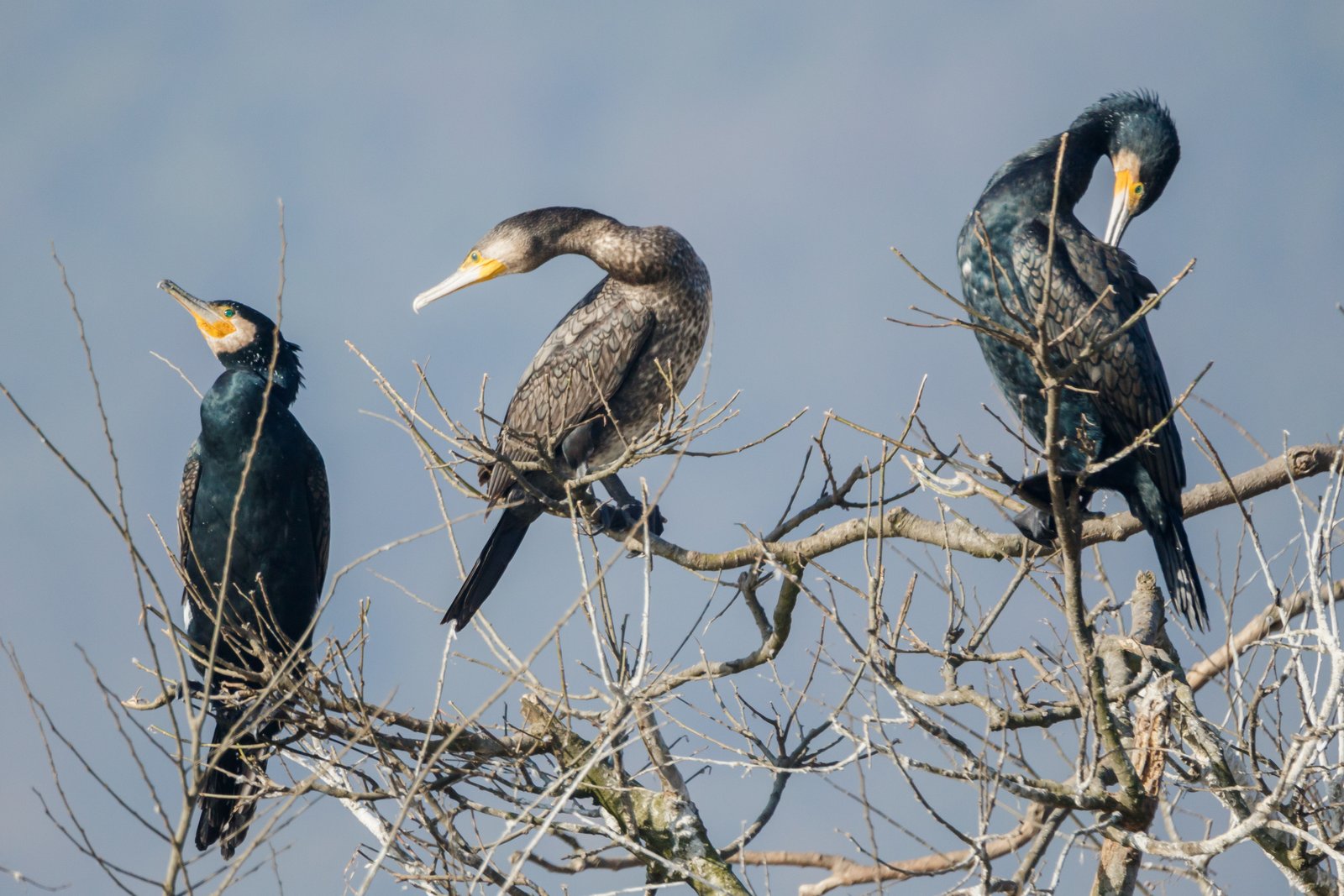
Large and black with a bronze-green gloss, a heavy, clearly hooked bill, a white chin patch and yellow bare skin around the bill base. In breeding plumage it adds a white thigh patch, and the form sinensis much white on head and neck. The Moroccan form maroccanus has an extensively white throat and foreneck, grading towards the white-breasted African birds. Juveniles are brown with variably white underparts. Swims low, half leaps from the water when diving and flies goose-like with a kinked neck, often in lines or V-formation; often perches with wings spread to dry.
Confusion species
European Shag (Gulosus aristotelis) is smaller and slimmer, with a steep forehead, a thin bill, no white chin patch and a straight neck in flight; it keeps to rocky coasts. Socotra Cormorant (Phalacrocorax nigrogularis) of the Gulf and Arabian Sea is smaller and slimmer, with a thin bill and dark facial skin without yellow. Pygmy Cormorant (Microcarbo pygmaeus) is much smaller, with a short bill and a long tail.
Habitat
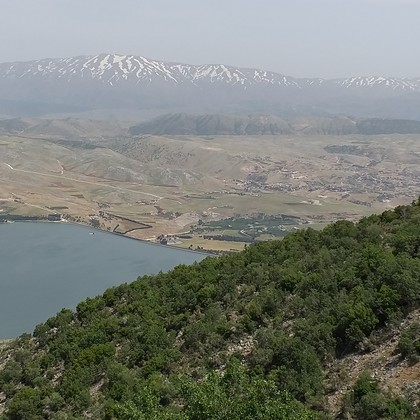
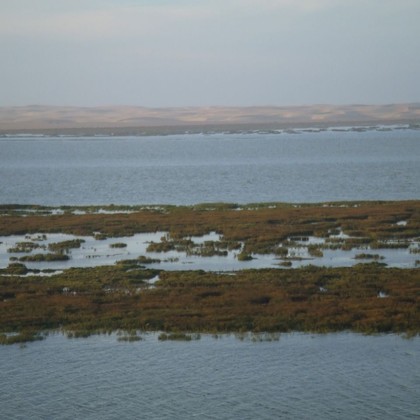
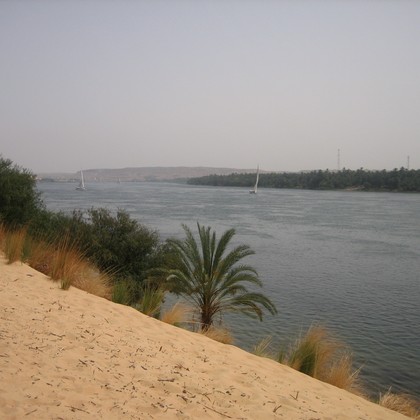
Almost any water rich in fish: reservoirs, rivers and the Nile, delta lakes, fishponds, lagoons, harbours and shallow coastal waters. In winter roosts communally in trees, on pylons or on rocks, sometimes in thousands. The Moroccan breeders nest on sea cliffs and in trees at reservoirs.
Where the bird is most at home, classified by the habitats of North Africa and the Middle East.
Range and movements
A winter visitor throughout the north of the region. In Morocco widespread on reservoirs and along the coast, reaching ever further south; the resident form maroccanus breeds on sea cliffs from the Essaouira archipelago southwards and at the Youssef Ben Tachfine dam near Tiznit, and in 2017 young birds of possibly European parents were seen near Mohammedia. In Algeria and Tunisia a numerous winter visitor to lakes, sebkhas and the coast, with occasional breeding; in Libya some 1000–2000 birds in January, mainly at Farwa, Tripoli and Benghazi, with a few at the oases of Houn and Jaghbub. In Egypt on the delta lakes, along the Nile and on Lake Nasser. Large numbers winter in Israel: 23,468 were counted in January 2025, including in the Hula, Bet She'an and Jordan valleys, on the coast and at Eilat. Also a winter visitor to Lebanon, Syria, Jordan and Iraq, and along the Persian Gulf from Kuwait to Oman; scarcer in inland Saudi Arabia and on the Red Sea coast, and rare in Yemen. Beyond the region it breeds from western Europe and the Black Sea to East Asia, and in Africa, Australia and North America.
- Resident
- Summer visitor (c. Apr–Sep)
- Winter visitor (c. Oct–Mar)
- Passage (Mar–Apr, Oct–Nov)
- dark = core range, pale = thinly spread
How and when to look
The roosts in Israel, as in the Bet She'an valley and at the Hula, draw long skeins of birds in the evening. For the Moroccan form, the islands and cliffs at Essaouira and the coast south to Souss-Massa are the place; look there for adults with a white throat and neck.
Conservation status
Not globally threatened and strongly increasing in Europe since the 1980s, which has also boosted the number of winter visitors in the region. In Israel it was almost wiped out by hunting in the 1950s; it has since recovered, but limited shooting is allowed at fishponds. Elsewhere it is persecuted as a competitor of fishermen. The small population of the Moroccan form deserves attention, partly because breeding European birds could interbreed with it.
Scientific name
Phalacrocorax carbo | (Linnaeus, 1758)
Linnaeus described the species in 1758 as Pelecanus Carbo; because it was later moved to another genus, the author and year stand in brackets. The genus Phalacrocorax was introduced in 1760 by Brisson. Phalacrocorax is the Latinised form of Greek phalakrokorax, from phalakros 'bald' and korax 'raven'. carbo is Latin for 'charcoal', after the black plumage. The specimen the first description was based on came from the North Atlantic.