All species › Bustards › Bustards › Great Bustard
Great Bustard | Otis tarda
Grote trap | Avutarda común
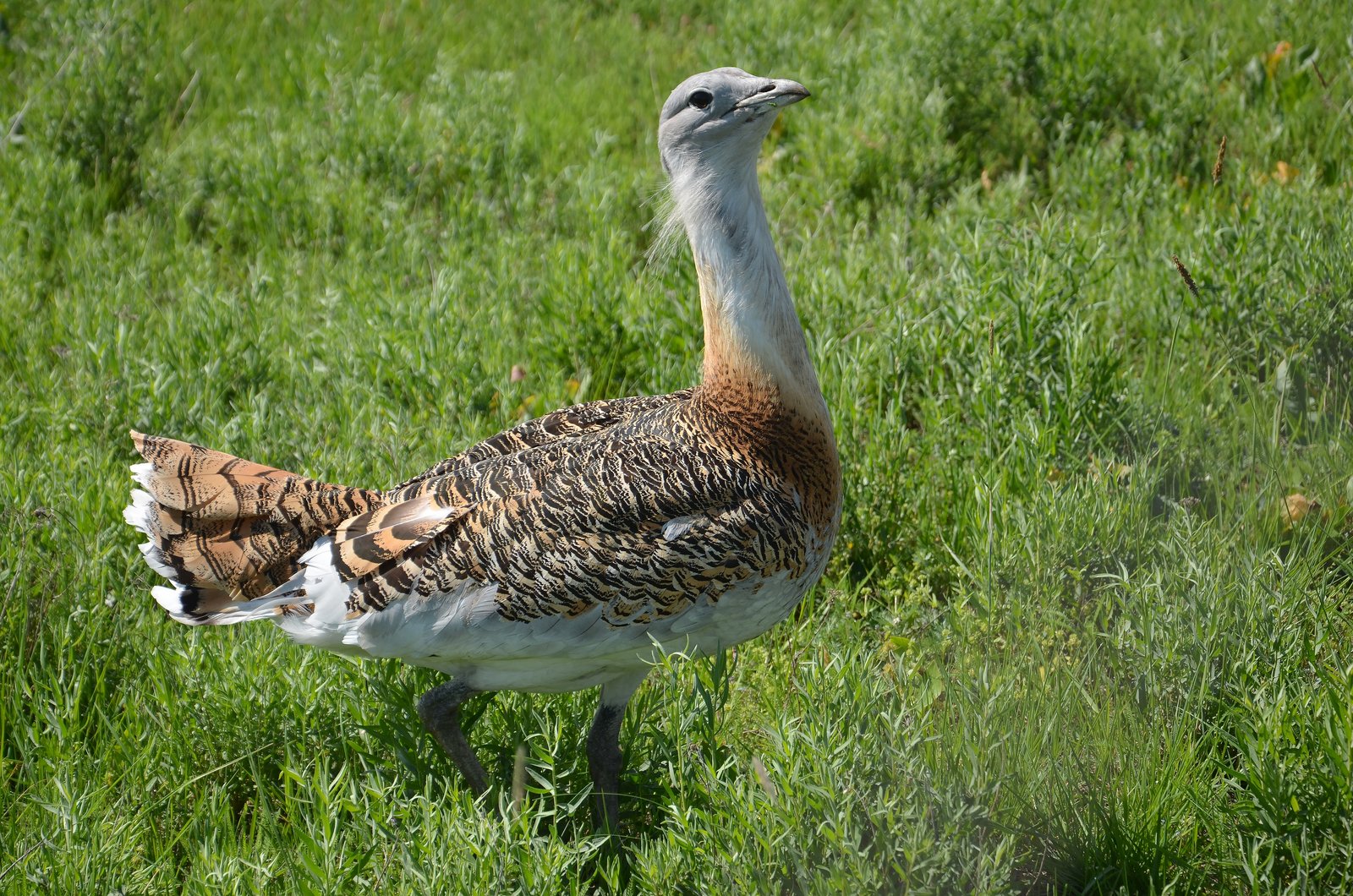
The heaviest flying bird of the region and at the same time one of its rarest breeding birds. A few dozen Great Bustards survive on the cereal plains between Tangier and Larache, the last in all of Africa; in March the displaying males stand there like white balls among the young wheat.
Voice
Almost always silent. The displaying male makes at most a low, muffled grunt that fades within a few dozen metres; alarmed birds sometimes give a short, barking ak. This is a species found by sight, not by sound.
Recording: Esperanza Poveda — CC BY-NC-SA 4.0 · converted to mono · xeno-canto
Identification
Large and heavily built, with a thick neck and broad chest; the male is much larger and heavier than the female. The male has a blue-grey head and neck, in spring long white whiskers on either side of the bill base, and a rufous breast band that grows broader and darker with age. The female is slimmer, with a thinner grey neck, and lacks whiskers and breast band. Both have ochre-brown, densely black-barred upperparts and a white belly. In flight: broad wings with much white in the arm, blackish-brown primaries and a dark trailing edge, and slow, powerful, goose-like beats.
Confusion species
Little Bustard (Tetrax tetrax) is more than eight times lighter, short-necked, and flies fast with whistling wingbeats. African Houbara (Chlamydotis undulata) is smaller and slimmer, paler and sandier, with a black stripe down the side of the neck and a white patch on the primaries; it lives on steppe and stony desert, not among cereals. Common Crane (Grus grus) also stands tall and grey in a field at a distance, but has much longer legs and a thin neck, and travels in lines and V-formations.
Habitat
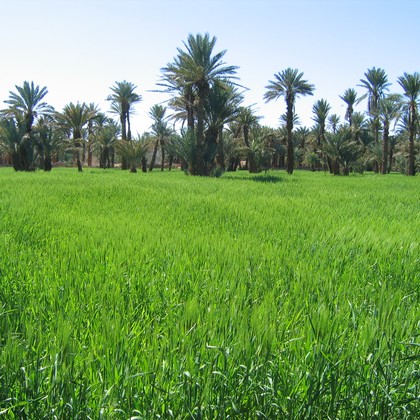
Open, rolling farmland with wheat, barley, chickpeas, fallow and lightly grazed pasture, without trees, buildings or overhead wires. In northern Morocco a small-scale mosaic on low hills; in winter the birds seek green crops and clover. Very shy and sensitive to disturbance.
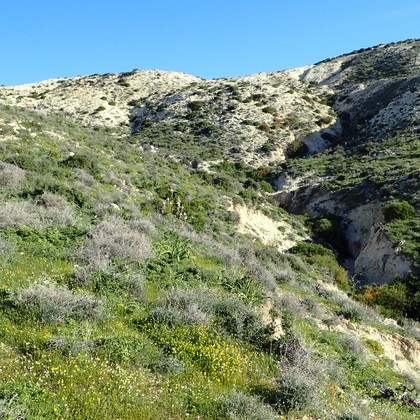
Where the bird is most at home, classified by the habitats of North Africa and the Middle East.
Range and movements
In the region the Great Bustard breeds only in the far north-west of Morocco, in two small groups in the hill country south of Tangier (around Tleta Rissana and Araoua); the national count of 2023 found almost seventy birds. It formerly occurred more widely in northern Morocco and also in northern Algeria and northern Tunisia, where it disappeared long ago. In the east a rare winter visitor or vagrant from Turkey and Iran, mainly in northern Syria and northern Iraq; exceptional farther south in the Levant. Outside the region: Iberia, home to most of the world population, central Europe, southern Russia and Kazakhstan, Anatolia and the Iranian Plateau, and east to Mongolia and north-east China.
- Resident
- Summer visitor (c. Apr–Sep)
- Winter visitor (c. Oct–Mar)
- Passage (Mar–Apr, Oct–Nov)
- dark = core range, pale = thinly spread
How and when to look
Visit the plains south of Tangier in March or early April, early in the morning, and scan from the road or from the car with a telescope. Never walk into the fields: the birds are extremely shy, and in so small a population every disturbance of the display matters. Local birders and conservationists know where the groups are.
Conservation status
Endangered. The Moroccan population fell from almost a hundred birds around 2000 to about fifty in 2015 and, under a national action plan, seems to have stabilised at around seventy since. Collisions with power lines, agricultural intensification, fragmentation by roads and buildings and illegal hunting are the main threats. As a winter visitor in the east the species has all but disappeared through hunting.
Scientific name
Otis tarda | Linnaeus, 1758
Linnaeus described the species in 1758 and placed it straight away in the genus where it still stands. He introduced the genus Otis in that same work. Otis is Greek ōtis, the name Pliny and other classical authors used for the bustard. tarda is Latin for 'slow, deliberate', after the bird's measured walk; from avis tarda 'slow bird' came the English name bustard, by way of Old French. The specimen the first description was based on came from Poland.