All species › Waders, gulls and terns › Gulls and terns › Franklin's Gull
Franklin's Gull | Leucophaeus pipixcan
Franklins meeuw | Gaviota de Franklin
A small, dark-mantled gull of the North American prairies that normally winters along the Pacific coast of South America. A handful of birds have crossed to the Old World and usually turn up among Black-Headed Gulls, from Morocco's Atlantic coast to Eilat and the Gulf.
Voice
A soft, nasal kuk or weeh, higher and less hoarse than Black-headed Gull; vagrants are usually silent.
Recording: Dante Buzzetti — CC BY-NC-SA 4.0 · converted to mono · xeno-canto
Identification
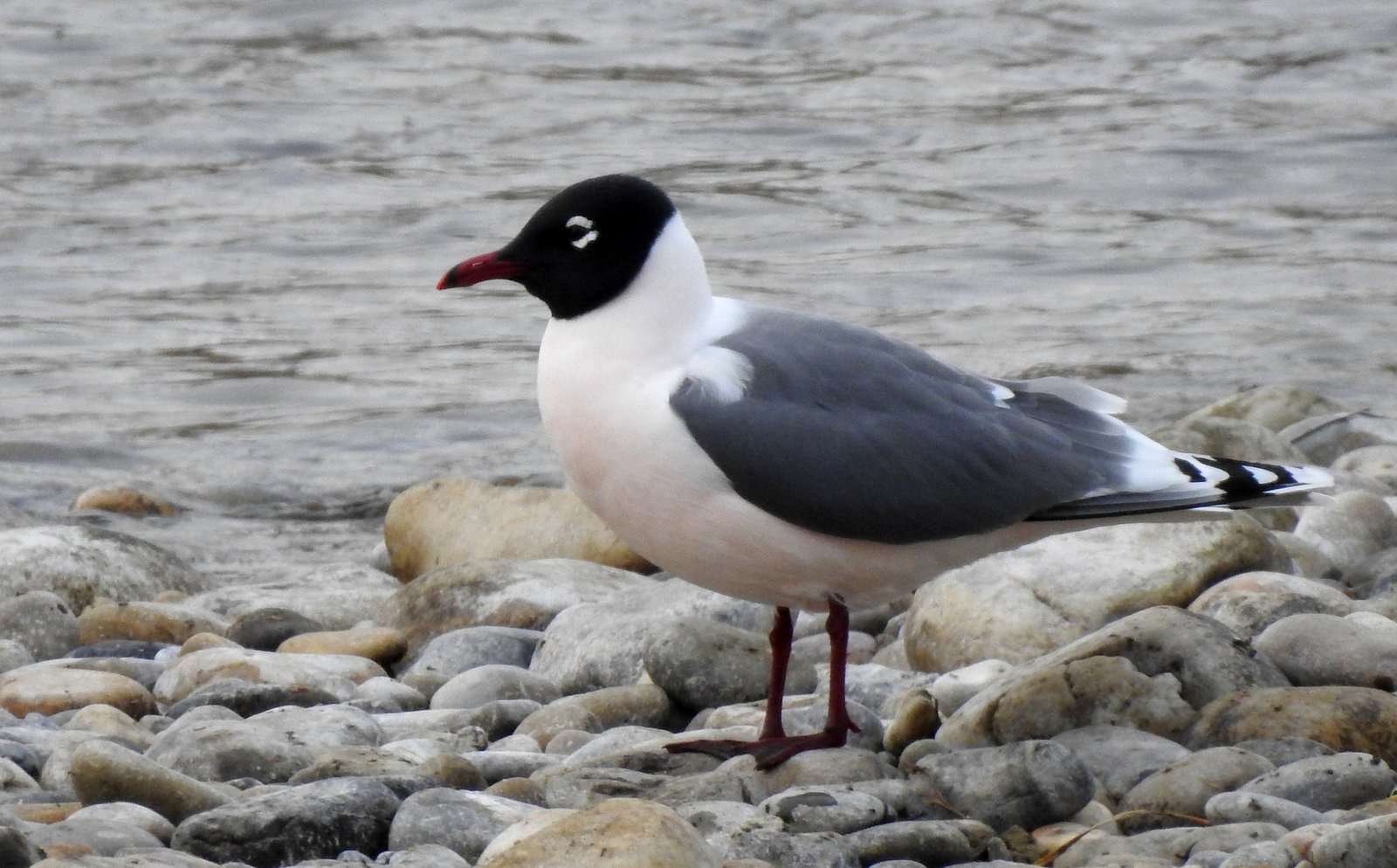
Smaller and more compact than Black-headed Gull, with a rounded head, a fairly short bill and shorter legs. The mantle is dark slate-grey, clearly darker than Black-Headed and Mediterranean Gulls. Adults have a broad white trailing edge to the wing and a white band between the grey and the black wingtips, which themselves carry small white spots. Broad white eye-crescents above and below the eye stand out in all plumages. In breeding plumage a full black hood and a red bill, the breast sometimes flushed pink; in winter a dark 'half-hood' over the rear crown and ear coverts, with white forehead and throat. First-years have a grey mantle, a dark half-hood, a narrow black tail band with grey outer feathers, and a white breast.
Confusion species
Laughing Gull (Leucophaeus atricilla, not in this guide) is larger, with a longer, drooping bill and no white band before the wingtip; first-years have grey breast sides. Black-headed Gull (Chroicocephalus ridibundus) is much paler above, has a white leading edge to the wing and in winter only an ear spot. Mediterranean Gull (Ichthyaetus melanocephalus) has a similar dark mask in winter, but a pale mantle and white wingtips.
Habitat
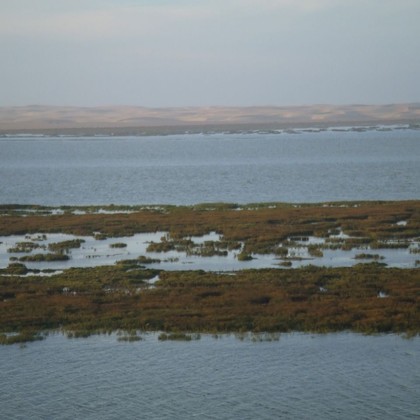
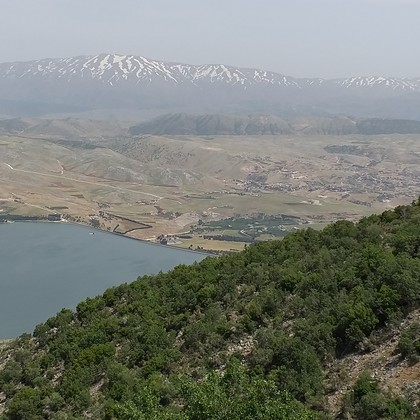
In the region mainly on beaches, harbours, lagoons and estuaries, among flocks of Black-Headed and other small gulls; one bird stayed on a temporary desert lake. On the breeding grounds prairie marshes, in winter the Pacific coast and farmland.
Where the bird is most at home, classified by the habitats of North Africa and the Middle East.
Range and movements
Just over ten records in Morocco, most on the Atlantic coast in the Souss, one on the Mediterranean coast and one far inland at the temporary lake Dayet Srij near Merzouga (April 2019). In Israel two birds at Eilat (June 2003 and July 2006); in Egypt one on the Nile at Luxor in March, the first for the country; in Kuwait one in southern Kuwait Bay (June 2012); in the Emirates one near Fujairah (September 2018). We know of no records from Algeria, Tunisia, Libya or Saudi Arabia. Beyond the region it breeds on the prairies of Canada and the northern United States and winters along the coast of Peru and Chile; vagrants regularly reach western Europe and West Africa.
How and when to look
In Morocco, scan the Black-headed Gull flocks at the Souss estuary and the beaches near Agadir in autumn and winter, looking for a darker-mantled bird with a dark half-hood. In the Gulf and at Eilat most vagrants have turned up in summer, so check gull flocks then too.
Conservation status
Not globally threatened and numerous in North America. In the region a rare vagrant, recorded just over ten times in Morocco and once or twice each in four other countries.
Scientific name
Leucophaeus pipixcan | (Wagler, 1831)
Wagler described the species in 1831 as Larus Pipixcan; because it was later moved to another genus, the author and year stand in brackets. The genus Leucophaeus was introduced in 1855 by Bruch. Leucophaeus is Ancient Greek, from leukos 'white' and phaios 'dusky'. pipixcan is a Nahuatl name for a kind of gull. The specimen the first description was based on came from Mexico.