All species › Passerines › Crows and jays › Fan-Tailed Raven
Fan-Tailed Raven | Corvus rhipidurus
Waaierstaartraaf | Cuervo colicorto
A stocky, short-tailed raven of the cliffs along the Rift Valley and the Red Sea. Above the cliffs of the Dead Sea, at Petra and in the mountains of the Hejaz and Yemen it soars skilfully on thermals and in the air looks like a large black bat or a tailless vulture.
Voice
A high, hoarse, nasal kraah or aaark, more clipped than Brown-necked Raven, often in series from a cliff edge or in flight; also a dry rattle and soft throaty sounds at the nest. A flock over a cliff produces a continuous high cawing echoing off the walls.
Recording: Stanislas Wroza — CC BY-NC-SA 4.0 · shortened to the first 60 s, mono · xeno-canto
Identification
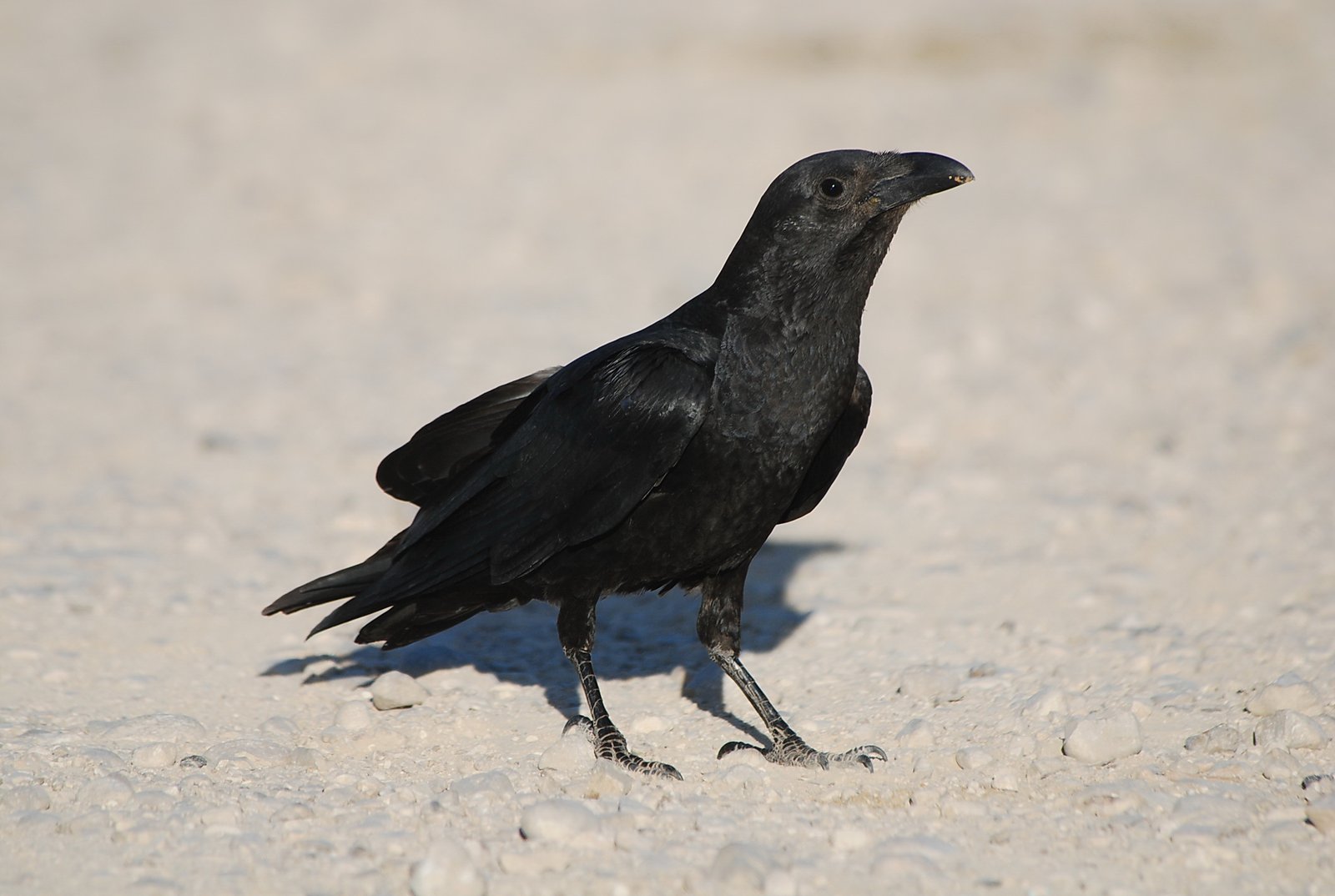
Heavily built, with broad, deeply fingered wings, a thick head and a heavy, curved bill, and a strikingly short tail. In a perched bird the wingtips reach to or beyond the tail tip. In flight the bird looks almost tailless: the short tail is fanned into a half-circle when soaring and the wingspan seems enormous relative to the body. The plumage is glossy black with purple and bronze sheen; the throat feathers are short. Juveniles are duller and browner, with a shorter bill.
Confusion species
Brown-necked Raven (Corvus ruficollis), often at the same sites, is slimmer and narrower-winged and has a tail that projects clearly beyond the wingtips. Northern Raven (Corvus corax), in Israel and Jordan in the northern hills, is larger and has a long, pointed wedge-shaped tail. Tristram's Starling (Onychognathus tristramii) shares the same rocky terrain and looks black and broad-winged at a distance too, but is much smaller, shows orange-red wing panels and whistles clearly.
Habitat
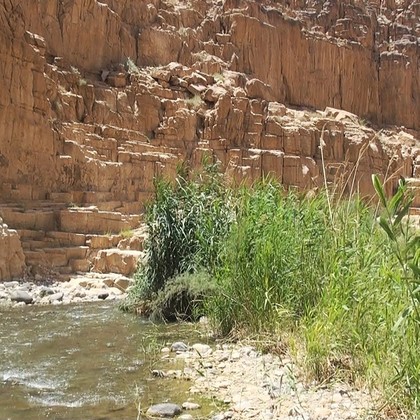
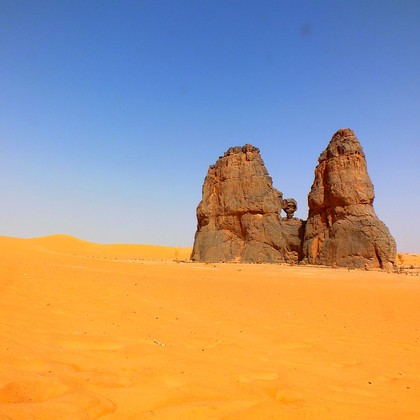
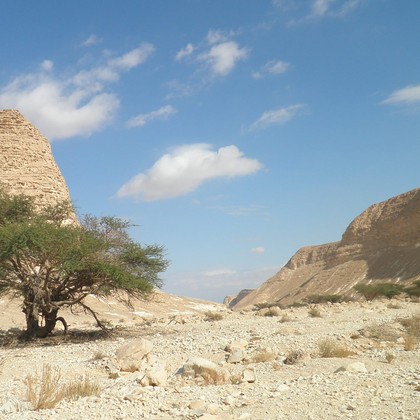
Steep cliffs, gorges, canyons and mountains in arid country, from the Dead Sea shore (over 400 m below sea level) to high in the Yemeni mountains. Also feeds in wadis, on fields, near villages, campsites, viewpoints and rubbish dumps, and follows livestock and camels. Nests on a ledge or in a crevice in a cliff.
Where the bird is most at home, classified by the habitats of North Africa and the Middle East.
Range and movements
In Israel along the Dead Sea, in the Judean Desert and in the mountains around Eilat, and in Judea and Samaria in the desert wadis running down to the Dead Sea; in Jordan along the Dead Sea, at Petra, Wadi Rum and around Aqaba; in Egypt in the mountains of southern Sinai (St Catherine) and in the Red Sea mountains south to Gebel Elba. On the Arabian Peninsula along the whole western edge: the Hejaz and Asir mountains in Saudi Arabia and the highlands and escarpment of Yemen, and in Oman mainly in Dhofar. Beyond the region in East Africa (Sudan, Eritrea, Ethiopia, Somalia, northern Kenya) and in isolated Sahelian mountains in Chad (Ennedi, Tibesti) and Niger (Aïr).
- Resident
- Summer visitor (c. Apr–Sep)
- Winter visitor (c. Oct–Mar)
- Passage (Mar–Apr, Oct–Nov)
- dark = core range, pale = thinly spread
How and when to look
Masada, Ein Gedi and the viewpoints along the Dead Sea are classic: the birds pass at close range here, often together with Tristram's Starlings. At Petra and Wadi Rum they are equally hard to miss.
Conservation status
Not globally threatened and locally common in the region; it benefits from tourism and refuse around viewpoints and settlements.
Scientific name
Corvus rhipidurus | Hartert, 1918
Hartert described the species in 1918 and placed it straight away in the genus where it still stands. The genus Corvus was introduced in 1758 by Linnaeus. Corvus is the Latin word for 'raven'. rhipidurus is Greek, from rhipis 'fan' and oura 'tail', after the short tail spread wide in flight. The specimen the first description was based on came from Massawa, Eritrea.