All species › Waders, gulls and terns › Stone-curlews › Eurasian Thick-Knee
Eurasian Thick-Knee | Burhinus oedicnemus
Griel | Alcaraván común
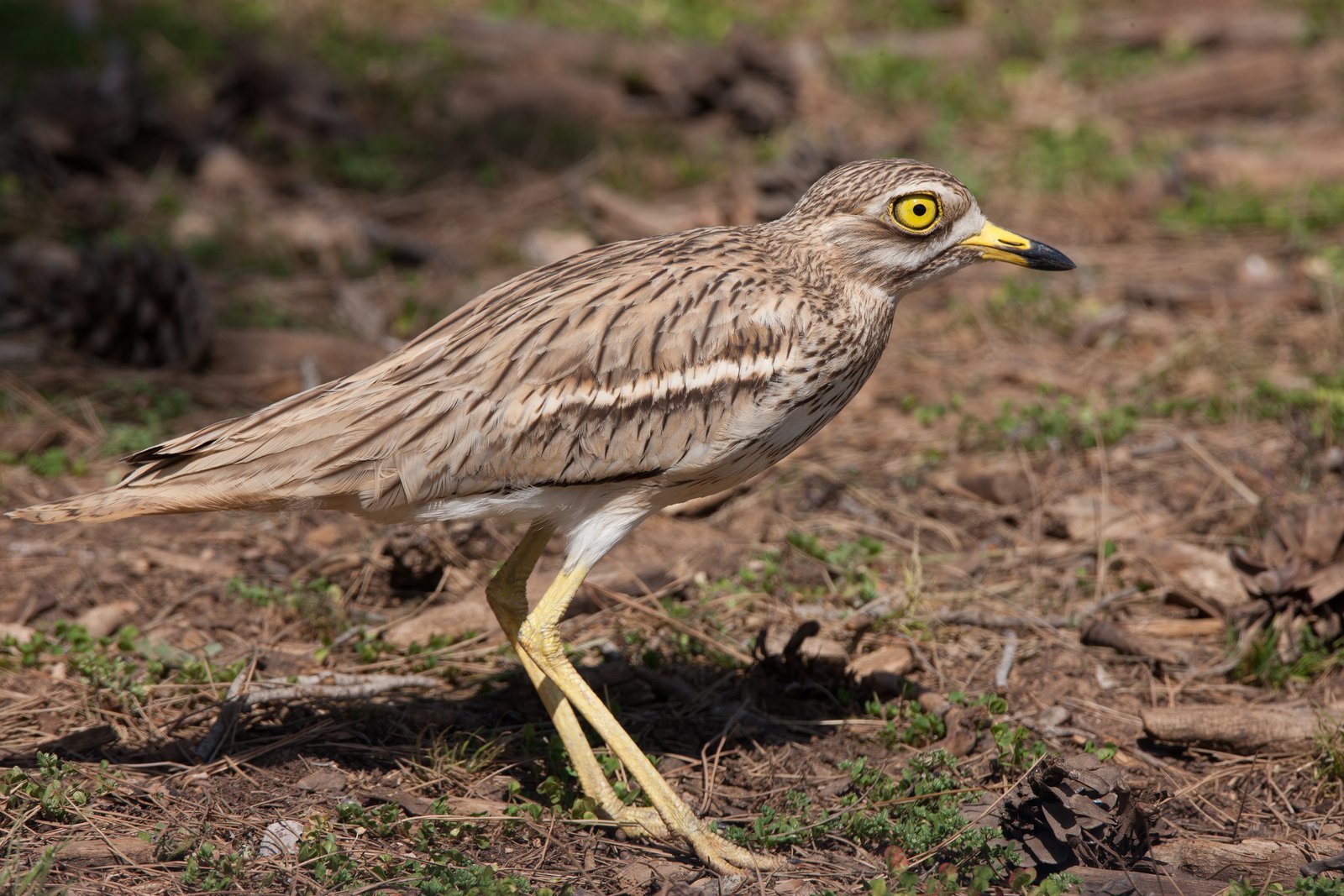
A large, sand-coloured wader of stony plains and steppe, lying motionless among the stones by day and becoming active only as night falls. In the Maghreb and the Levant a widespread breeder; in winter birds from the north settle deep into Arabia.
Voice
From sunset a plaintive, drawn-out and rising coor-leeee, curlew-like but sharper and shriller. Birds answer each other and build this into a chorus in which the calls become shorter and faster, kwee-kwee-kwee. When alarmed a short, hard kik-kik-kik. On calm nights the sound carries far across the plain.
Recording: Sophie REVERDIAU — CC BY-NC-SA 4.0 · converted to mono · xeno-canto
Identification
Coarsely streaked sandy-brown, with a sturdy neck, a heavy, round head and a large, bright yellow eye. A white supercilium and a white stripe below the eye frame a dark cheek stripe. The short, thick bill is yellow with a black tip; the legs are yellow and thick, with a swollen tarsal joint. On the folded wing there is a striking black-white-black bar across the coverts. In flight black primaries with two white patches and a broad-winged, slow impression. North African and Middle Eastern birds (saharae) are paler and more rufous-sandy than European ones.
Confusion species
Senegal Thick-Knee (Burhinus senegalensis) in Egypt is smaller, with a longer, mainly black bill with a small yellow base, a plain grey panel above a narrow black bar on the folded wing and a single white primary patch. Spotted Thick-Knee (Burhinus capensis) in south-west Arabia is spotted rather than streaked and lacks the wing bar. Great Stone-curlew (Esacus recurvirostris) is much larger, unstreaked and has a massive, upturned-looking bill. In flight the wing pattern may suggest a large plover, and in the dark the call is sometimes mistaken for Eurasian Curlew (Numenius arquata).
Habitat
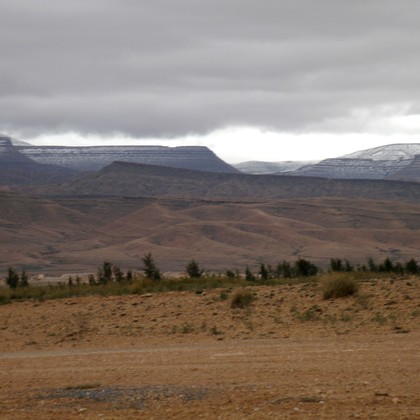
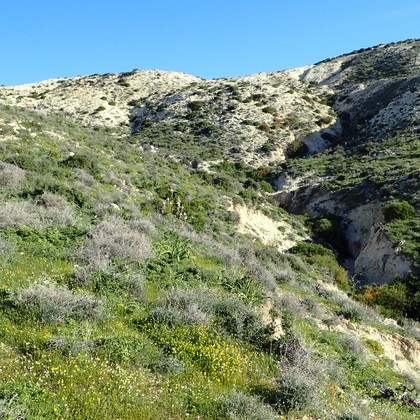
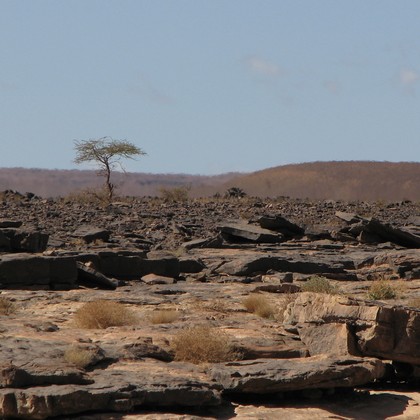
Open, dry, sparsely vegetated country with a stony or gravelly soil: alfa steppe and high plateaus, herbaceous steppe, the edges of stony desert, dry fields, fallow and olive groves, and in winter also semi-desert, wadis, farmland, and lawns and golf courses in the Gulf states. Nests in a scrape on bare ground.
Where the bird is most at home, classified by the habitats of North Africa and the Middle East.
Range and movements
Breeds in the north of the region. Morocco: widespread on the plains and steppes, from the Atlantic coast and the Souss to the high plateaus in the east. Algeria and Tunisia: on the steppes, high plateaus and the northern edge of the Sahara. Libya: in Tripolitania and Cyrenaica. Egypt: breeds on the north coast and in Sinai, otherwise mainly a passage migrant and winter visitor. In the Levant a common breeder in Israel, especially in the Negev and the coastal plain, and in Jordan, Syria and Lebanon; also in Iraq. In Arabia mainly a passage migrant and winter visitor, from Kuwait and northern Saudi Arabia to Bahrain, Qatar, the Emirates and Oman, and scarce in Yemen; in the Emirates birds often stay for days in farmland. Beyond the region from southern and central Europe to Central Asia and the Indian subcontinent; northern birds partly winter in the Sahel.
- Resident
- Summer visitor (c. Apr–Sep)
- Winter visitor (c. Oct–Mar)
- Passage (Mar–Apr, Oct–Nov)
- dark = core range, pale = thinly spread
How and when to look
After sunset go to an open, stony plain, for example in the steppes of eastern Morocco or the Negev, switch off the engine and listen. In autumn flocks of dozens gather on fallow and stubble, the best chance to see them by daylight; scan the bare ground for the yellow eyes. In the Gulf states wintering birds often sit still by day in the shade under bushes in farmland.
Conservation status
Not globally threatened. In the region it is declining locally through the ploughing of steppe, more intensive farming and building, and in winter through hunting and trapping, among others in Arabia, where the Emirates publicly warn against poaching.
Scientific name
Burhinus oedicnemus | (Linnaeus, 1758)
Linnaeus described the species in 1758 as Charadrius Oedicnemus; because it was later moved to another genus, the author and year stand in brackets. The genus Burhinus was introduced in 1811 by Illiger. Burhinus is Greek, from bous 'ox' and rhis 'nose', after the heavy, broad base of the bill. oedicnemus is Greek, from oideō 'to swell' and knēmē 'shin', after the thick joints of the legs. The specimen the first description was based on came from England.