All species › Owls › Typical owls › Eurasian Scops-Owl
Eurasian Scops-Owl | Otus scops
Dwergooruil | Autillo europeo
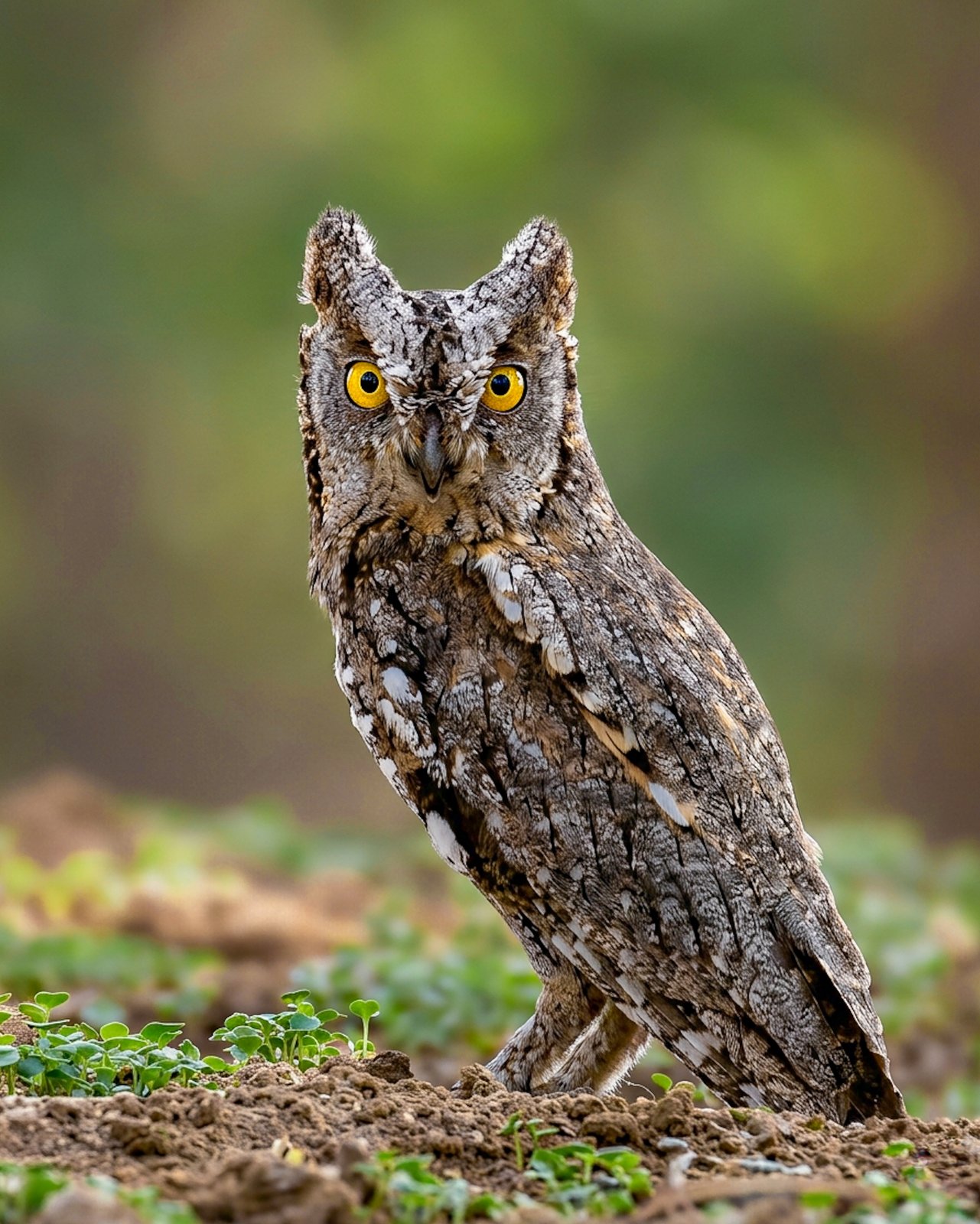
A small, slim eared owl that is heard far more often than seen: its monotonous whistle rings out on summer nights in the Atlas, in Mediterranean villages and in the mountains of the Levant. In spring and autumn it migrates through the whole region, including across the Sahara and the Arabian Peninsula.
Voice
The song is a pure, short whistled tyoo, repeated every two or three seconds for hours, often in duet with the female, who whistles slightly higher. It resembles the call of the midwife toad, which calls on the same nights.
Recording: Thierry THOMAS — CC BY-NC-SA 4.0 · converted to mono · xeno-canto
Identification
Small and slim, with short ear tufts that it can flatten or raise. Plumage grey-brown, finely spotted and streaked like tree bark, with a row of pale spots on the scapulars and thin black shaft streaks below. The eyes are yellow. Some birds are greyer, others browner. By day it sits elongated with its eyes almost closed against a trunk, virtually invisible. The wings are long and pointed for a small owl.
Confusion species
Pallid Scops Owl (Otus brucei) is paler and plainer sandy grey, with less fine vermiculation, bolder black streaks on the breast, a whiter face and a completely different song. Arabian Scops Owl (Otus pamelae) of south-western Arabia is smaller and paler, with shorter wings. Little Owl (Athene noctua) has a flat head without ear tufts and sits out on rocks by day.
Habitat
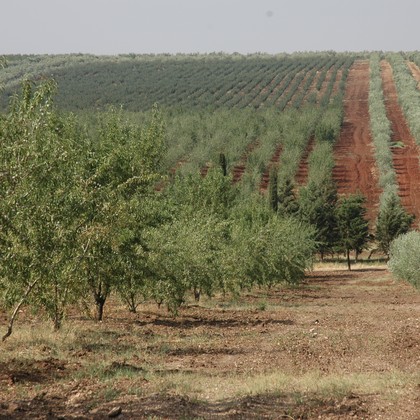
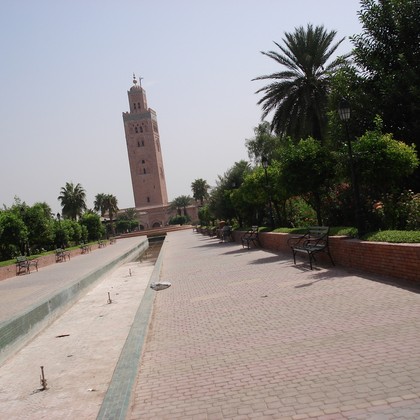
Semi-open country with scattered trees: olive groves, orchards, open oak and cedar woods, poplars along streams, parks and village gardens with old trees. Nests in tree holes, woodpecker holes and wall cavities, also in nest boxes. Hunts mainly large insects such as grasshoppers, crickets and moths. On migration in any copse, oasis or palm grove, even in the desert.
Where the bird is most at home, classified by the habitats of North Africa and the Middle East.

Range and movements
Breeds in northern Morocco, the Middle and High Atlas and the Rif, northern Algeria and northern Tunisia, and in Libya in the Jebel Akhdar of Cyrenaica. In the east it breeds in Lebanon, western Syria, northern Israel (Galilee, the Golan and Mount Hermon), locally in northern Jordan and in Iraqi Kurdistan. A small wintering population remains in the lowlands of Morocco, Algeria and Tunisia. On passage, mainly in April–May and September–October, it appears throughout North Africa including the Saharan oases and Egypt, in Israel and Jordan, and in small numbers across Saudi Arabia, Kuwait, Bahrain, Qatar, the Emirates and Oman. Beyond the region it breeds from southern Europe to Central Asia and winters in the Sahel and the savannas south of the Sahara.
- Resident
- Summer visitor (c. Apr–Sep)
- Winter visitor (c. Oct–Mar)
- Passage (Mar–Apr, Oct–Nov)
- dark = core range, pale = thinly spread
How and when to look
Listen on a warm evening in May or June in the cedar towns of the Middle Atlas, such as Ifrane and Azrou, or in the villages of the Lebanese mountains: once the song starts, the bird can often be found on a branch with a torch. On migration, check the trees of gardens in Eilat or parks in the Gulf states.
Conservation status
Not threatened. In Europe and North Africa locally declining due to the loss of old trees, insecticide use and agricultural intensification; on migration birds die through illegal trapping and traffic.
Scientific name
Otus scops | (Linnaeus, 1758)
Linnaeus described the species in 1758 as Strix Scops; because it was later moved to another genus, the author and year stand in brackets. The genus Otus was introduced in 1769 by Pennant. Otus is Latin for 'eared owl', borrowed from the Greek ōtos, from ous 'ear'. scops comes from Greek skōps, the classical name for a small eared owl. The specimen the first description was based on came from Italy.