All species › Passerines › Crows and jays › Eurasian Jackdaw
Eurasian Jackdaw | Coloeus monedula
Kauw | Grajilla occidental
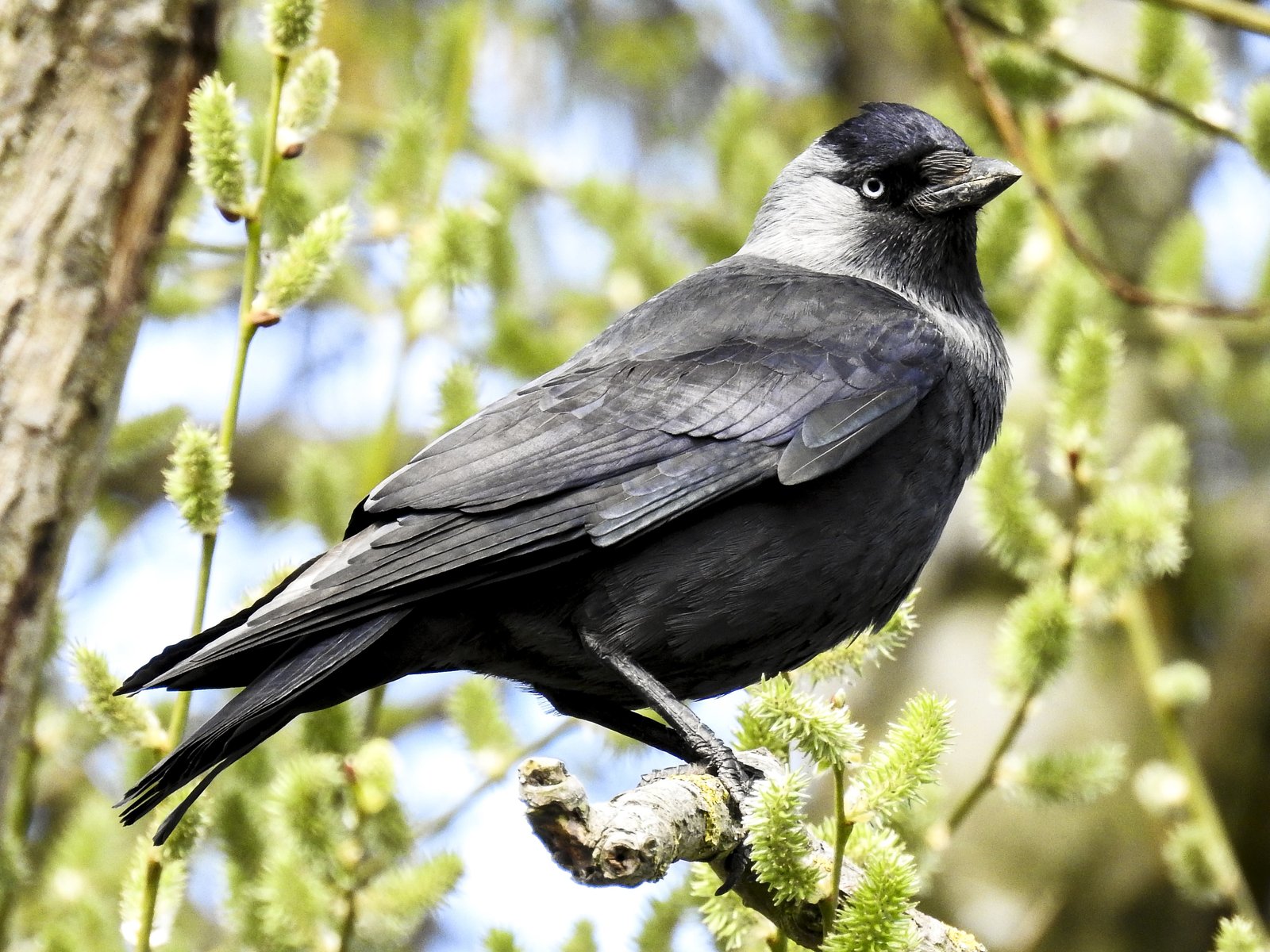
A small, social crow with a grey nape and a strikingly pale iris. In the region it has two separate strongholds: north-west Africa, where it breeds in gorges and old towns, and the Levant to northern Iraq, home to the form with a silvery-white neck patch.
Voice
A short, metallic tchak or kyak, repeated busily and cheerfully in flocks; also a longer kyaa and softer sounds at the nest.
Recording: Clément Bruneau — CC BY-NC-SA 4.0 · converted to mono · xeno-canto
Identification
30–34 cm. Black with a grey hindcrown and nape, a pearly white to pale grey iris and a short, thick black bill. The eastern form in the Levant and Iraq has a pale grey nape and a silvery-white patch on the side of the neck; the North African form is darker, with a less contrasting nape. Juveniles have a dark iris and duller nape. Flies fast with fairly deep wingbeats and has a short tail; often in noisy flocks, also with Rooks.
Confusion species
Red-billed Chough (Pyrrhocorax pyrrhocorax) and Alpine Chough (Pyrrhocorax graculus) have a red or yellow bill and red legs. Rook (Corvus frugilegus) is much larger with a bare bill base. House Crow (Corvus splendens) on the Gulf and Red Sea coasts also has a grey neck, but is larger, with a heavy bill, dark iris and grey extending onto the breast.
Habitat
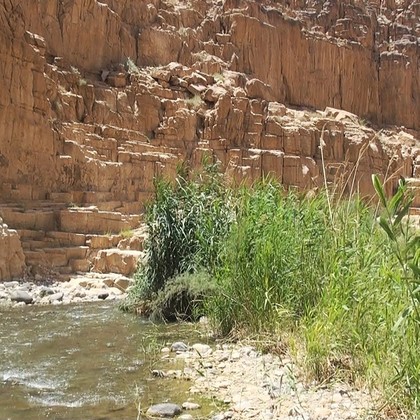
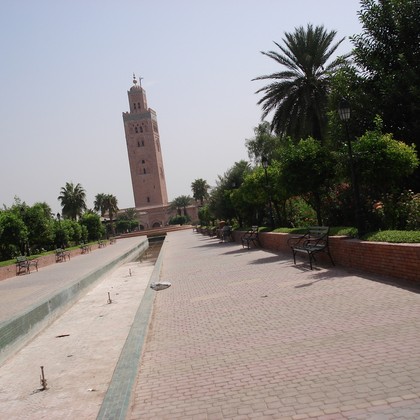
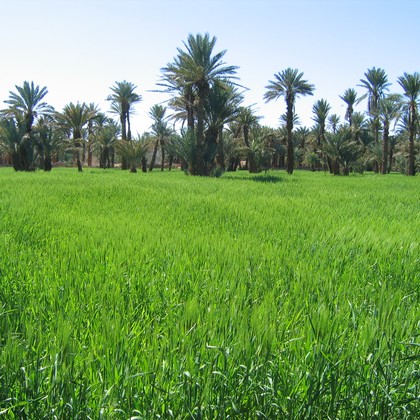
Cliffs, gorges and steep river banks, ruins, old buildings, minarets and city walls, and the surrounding open country with fields and pastures. Nests in holes in rock, buildings and trees, often colonially. In winter flocks feed on fields and rubbish tips.
Where the bird is most at home, classified by the habitats of North Africa and the Middle East.
Range and movements
In Morocco in the Middle Atlas and High Atlas, with breeding colonies in gorges and in towns and villages such as Ifrane and Azrou, and locally in the north. In Algeria in the Tell and on the northern high plateaus, including around Constantine. In the Levant in Israel (Golan, Hermon, Galilee, the Judean hills), Samaria and Judea, north-western Jordan, Lebanon and Syria, and further in northern Iraq. In winter flocks wander and a few birds appear further south, to Kuwait and northern Saudi Arabia; a vagrant in Egypt. Beyond the region it breeds from Europe and Turkey to western Siberia and Central Asia.
- Resident
- Summer visitor (c. Apr–Sep)
- Winter visitor (c. Oct–Mar)
- Passage (Mar–Apr, Oct–Nov)
- dark = core range, pale = thinly spread
How and when to look
In Israel colonies breed in the gorges and ruins of the Golan, such as at Gamla, and in winter large flocks roam the fields of the Hula Valley together with Rooks. In Morocco they are easy to see in Ifrane and Azrou and in the gorges of the Middle Atlas.
Conservation status
Not globally threatened. The North African population is small and fragmented and seems to be declining locally; in the Levant it has decreased in parts of its range. Loss of nest holes through restoration or demolition of old buildings plays a local role.
Scientific name
Coloeus monedula | (Linnaeus, 1758)
Linnaeus described the species in 1758 as Corvus Monedula; because it was later moved to another genus, the author and year stand in brackets. The genus Coloeus was introduced in 1829 by Kaup. Coloeus comes from Ancient Greek koloios, the classical name for the jackdaw. monedula is the Latin word for jackdaw, linked to moneta 'coin, money', after the bird's reputation for carrying off shiny objects. The specimen the first description was based on came from Sweden.