All species › Falcons › Falcons › Eleonora's Falcon
Eleonora's Falcon | Falco eleonorae
Eleonora's valk | Halcón de Eleonor
Eleonora's Falcon is a long, slender sea falcon that has timed its breeding to the autumn migration: the young are raised in August and September on songbirds crossing the sea. In the region it breeds in a handful of colonies on islets and cliffs in Morocco, Algeria and Tunisia, the best known being Mogador island off Essaouira.
Voice
Noisy at the colony: a hard, nasal, hoarse kyeh-kyeh-kyeh-kyaah, harsher than a hobby's call, and a sustained alarm when someone approaches the cliff. Silent away from the colony.
Recording: Lars Lachmann — CC BY-NC-SA 4.0 · converted to mono · xeno-canto
Identification
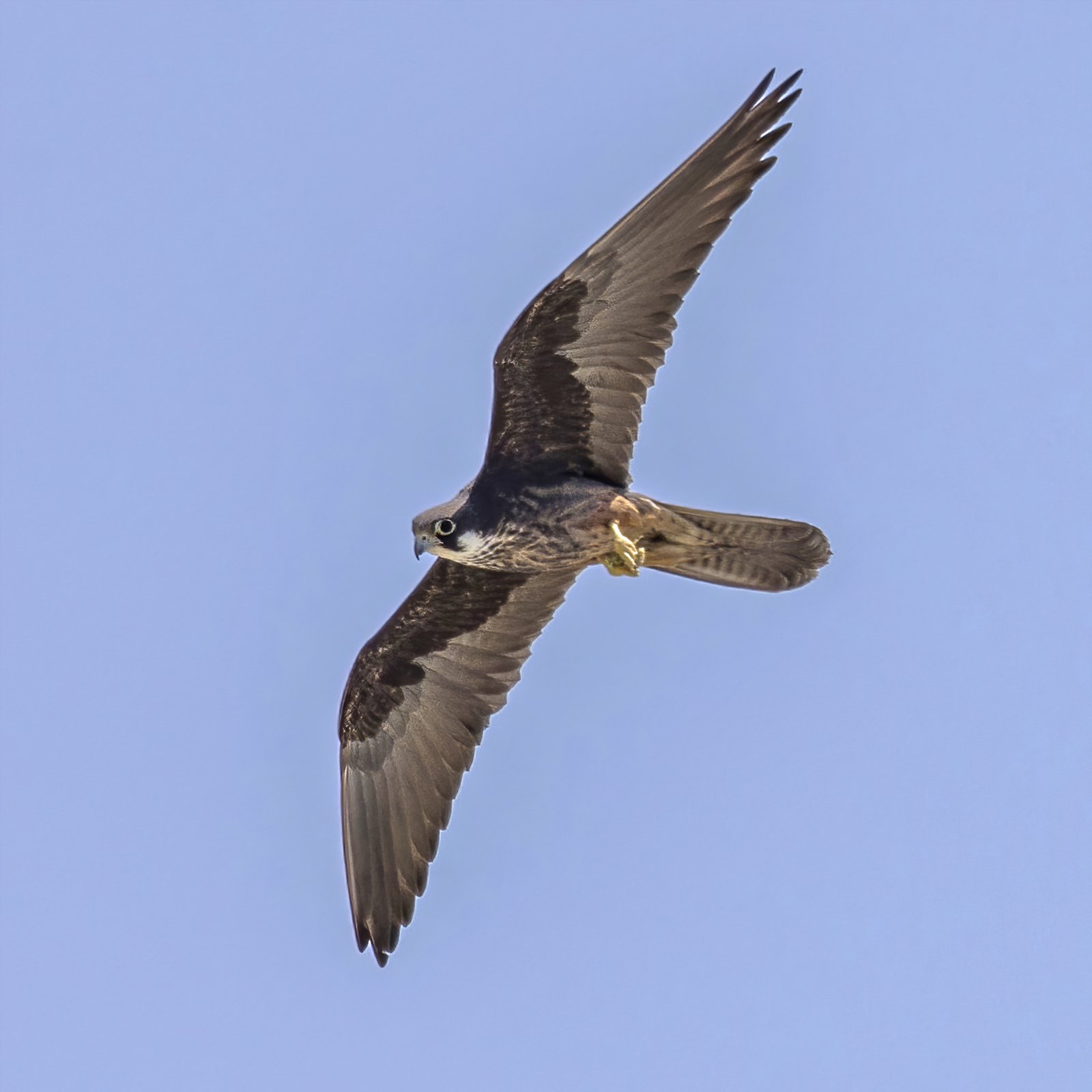
36–42 cm, wingspan 87–104 cm. Clearly larger and longer than a Eurasian Hobby, with long, narrow wings and a long tail. There are two colour morphs. The pale morph is dark greyish-brown above, with a creamy throat and cheek, a broad black moustache and warm rufous, dark-streaked underparts; in flight the blackish underwing coverts contrast with paler flight feathers, the best feature at range. The dark morph is almost uniformly sooty brown to black, with only slightly paler flight feathers below. The cere is yellow in adult males and bluish-grey in females. Flight is supple and floating, with long glides and lightning-fast stoops.
Confusion species
Eurasian Hobby (Falco subbuteo) is smaller and more compact, with a shorter tail, a sharp black-and-white head pattern, white, black-streaked underparts and a pale underwing. Sooty Falcon (Falco concolor) is uniform blue-grey, smaller and evenly grey below, and belongs to the Red Sea and deserts; the dark morph of Eleonora's Falcon is brownish-black and shows dark underwing coverts. Peregrine Falcon (Falco peregrinus), also on sea cliffs, is bulkier, broader at the wing base and barred below. A dark bird can recall a Black Kite (Milvus migrans) in silhouette, but that has broad wings and a forked tail.
Habitat
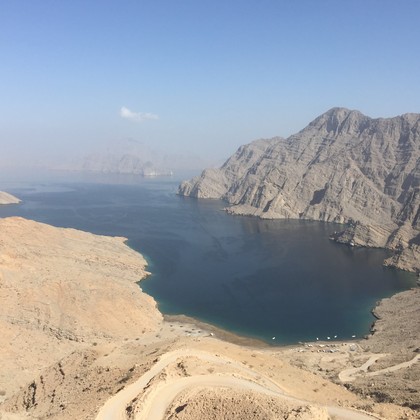
Rocky islets and steep sea cliffs, with the open sea as hunting ground. Lays without a nest on ledges, in crevices and under stones. In spring and early summer it hunts mainly large insects over coastal plains, woodland and estuaries; from August the birds of a colony hang in a loose wall over the sea and intercept migrating songbirds.
Where the bird is most at home, classified by the habitats of North Africa and the Middle East.
Range and movements
In Morocco the largest colony is on Mogador island off Essaouira, with an estimated thousand or so pairs and an increasing trend, plus a few smaller colonies along the Atlantic coast. In Algeria about 300 pairs on islets and cliffs along the east coast, the largest colony, near Chetaïbi (Kef Amor), falling from 130 to 100 pairs in 2010–2012. In Tunisia about 150 pairs on the Galite archipelago and the Fratelli islets. Also in the Canary Islands and scattered across the Mediterranean, the bulk in the Aegean. The entire world population winters in Madagascar; migration crosses the African continent, and passage birds are seen scarcely in Libya, Egypt and Israel, rarely in Arabia.
- Summer visitor (c. Apr–Sep)
- Passage (Mar–Apr, Oct–Nov)
- dark = core range, pale = thinly spread
How and when to look
From Essaouira harbour the Mogador birds can be watched in August and September, especially in the low light of early morning and evening when they hunt over the sea; the island itself is protected and closed to visitors. Measure the tail against the wingtips on every bird and look for the dark underwing coverts: at range the difference from a hobby.
Conservation status
Not threatened, with a world population of about 14,500 pairs, up to 80% of them in Greece. As everything is concentrated on a limited number of islets, the species is sensitive to disturbance by boats, fishermen, campers and tourism, to introduced cats and rats, and to trapping; in Algeria some colonies are declining.
Scientific name
Falco eleonorae | Géné, 1839
Géné described the species in 1839 and placed it straight away in the genus where it still stands. The genus Falco was introduced in 1758 by Linnaeus. Falco is Late Latin for 'falcon', from falx, falcis 'sickle', after the sickle-shaped claws of the bird. eleonorae honours Eleanor of Arborea (1347–1404), judge of the Sardinian judicate of Arborea. The specimen the first description was based on came from Sardinia.