All species › Nightjars › Nightjars › Egyptian Nightjar
Egyptian Nightjar | Caprimulgus aegyptius
Egyptische nachtzwaluw | Chotacabras egipcio
The nightjar of the desert: a pale, sandy species breeding in the oases and river valleys of the Sahara, along the Nile and in Mesopotamia. By day it lies invisible on the sand; only at dusk does it come out to hunt over fields and salt flats.
Voice
A sustained, hollow churr of rapidly repeated notes, kowrr-kowrr-kowrr, lasting minutes, slower and deeper than the churring of Eurasian Nightjar and without sudden pitch changes. Delivered from the ground. Flight call a soft tuk-tuk.
Recording: Stanislas Wroza — CC BY-NC-SA 4.0 · converted to mono · xeno-canto
Identification
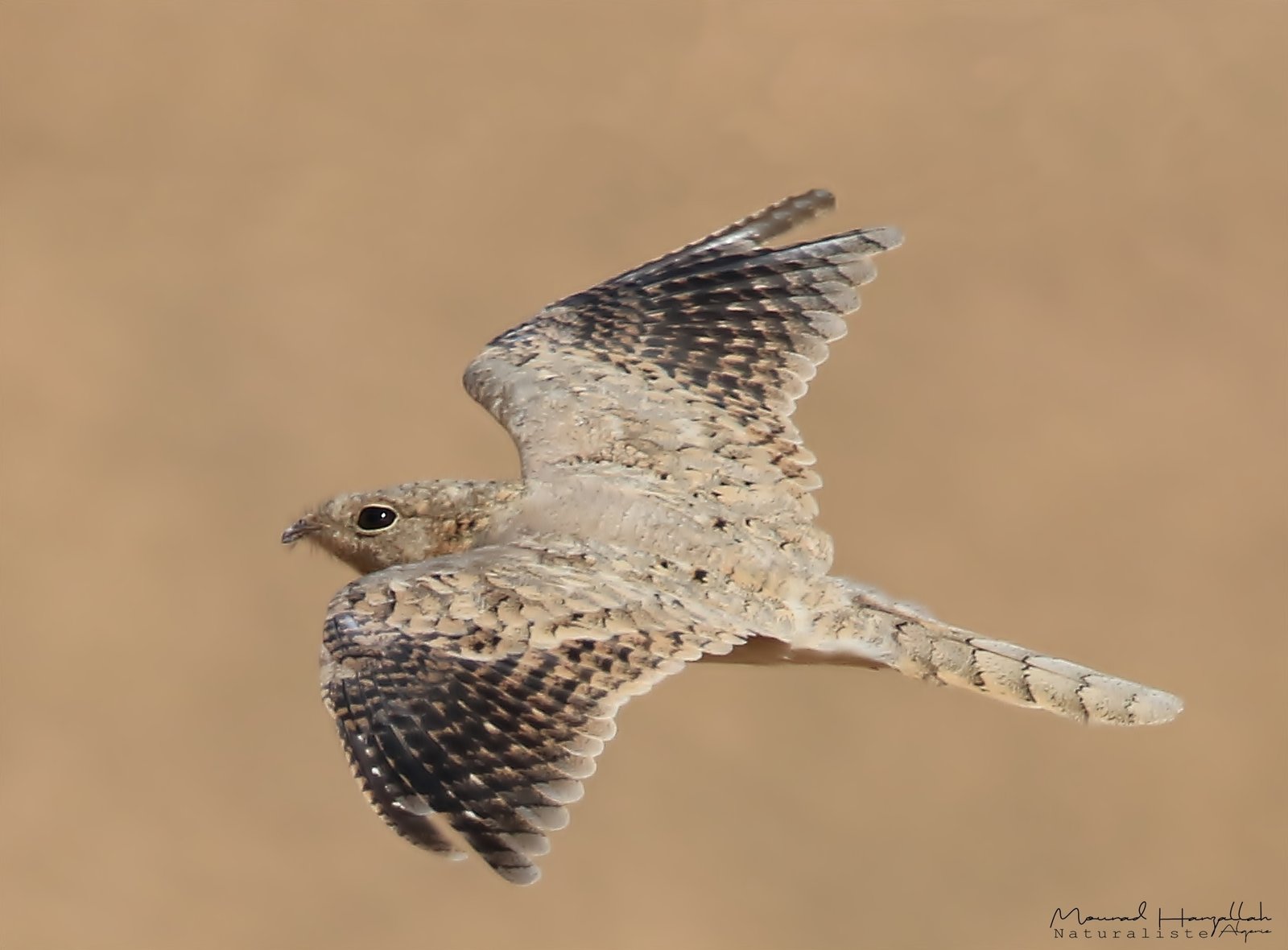
Larger and longer-winged and longer-tailed than Eurasian Nightjar and much paler: uniformly sandy to pale greyish-buff, with fine markings that disappear at a distance. Rows of creamy spots across the wing-coverts; no dark scapular line. The white primary spots are small and dull and white tail corners are almost lacking in both sexes. In flight the dark underside of the hand contrasts with the pale body; the wingbeats are slow and soft, with long glides.
Confusion species
Eurasian Nightjar (Caprimulgus europaeus) is darker and greyer, with a dark scapular line and, in the male, bright white in wing and tail. Red-necked Nightjar (Caprimulgus ruficollis) has a rufous collar and a white throat patch. Golden Nightjar (Caprimulgus eximius) of Western Sahara is golden-buff with bold white and black spotting. Sykes's Nightjar (Caprimulgus mahrattensis), a vagrant to Oman and the Emirates, is smaller and the male has large white wing and tail spots.
Habitat
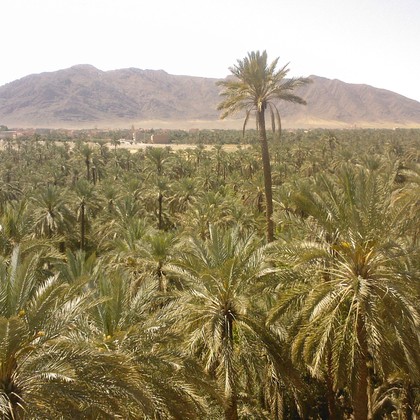
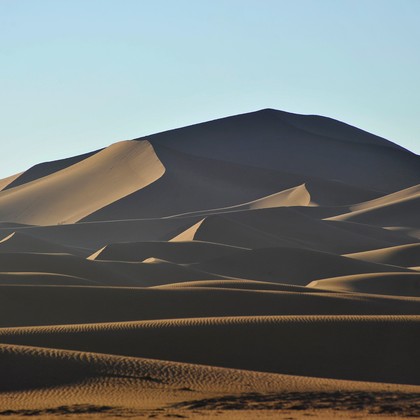
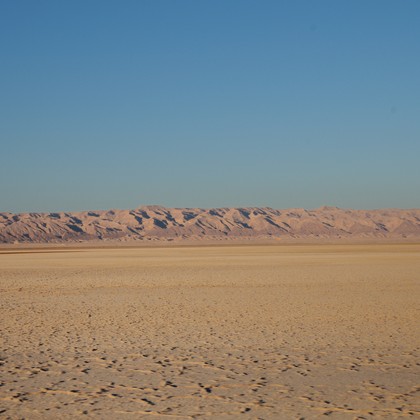
Sand and gravel plains with scattered bushes on the edge of oases, palm groves and irrigated fields, riverbanks with tamarisk, salt flats and sebkhas with some vegetation. Hunts low over alfalfa fields, reedbeds and water, where insects are plentiful. Nests on bare ground, often in the shade of a bush.
Where the bird is most at home, classified by the habitats of North Africa and the Middle East.
Range and movements
In Morocco it breeds south of the Atlas, especially in the Tafilalt around Erfoud, Rissani and Merzouga and in the Drâa valley. In Algeria it breeds in the northern Saharan oases (including around Biskra, Ouargla and El Goléa), in Tunisia in the southern oases of the Nefzaoua and the Djerid, and in Libya scattered in the Fezzan and near Ghadames. In Egypt it breeds along the Nile, in the Faiyum, Wadi Natrun and the oases of the Western Desert. In Iraq the nominate form breeds in Mesopotamia. In Israel it formerly bred; it is now a scarce migrant there. On the Arabian Peninsula it was long considered a vagrant, but in eastern Saudi Arabia and Kuwait it is now a scarce migrant and summer and winter visitor; rare in the Emirates, Oman and Yemen. Beyond the region it breeds in Iran and Central Asia and winters in the Sahel.
- Resident
- Summer visitor (c. Apr–Sep)
- Winter visitor (c. Oct–Mar)
- Passage (Mar–Apr, Oct–Nov)
- dark = core range, pale = thinly spread
How and when to look
Around Merzouga and Rissani local guides often know a daytime roost; ask, and keep your distance. In Egypt they hunt at dusk over the fields of the Faiyum. In Saudi Arabia, Sabkhat Al Fasl near Jubail is the best site in July and August.
Conservation status
Not globally threatened and with an enormous range. In the oases breeding habitat is lost to agricultural intensification, urban expansion and insecticide use; elsewhere the species seems to be spreading to new irrigation schemes and water bodies, as in eastern Arabia.
Scientific name
Caprimulgus aegyptius | Lichtenstein, 1823
Lichtenstein described the species in 1823 and placed it straight away in the genus where it still stands. The genus Caprimulgus was introduced in 1758 by Linnaeus. Caprimulgus is Latin, from capra 'nanny goat' and mulgere 'to milk', after the old belief that nightjars suckled goats at night. aegyptius is Latin for 'Egyptian'. The specimen the first description was based on came from Upper Egypt.