All species › Waterfowl › Ducks, geese and swans › Egyptian Goose
Egyptian Goose | Alopochen aegyptiaca
Nijlgans | Ganso del Nilo
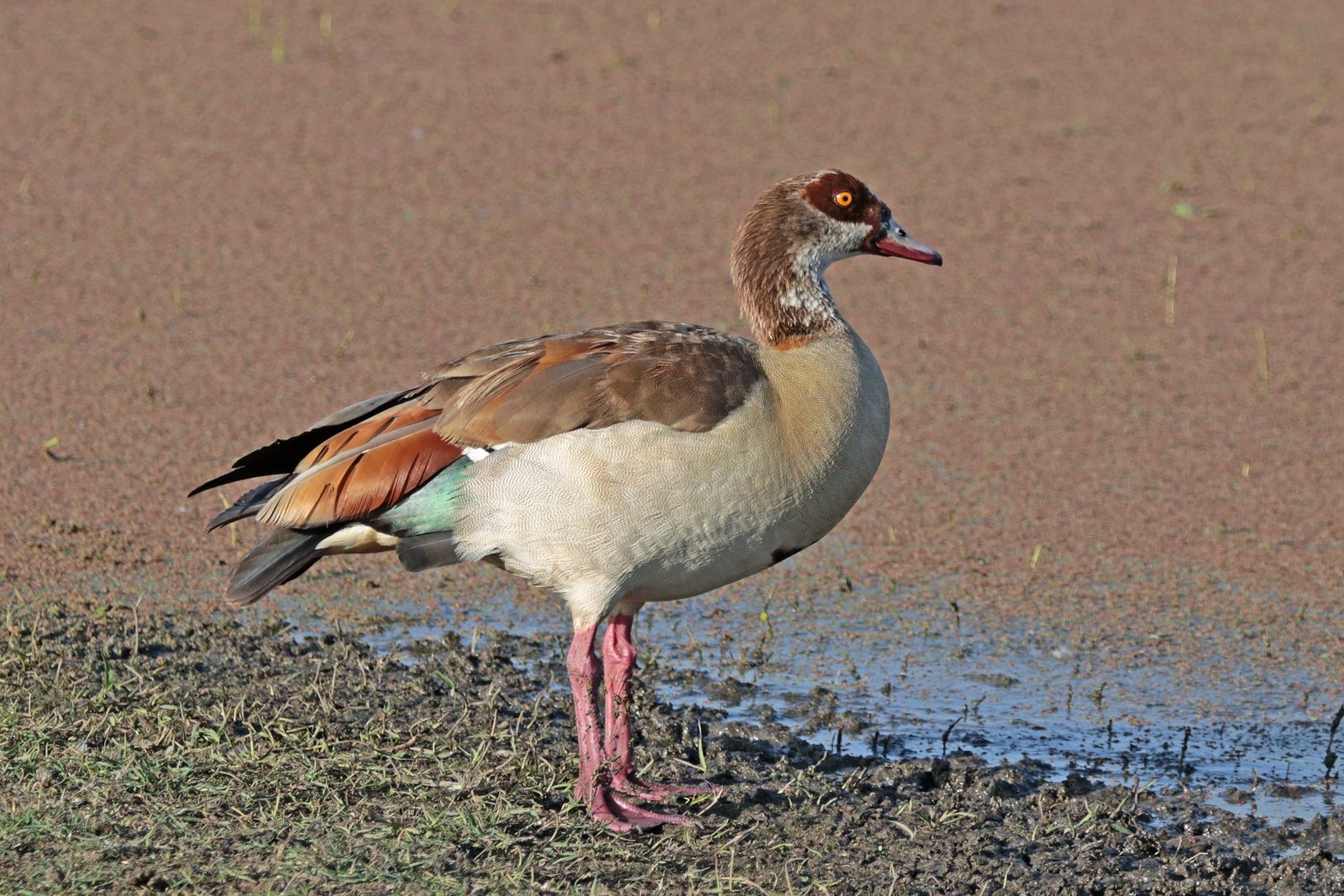
The Egyptian Goose is an upright, long-legged shelduck of African rivers which, within the region, is native only to Egypt. Along the Nile it was a familiar bird even in antiquity: it is depicted countless times on Egyptian tomb walls and was held sacred.
Voice
Noisy, especially when disturbed and in territorial disputes. The female gives a strident, trumpeting cackle, honk-haa-haa-haa, the male a hoarse, hissing wheeze, hhaa-hhaa. Pairs often call in duet, with neck stretched and wings spread.
Recording: African Bioacoustics Community — CC BY-NC-SA 4.0 · shortened to the first 60 s, mono · xeno-canto
Identification
About 70 cm, sandy greyish-brown with a darker, rufous-brown back and a striking chestnut patch around the eye. A small dark brown spot sits in the centre of the breast, and the neck has a narrow rusty collar. The bill and long legs are pink. In flight the large white wing coverts stand out, bordered by black primaries and green-glossed secondaries; on the ground only a narrow white line on the folded wing shows. The sexes are alike, the male slightly larger. Juveniles lack the eye and breast patches and have a greyish bill.
Confusion species
The Ruddy Shelduck (Tadorna ferruginea) has the same white wing pattern but is plain orange-brown with a pale head and black bill and legs, without an eye patch. The Common Shelduck (Tadorna tadorna) is white with a green-black head and a red bill. Juvenile Egyptian Geese lacking the eye patch can recall a dull Ruddy Shelduck, but have pink legs and a more upright stance.
Habitat
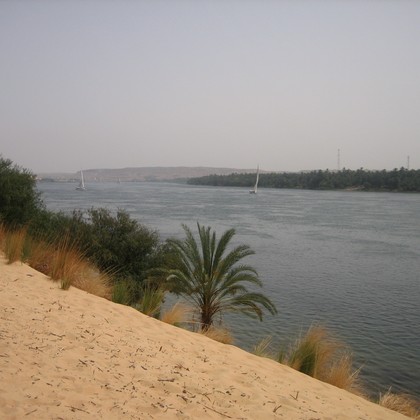
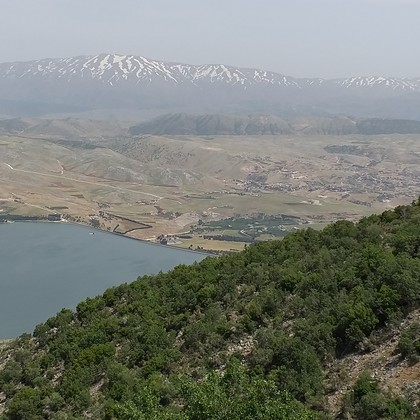
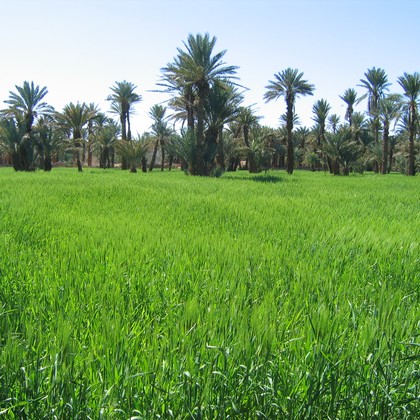
River banks, islets and sandbars in the Nile, irrigation canals, reservoirs and ponds with open, grassy margins. It grazes on fields, clover and lawns, also in towns. It nests on the ground among vegetation, in tree holes, on buildings or in the old nests of other large birds.
Where the bird is most at home, classified by the habitats of North Africa and the Middle East.
Range and movements
In Egypt resident along the entire Nile, from Lake Nasser at Aswan through the Nile Valley to the Delta, and also in the Faiyum. In Israel a feral population has become established since around 2000, has grown rapidly and is now widespread in the north and centre of the country; feral birds also breed in the United Arab Emirates and are seen occasionally elsewhere, including Jordan and Saudi Arabia. Beyond the region throughout almost all of sub-Saharan Africa, and established as an introduced species in western Europe.
- Resident
- Summer visitor (c. Apr–Sep)
- Winter visitor (c. Oct–Mar)
- Passage (Mar–Apr, Oct–Nov)
- dark = core range, pale = thinly spread
How and when to look
From a felucca or the quays at Luxor and Aswan, pairs on the Nile banks and islets are easy to see all year. In Israel the ponds in town parks and the fishponds of the Hula and Beit She'an valleys will do. In flight look for the large white wing panel.
Conservation status
Not threatened and common in Africa. In Egypt stable along the Nile. The feral populations in Israel and the Gulf states are growing; in Israel the species is regarded as invasive because it drives other waterbirds and hole-nesters from nest sites.
Scientific name
Alopochen aegyptiaca | (Linnaeus, 1766)
Linnaeus described the species in 1766 as Anas aegyptiaca; because it was later moved to another genus, the author and year stand in brackets. The genus Alopochen was introduced in 1885 by Stejneger. Alopochen is Greek, from alōpēx 'fox' and chēn 'goose': the fox-goose, after the ruddy back. aegyptiaca is Latin for 'Egyptian', after the country on the Nile where the bird is common. The specimen the first description was based on came from Egypt.