All species › Passerines › Thrushes › Dusky Thrush
Dusky Thrush | Turdus eunomus
Bruine lijster | Zorzal oscuro
The Dusky Thrush is a sturdy, boldly patterned thrush from eastern Siberia that winters in East Asia, thousands of kilometres east of the region. Here it is a great rarity: there are only a handful of records, mainly from the Gulf states, always single birds turning up in late autumn or winter at a farm, oasis or park, sometimes among other thrushes.
Voice
Calls a lot: a harsh, somewhat nasal shack-shack or kwek-kwek, lower and rougher than a Fieldfare's, and a thin, drawn-out tsee in flight. When alarmed a rattling chack-chack-chack. The song, not to be expected in the region, is a short phrase of a few clear whistles followed by a dry creak.
Recording: Barry Edmonston — CC BY-NC-SA 4.0 · converted to mono · xeno-canto
Identification
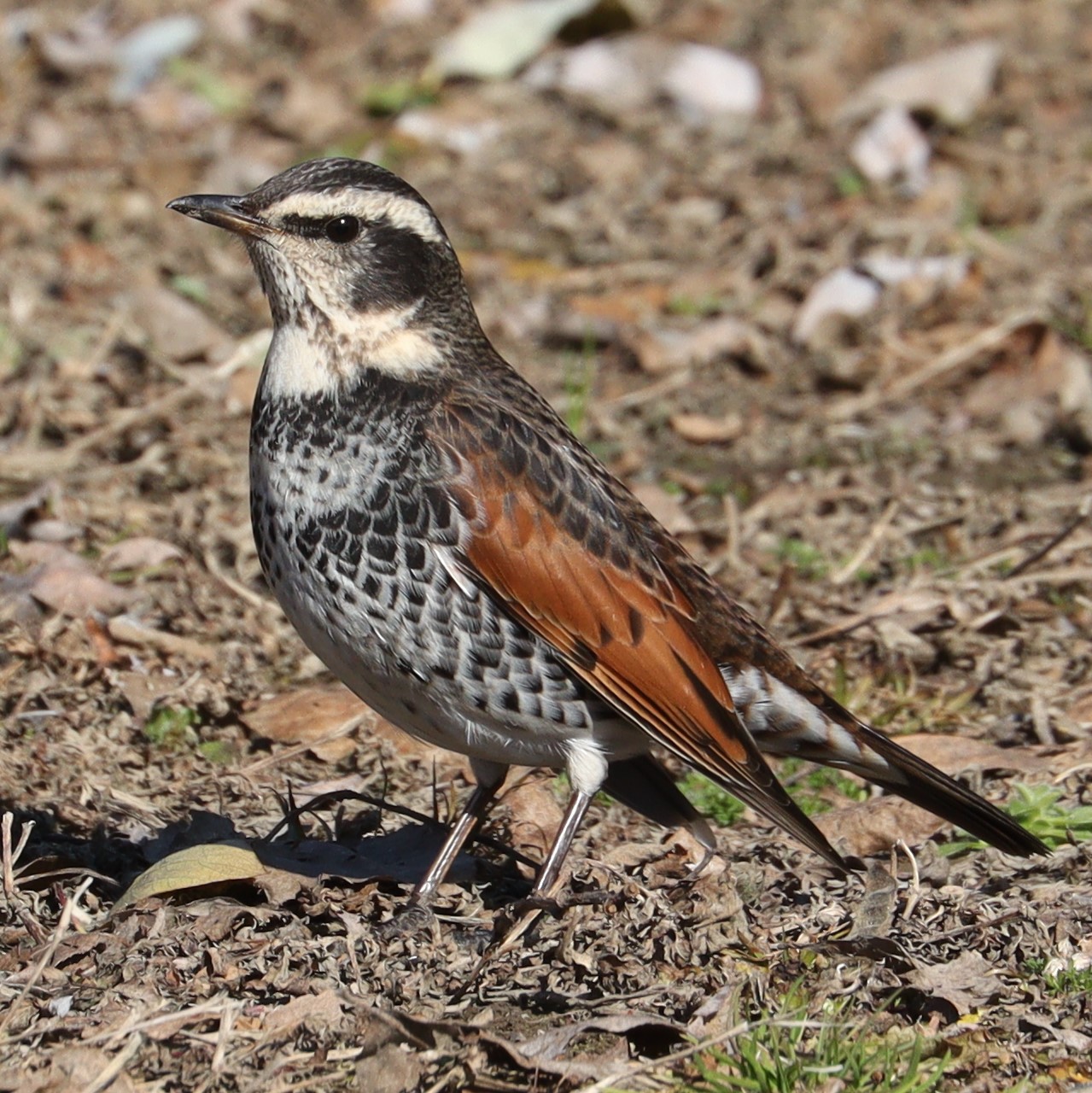
23–25 cm. About the size of a Song Thrush but bulkier and broader-chested. The face is sharply marked: a long, broad creamy-white supercilium, dark ear-coverts, a white moustachial stripe and a black malar stripe; the throat is white. Breast and flanks are white with heavy black crescents forming a broad band across the breast and continuing in rows along the flanks; the belly is white. The clincher is the folded wing: the greater coverts and the fringes of the secondaries form a bright rufous panel contrasting with the dull brown, dark-scaled mantle. The underwing-coverts are rufous too. Females and first-winters are duller, with browner crescents and a less bright wing panel. Bill dark with a yellow base to the lower mandible.
Confusion species
Black-throated Thrush (Turdus atrogularis), a common winter visitor in the east of the region, lacks the white supercilium, the crescents and the rufous wing panel: it is plain grey-brown above with a black (female: streaked) throat and breast. Redwing (Turdus iliacus) is smaller, with rufous flanks and underwing but no wing panel, and fine streaks rather than crescents. Fieldfare (Turdus pilaris) is larger, with grey head and rump and a white underwing. Naumann's Thrush (Turdus naumanni), formerly lumped with Dusky Thrush, has the red not in the wing but on breast, flanks and tail; intergrades occur, so a bird with much orange below deserves a critical look.
Habitat
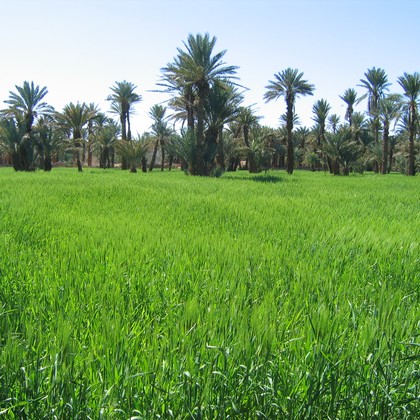
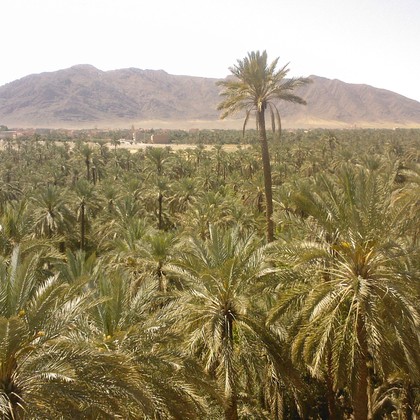
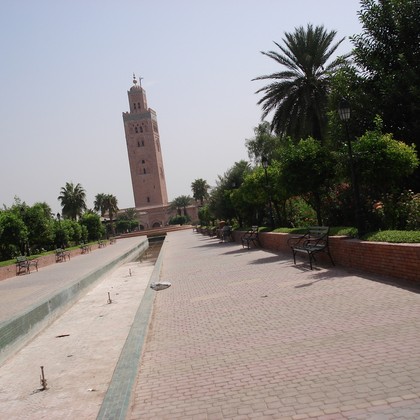
Breeds in open larch and birch forest and willow scrub at the treeline in eastern Siberia; winters on fields, rice paddies, in orchards and parks. Vagrants in the region have been found on irrigated farms, in oases and in green gardens and parks, where they forage on the ground or look for berries and fruit.
Where the bird is most at home, classified by the habitats of North Africa and the Middle East.
Range and movements
In the region a vagrant only. A few records in the United Arab Emirates; the fourth was at Wamm Farms near Al Ain on 31 October 2015. In Kuwait one stayed at Al-Abraq in January and early February 1985. There are scattered further reports elsewhere in the Middle East; the species is unknown from North Africa. Breeds from central Siberia to Kamchatka and winters in East Asia, from Japan, Korea and China to Taiwan; scarce as far as the Himalaya and north-east India. A very rare vagrant to Europe.
How and when to look
A bird for luck and for keeping up with the news. Your best chance is in the UAE from late October into winter: work the green farms and parks, such as Wamm Farms and the fields around Al Ain, and check every group of thrushes on the ground. Look at the wing first: the rufous panel stands out at a distance, then check the head pattern and crescents.
Conservation status
Globally not threatened, with a large range and population, although numbers are probably declining through the loss of rice paddies and the felling of larch forest. The Red List now assesses Dusky Thrush separately from Naumann's Thrush. In the region a very rare vagrant, with a handful of records since the 1980s, mainly from the Gulf states.
Scientific name
Turdus eunomus | Temminck, 1831
Temminck described the species in 1831 and placed it straight away in the genus where it still stands. The genus Turdus was introduced in 1758 by Linnaeus. Turdus is the ordinary Latin word for 'thrush'. eunomus is Greek, from eu 'well' and nomos 'order', hence 'well-ordered'; why the name was given to this thrush is not clear. The specimen the first description was based on came from Japan.